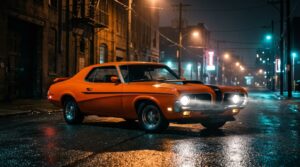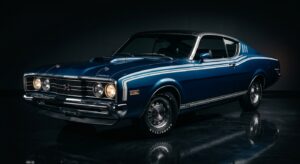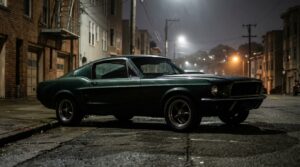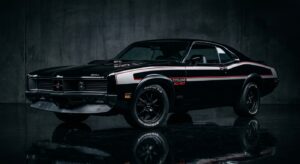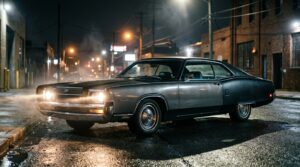
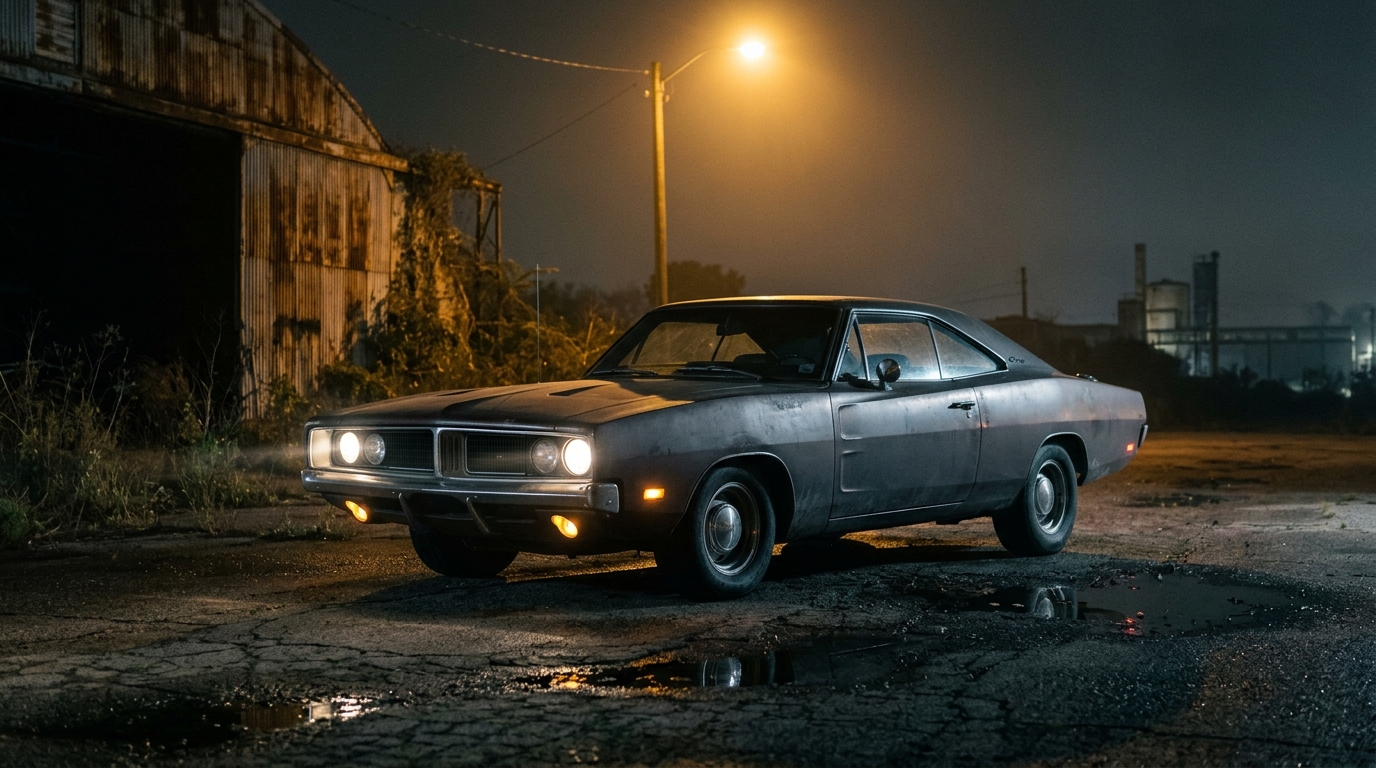
Picture a deserted four-lane highway at 1 a.m., sodium lamps stuttering past in an orange rhythm, and a long fastback silhouette sliding through the glow with a 440 Magnum burbling low in its chest. That car is the 1969 Dodge Charger 500, a machine engineered for one purpose and remembered for something quite different. We spent a night with the aero pioneer that history keeps overshadowing.
Why the Charger 500 Exists
The second-generation 1968 Charger was a beautiful car with a stubborn problem on the superspeedway. Its tunnel-back rear window created turbulence, and its deeply recessed grille acted like a parachute at 190 mph. Ford’s Torino Talladega and Mercury’s Cyclone Spoiler were running slipperier shapes, and Dodge was losing races it expected to win.
The fix was the Charger 500, introduced for 1969 as a homologation special so Dodge could run a modified body in NASCAR. Stock car rules required a minimum number of production units for the model to qualify, and Dodge built a reported 392 Charger 500s for the 1969 model year. Chrysler engineers replaced the recessed grille with a flush-mounted 1967 Coronet-style unit and installed a flush rear window plug over the tunnel-back glass. Both changes smoothed airflow dramatically.
Dodge then pushed the idea further with the Charger Daytona, the winged car, but the humble 500 came first and proved the aero concept on the track. It is the quiet pioneer of the family.
Driving It After Dark
Night is where a Charger 500 makes the most sense. The cabin is a classic Mopar cave: a deep dashboard, a pair of deeply hooded gauges that glow a soft amber-green, and a long hood stretching ahead of the windshield. Sit low, thumb the ignition, and the 440 settles into a loping, lumpy idle that rattles loose change in the center console.
The sound is the headline. At idle it is a muted rumble. Past 3,000 rpm through the dual exhaust it hardens into a bellow that bounces off concrete overpasses and shop fronts. At night, with traffic thin and the air dense, that noise carries a mile. Residential streets at midnight are not where this car wants to be, but a deserted ring road is its natural habitat.
Visibility is where the era shows. The sealed-beam headlights, hidden behind the grille’s rotating covers on standard Chargers, are fixed on the 500 thanks to the flush grille, which is a small win. Sealed beams of the period were dim by modern standards, throwing a warm yellow wash that fades quickly beyond about 150 feet. You learn to drive within your lights, and to trust the road more than your eyes. That is part of the charm and a real safety conversation if you plan regular night use.
The Powertrain
The standard Charger 500 engine was the 440 Magnum V8, a 7.2 liter wedge rated at 375 horsepower and 480 lb-ft of torque. It breathes through a single four-barrel Carter carburetor and sends power through either a TorqueFlite three-speed automatic or a four-speed manual with a Hurst shifter. The hotter 426 Hemi was a available option and appeared in a small number of 500s, giving those cars a much rarer pedigree.
On the road, the 440 delivers torque in a thick, effortless wave. Mash the throttle from a stoplight and the rear tires light up, the nose lifts, and the speedometer needle swings. Zero to 60 mph arrives in the mid six-second range, and the quarter mile falls in the mid-14s, genuinely quick for 1969.
Handling and Brakes
Let us be honest: this is a straight-line car. The recirculating-ball steering is slow and vague, the leaf-spring rear and torsion-bar front suspension body-roll in corners, and front disc brakes were an option worth ticking. At night on a winding road you feel every ounce of its roughly 3,700 pounds. Drive it as the designers intended, smoothly and with room to spare, and it rewards you with a kind of mechanical theater no modern car replicates.
The Forgotten Legacy
The Charger 500 never got the fame of the Daytona or the cultural weight of the Charger R/T. Yet it did something important: it proved that aerodynamics could win races in the muscle era. Its flush grille and plug rear window were the first steps toward the winged cars that dominated NASCAR in 1969 and 1970. On a dark road with a single lamp reflecting off that smooth, wind-cheating nose, you can see the idea taking shape.
Editor’s verdict: The Charger 500 is the muscle car era’s overlooked aero experiment, a rare homologation special that traded looks for lap speed and ended up beautiful anyway. It drives like a thunderstorm in a trench coat, loud, heavy and unforgettable after dark. If you can find one, it is a smart piece of Mopar history that will only grow more valuable.