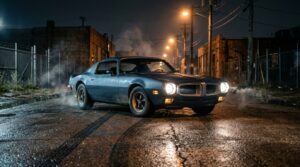
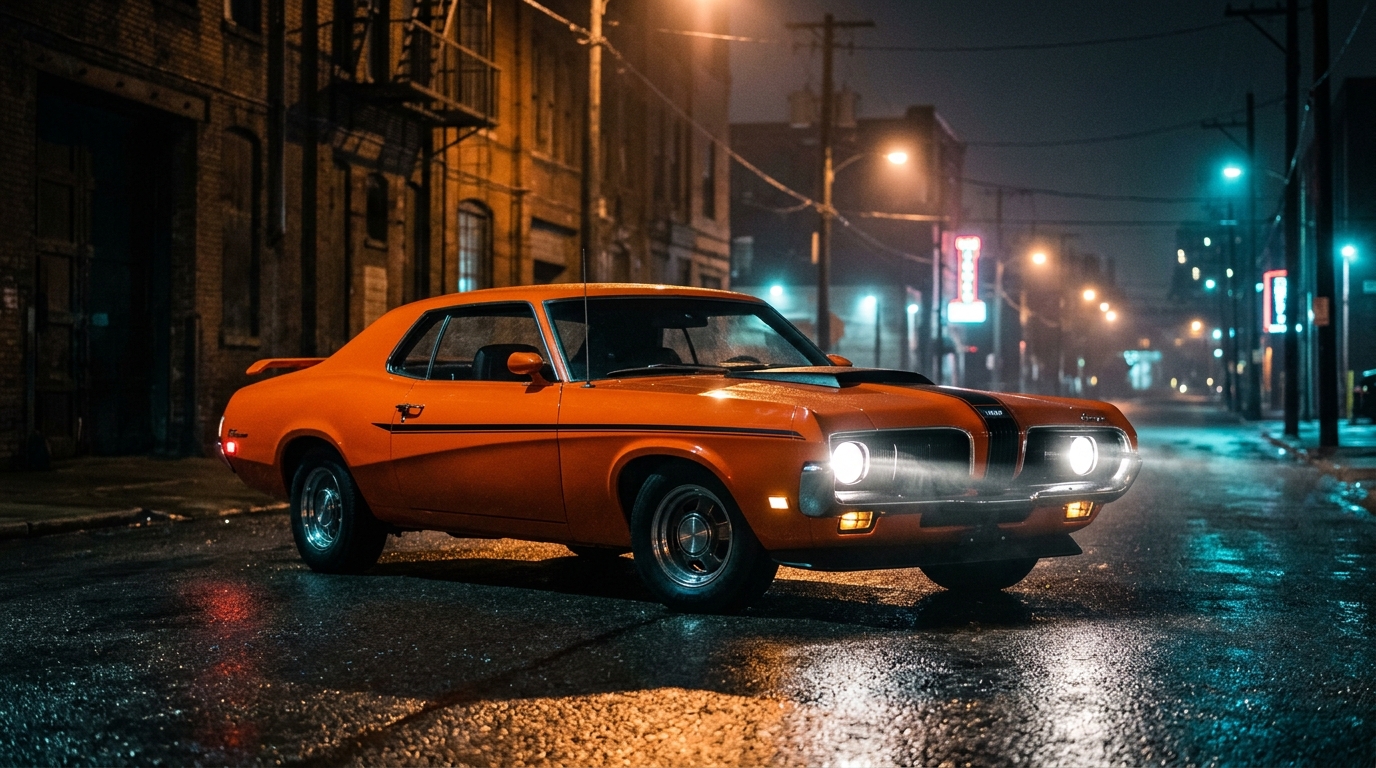
It is a few minutes past midnight, and the streetlights are strung out ahead like a runway of sodium orange. Somewhere behind the Cougar’s hidden headlight doors, a 302 cubic inch V8 is idling with a lumpy, impatient burble that rattles the quiet side streets. This is the 1969 Mercury Cougar Eliminator, and it was built to hunt after dark.
The Cat That Went to Racing School
Mercury launched the Cougar in 1967 as a more upscale, gentler cousin to the Mustang. By 1969 the pony car wars had turned ugly, and Lincoln-Mercury needed a street fighter. The answer arrived in the middle of the model year as the Eliminator package, a $2,500-ish performance and appearance option that turned the plush Cougar into a legitimate road warrior. It was aimed squarely at the Camaro Z/28 and the Boss 302 Mustang, and the Eliminator shared much of its hardware with the latter.
Mercury had a motorsport story to tell, too. The division ran Cougars in the 1967 SCCA Trans-Am series, with Dan Gurney winning a race for the marque, and the Eliminator name carried that competition aura into showrooms. Only 2,411 Eliminators were built for 1969, which makes this one of the rarer Detroit muscle cars of the era.
Engine Choices: Four Ways to Go Fast
The Eliminator was offered with a wide menu of engines. The headliner was the Boss 302, a high-revving small block with solid-lifter cam, big canted-valve heads and a free-breathing intake, rated conservatively at 290 horsepower. The 351 Windsor four-barrel offered a more torque-rich approach at 290 horsepower in 4V form, while the 390 big block delivered 320 horsepower, and the mighty 428 Cobra Jet produced a rated 335 horsepower and a tidal wave of torque. The Boss 302 was the purist’s pick, an engine that came alive above 4,000 rpm and loved a heavy right foot.
Driving After Dark
Night is where a car like this shows its personality. The Cougar’s signature hidden headlights flip open with a vacuum-driven swallow, and at idle the dark front end gives nothing away. Switch them on and the road opens in warm, yellowish pools. Be realistic: 1969 sealed-beam units are a far cry from modern LEDs, so you drive the Eliminator at night with a bit of respect, scanning the road edges and trusting your instincts. A modern halogen conversion helps enormously without ruining the look.
The sound is the real star after dark. With little traffic to mask it, the Boss 302 delivers a ripping, mechanical wail as the revs climb, bouncing off shuttered storefronts and overpasses. Through a tunnel it is almost unfair. The cabin, with its woodgrain accents, bucket seats and toggle-switch console, glows softly in the dark, and the Cougar’s luxury roots mean the ride is more civilized than a Camaro. It is a cruiser that happens to have fangs.
The handling is old-school but honest. The competition suspension, with stiffer springs, a front sway bar and heavy-duty shocks, keeps the nose flat enough to enjoy a winding back road. Power steering was effortless but vague, and the available front disc brakes were a must-have, though by modern standards the stopping power demands planning. At night, on empty roads, you learn to brake early and exit corners with a fistful of throttle.
Looks That Work Under Streetlights
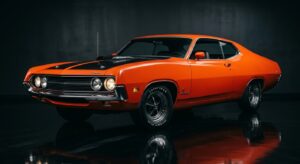
Competition Orange, a vivid hue, was the signature Eliminator color, though Bright Blue, Competition Yellow and Competition Green were also offered. The matte-black hood with its scooped treatment, plus the rear spoiler and bold stripes, made the car a rolling billboard of intent. Under a sodium streetlight, the orange glows like a hot coal, and the black hood turns into a deep, glossy pool. It is a car made for night photography.
Ownership Today
The Eliminator is a blue-chip collectible these days. Authentic cars with the Boss 302 or 428 Cobra Jet command strong money, and documentation matters enormously, as clones abound. Parts support for the Ford-based drivetrain is excellent, though Cougar-specific trim and hidden headlight hardware can be tricky to source. If you find a real one, treat it as both a driver and an investment.
The 1969 Cougar Eliminator is the muscle car for people who want their menace wrapped in a tailored suit. It is rare, loud and gorgeous under streetlights, with a Boss 302 that rewards every rev. Find a real one, drive it after dark, and the Eliminator will do exactly what the name promises.