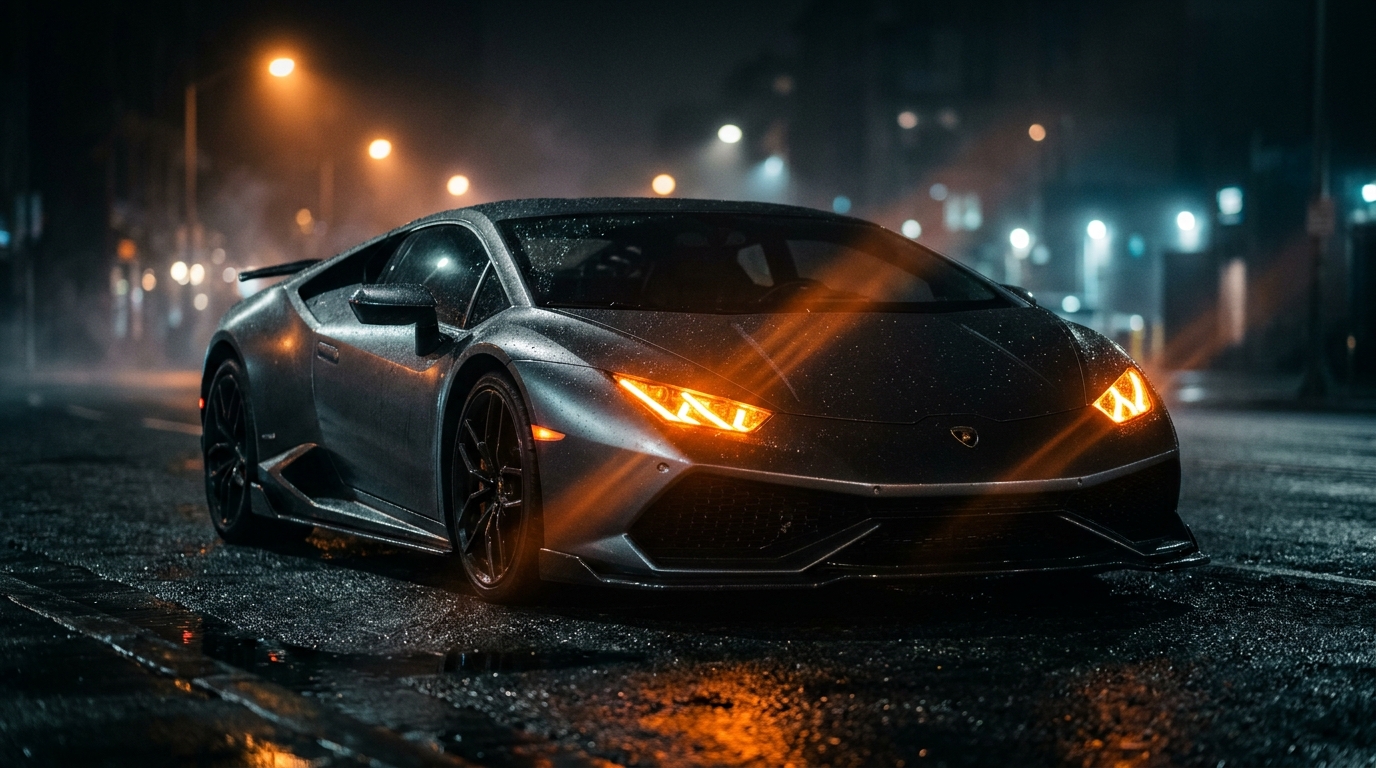
It is 1:40 a.m. and the parking structure is empty except for a squat wedge of Arancio Borealis paint, its Y-shaped LED eyes still holding a faint glow after the engine goes quiet. The Huracan was built to replace the Gallardo, the best-selling Lamborghini of all time, and after dark it makes a very persuasive case for itself. This is a car that looks best when the sun is gone.
The Bull Rewrites the Rules
The Huracan LP610-4 debuted at the 2014 Geneva Motor Show and reached customers in 2015, taking over from the Gallardo after a decade-long run. The name comes from a famed fighting bull, and the numbers in the badge are literal: 610 metric horsepower, with the 4 denoting all-wheel drive. Underneath sits a new aluminum and carbon fiber hybrid structure, shared in part with the Audi R8, and an all-new 5.2-liter naturally aspirated V10 producing 602 horsepower and 413 lb-ft of torque.
Lamborghini quotes a 0-60 mph time of 3.2 seconds and a top speed above 201 mph. Those are the figures that sell brochures. At night, they feel like something else entirely, because speed becomes a sensation of sound and light rather than a number on a dash.
Driving Impressions After Midnight
Press the red flap and thumb the start button, and the V10 barks to life with a bark that echoes off concrete walls. Late-night city streets are the perfect amplifier. Tunnels turn the exhaust note into something close to a tuning fork, and the 8,250 rpm redline arrives with a metallic scream that rattles through empty overpasses. This is a naturally aspirated engine in an era of turbochargers, and it sounds like it.
The seven-speed Lamborghini Doppia Frizione dual-clutch gearbox is quick and mostly well mannered. In Strada mode it slurs through gears at low speed with only mild hesitation in stop-and-go crawling, which is a minor annoyance in sparse overnight traffic but would grate in a daytime commute. Switch to Sport or Corsa via the ANIMA selector on the steering wheel and the shifts sharpen, the exhaust opens up, and the all-wheel-drive system sends more torque to the rear axle for a more playful stance.
Headlights, Visibility, and the Cockpit Glow
The Huracan’s Y-shaped lighting signature is its night calling card. Full LED headlights were available on this car at a time when many rivals still relied on xenon or halogen, and the throw is excellent: a crisp, even white beam that carves through dark canyon roads. The low seating position and steeply raked windshield mean you are looking up at oncoming headlights, which can feel dramatic, but the wide fenders are easy to place on a dark road because they are visible in your peripheral vision.
Rearward visibility is the weak point. The tiny rear window and thick C-pillars create real blind spots at night, and the rear-view mirror shows mostly engine cover and a sliver of road. Parking sensors and a rear camera are essential, and the optional lifting system for the nose helps with steep driveways and speed bumps, especially when you cannot see them coming.
Inside, the fully digital TFT instrument cluster was a bold move for 2015. At night it glows in crisp color, with a large central tachometer that dominates the display. The center stack uses toggle switches under red flaps for the start button and driving modes, and everything is backlit tastefully. The cabin is a theatrical, fighter-jet environment, and in the dark it feels tighter and more cocooning than it does in daylight.
Handling and Grip on Empty Roads
The Huracan is a remarkably forgiving exotic. Its all-wheel-drive layout and mid-mounted V10 give it huge traction, and on a damp night road the car squats and goes where you point it. Steering is quick, if slightly light in Strada mode, and weights up nicely in Sport and Corsa. Carbon ceramic brakes were optional, and they bite hard and repeatedly without fade on long mountain descents.
The ride, even on the standard setup, is firmer than a Ferrari 458 but not punishing. Lamborghini’s optional Magnetorheological suspension was not offered on the 2015 model, so what you get is a fixed-rate setup that favors precision over plushness. On cratered back roads at night, you feel every expansion joint, but the chassis never loses composure.
The Gallardo Shadow and the Huracan’s Place in History
Replacing the Gallardo was no small task. That car sold more than 14,000 units over ten years and defined the modern entry-level Lamborghini. The Huracan had to be more refined, more technological, and more aggressive without alienating loyal buyers. Lamborghini succeeded by pairing the Gallardo’s fighting spirit with Audi-engineered quality, creating a car that was easier to live with yet still wildly dramatic. The hexagonal design language, from the six-sided exhaust tips to the cabin’s geometric vents, set the template for Lamborghini styling for years afterward.
When it launched, the Huracan competed with the Ferrari 458 Italia, the McLaren 650S, and the Porsche 911 Turbo. Against the Ferrari, it traded some steering purity for greater stability and everyday comfort. Against the McLaren, it offered far more theater and a naturally aspirated soundtrack. It was the loud, flamboyant choice, and for many buyers that was exactly the point.
Living With a Bull After Dark
Ground clearance is low, the fuel tank is small, and a fill-up is a frequent ritual. Real-world economy hovers in the mid-teens for combined driving, and the EPA rated the car at 13 mpg city and 21 mpg highway. A late-night run to the coast is thrilling, but plan your fuel stops. Trunk space is a modest front compartment suitable for a weekend bag or two, and the cabin has little storage beyond a small shelf behind the seats.
Still, for an exotic, it is genuinely drivable. The cabin is quiet at cruising speed, the seats are supportive over long distances, and the digital cluster gives clear information at a glance. After a three-hour midnight cruise, you step out tired but never beaten up, which is more than can be said for many rivals of the era.
The 2015 Huracan LP610-4 is the rare modern exotic that feels almost as good parked under a streetlight as it does at full chat on an empty mountain road. It is louder, brighter, and more theatrical than anything in its class, and it is easy enough to drive that you will actually want to. Come dusk, the bull’s eyes glow orange, and you will not want to look away.