
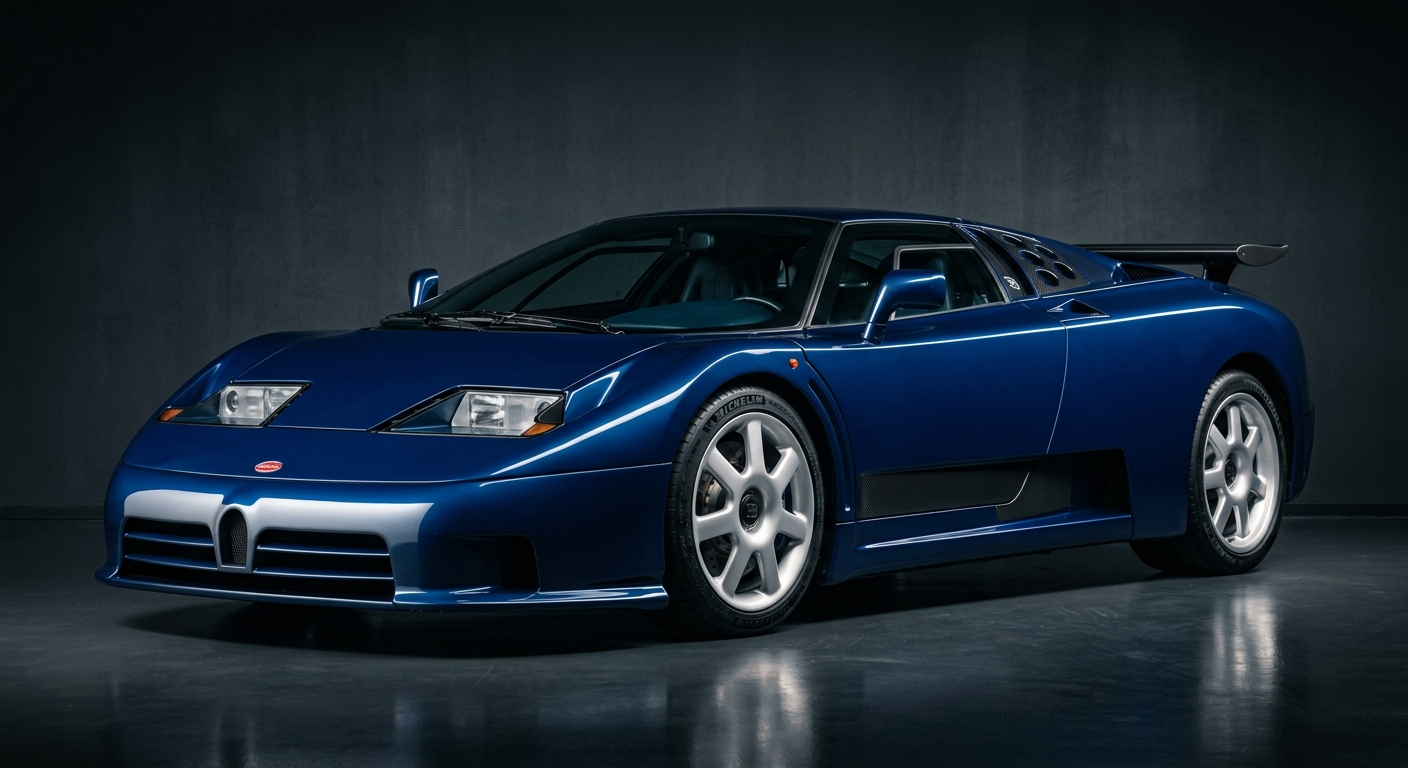
Long before the Veyron rewrote the hypercar playbook, Bugatti crafted a different kind of monster in the hills of Modena. The EB110 SS represented the French marque’s bold return to relevance, packing four turbochargers, all-wheel drive, and enough carbon fiber to make modern supercars jealous. This was Bugatti’s declaration that the legendary name would not fade quietly into history.
The Resurrection of a Legend
Romano Artioli’s ambitious revival of Bugatti in the 1990s produced one of the most technically advanced supercars of its era. The EB110, named to commemorate Ettore Bugatti’s 110th birthday, represented everything the reborn company stood for: uncompromising performance wrapped in Italian craftsmanship. The SS variant, introduced in 1992, took this philosophy to its logical extreme.
Built in a state-of-the-art facility in Campogalliano, the EB110 SS showcased technologies that wouldn’t become mainstream for another decade. Its carbon fiber monocoque construction provided exceptional rigidity while keeping weight in check, and the sophisticated all-wheel drive system delivered traction that seemed almost supernatural for the era.
Quad-Turbo Madness
At the heart of the EB110 SS lies one of the most complex engines ever fitted to a road car: a 3.5-liter V12 with four IHI turbochargers. This engineering tour de force produces 603 horsepower and 479 lb-ft of torque, figures that remained impressive even by modern standards. The engine’s 60-valve configuration and sophisticated engine management system delivered power with a smoothness that belied its extreme output.
The driving experience is intoxicating in a way that modern supercars struggle to match. There’s an immediacy to the EB110 SS that comes from its relatively modest weight and analog control systems. The steering communicates every nuance of the road surface, while the chassis balance allows you to exploit the car’s considerable performance with confidence.
Advanced Engineering
The EB110 SS introduced several innovations that would later appear on mainstream supercars. Its carbon fiber construction predated the McLaren F1 by several years, while the active aerodynamics system adjusted downforce based on speed and driving conditions. Even the interior showcased advanced materials, with carbon fiber trim and specially developed lightweight components throughout.
The six-speed manual transmission, developed specifically for this application, handles the engine’s considerable output with precision. The all-wheel drive system splits torque 27/73 front to rear under normal conditions, but can adjust the split dynamically based on traction needs. This technological sophistication was virtually unheard of in the early 1990s supercar landscape.
Tragic End to a Brilliant Chapter
Unfortunately, the EB110’s story is one of brilliant engineering overshadowed by corporate misfortune. Bugatti Automobili S.p.A. filed for bankruptcy in 1995, ending production after just 139 examples of the EB110 SS had been completed. This rarity, combined with the car’s exceptional performance and historical significance, has made surviving examples increasingly valuable among collectors.
The EB110 SS remains a fascinating glimpse into an alternate automotive timeline, one where Bugatti’s renaissance continued uninterrupted. Its combination of cutting-edge technology, dramatic styling, and explosive performance created a supercar that was arguably ahead of its time. Today, as Bugatti continues to push boundaries with cars like the Chiron, the EB110 SS stands as proof that the company’s engineering excellence was never truly dormant.
The EB110 SS stands as one of the most underappreciated supercars in automotive history, a technological tour de force that arrived too early for its own good. Its quad-turbo V12 and carbon fiber construction created a machine that was genuinely ahead of its time, offering performance that still impresses today. For those fortunate enough to experience one, the EB110 SS delivers a driving experience that modern supercars, for all their sophistication, struggle to match in terms of pure mechanical drama and analog engagement.