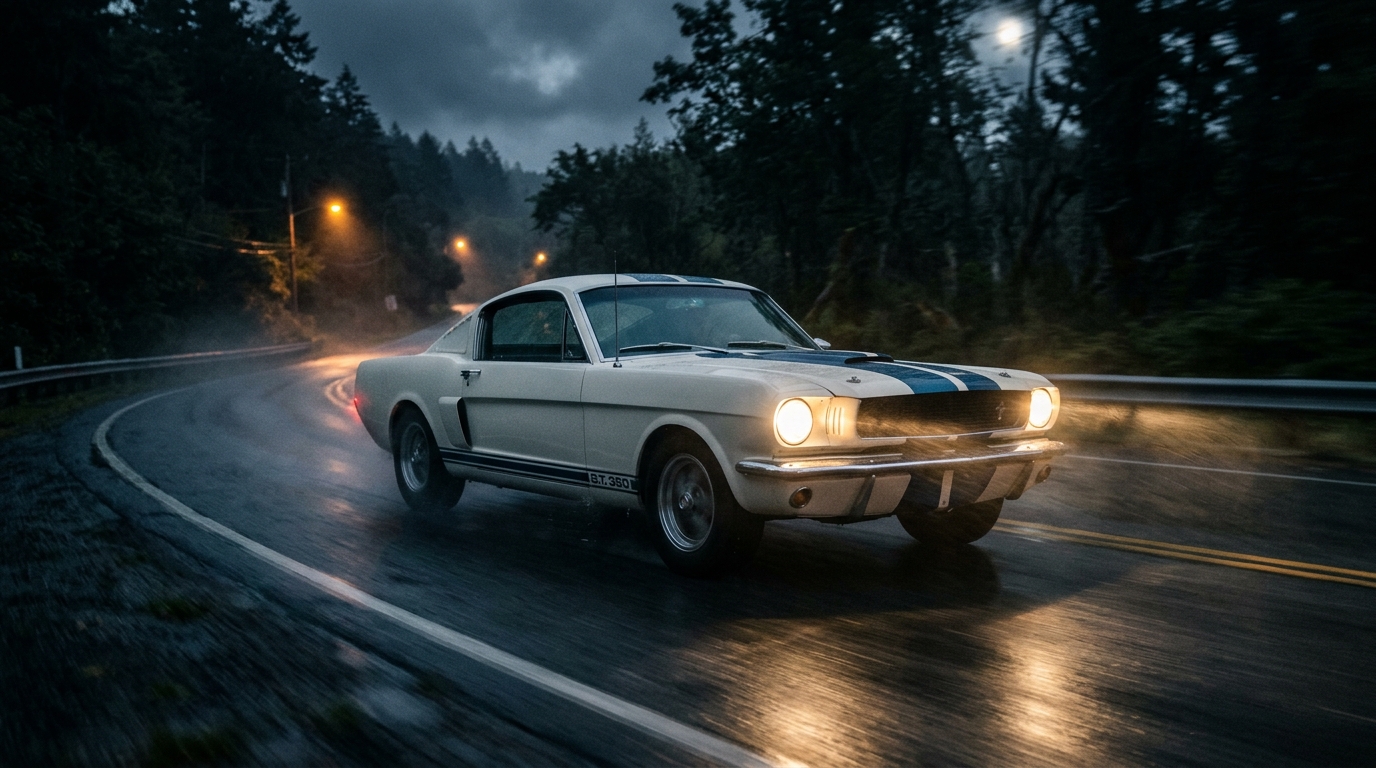
It is a little past midnight, the sodium lamps are buzzing orange over a deserted two-lane, and a white fastback with two blue stripes is idling at the curb with that lumpy, impatient burble only a solid-lifter small block can make. Nobody sane takes a 1966 Shelby GT350 out at this hour for the commute. You take it out because the dark is when it makes the most sense.
The Pony That Went to Race School
The GT350 story starts with a problem. Ford’s Mustang was a runaway sales hit in 1964, but it was a stylish secretary’s car with a sporty badge, and Ford wanted credibility on the track. The Sports Car Club of America had a class for production cars, and Ford turned to Carroll Shelby, the Texas chicken farmer turned Le Mans winner who had already stuffed Ford V8s into AC Bristol roadsters to create the Cobra.
Shelby’s brief was to build a Mustang that could beat the Corvette in SCCA B-Production. The 1965 GT350 was the result, and the 1966 model carried the formula forward with refinements. Cars arrived at Shelby American’s Los Angeles facility as bare Wimbledon White K-code fastbacks, then got the full treatment: a High Performance 289, stiffer suspension, big brakes, and a stripped, hardened personality.
Driving It After Dark
Climbing in at night is an exercise in 1960s honesty. The cabin is dimly lit by the amber glow of the gauges, and the Shelby-specific instrumentation adds a tachometer and oil pressure gauge that sit atop the dash in a pod, glowing faintly in your peripheral vision. The wood-rimmed steering wheel is thin and large, and the big Mustang door shuts with a flat, tinny thunk.
Turn the key and the 289 catches with a rough, mechanical rattle that settles into a deep idle. The Hi-Po K-code V8 breathes through a Holley four-barrel on an aluminum high-rise intake and exhales through Shelby’s Cobra-style tri-Y headers and a side-exit setup, though many cars wore the side pipes optionally in later runs. At night, with no traffic to absorb the sound, it reverberates off every storefront and overpass. The tone is a hard-edged bark under load that smooths into a purr at cruise.
The headlights deserve honesty. These are sealed-beam units, and compared to a modern LED or HID setup they are weak, yellow, and short-ranged. The 1966 car adds auxiliary driving lamps up front, mounted near the grille, and you will be grateful for them on a dark back road. Even so, the lesson at night is to keep your speed matched to what you can see, which is a neat reminder that this car was designed in an era when your own judgment was the primary safety system.
Where the GT350 shines is in how directly it communicates. The steering is manual, slow by modern standards but full of feedback, and the car pivots with a willingness the standard Mustang never had. Shelby relocated the front upper control arm mounting points, lowering the roll center, added a larger front sway bar, fitted Koni shocks, and used traction bars to tame rear axle wrap. The result is a car that leans less, tracks truer, and rewards a smooth hand. Push it too hard and the live rear axle and narrow bias-ply-era proportions remind you that this is a vintage machine, but it never feels vague.
The Borg-Warner T-10 four-speed has a heavy, positive throw and the clutch asks for real leg. Upshifts at the 6,000 rpm redline are accompanied by a crisp rasp, and the engine pulls harder than the 306 horsepower figure suggests once the revs build. The brakes were a major upgrade over a stock Mustang, with front discs and Kelsey-Hayes hardware, and in 1966 they were more than adequate for spirited use, though fade is a consideration if you really lean on them.
What Changed for 1966
The 1966 model year brought several notable changes. Colors expanded beyond white: Candy Apple Red, Ivy Green, Sapphire Blue, and Raven Black joined Wimbledon White. The rear quarter windows became functional on later cars, replacing the fixed Plexiglas, and a rear seat became available as a more liveable option. The Cobra-style Le Mans stripes remained optional, and the car was deliberately made a little more road-friendly, with an available automatic transmission, which was a controversial concession among purists.
Production for 1966 reached roughly 2,380 cars, a significant jump from the 562 street GT350s built the previous year. A handful of those became the famous Hertz Rent-A-Racer cars, black with gold stripes, which were rented to weekend warriors and sometimes raced by them. Rumor has it that more than a few were returned with traces of the track still on them.
Why It Still Matters
The GT350 proved that a Detroit pony car could be a legitimate sports car. It won the SCCA B-Production national championship in 1965, 1966, and 1967, and it set the template for every Mustang performance derivative that followed. Today a good 1966 GT350 is a six-figure blue-chip collectible, and the market has been kind to well-documented cars.
At night, with the streetlights strobing past and the exhaust bouncing off the dark, you understand the appeal. It is loud, a bit rough, and utterly honest, and it makes you feel like you are getting away with something.
The 1966 Shelby GT350 is the car that taught Detroit a pony could race, and it still does its best work when the world goes quiet and the road empties out. It is loud, demanding, and gloriously unrefined, which is exactly the point. If you can find one, drive it after midnight.