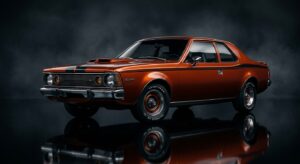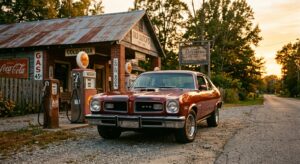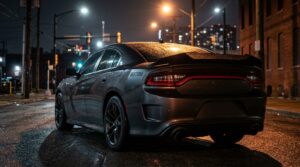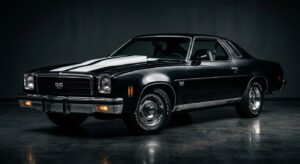
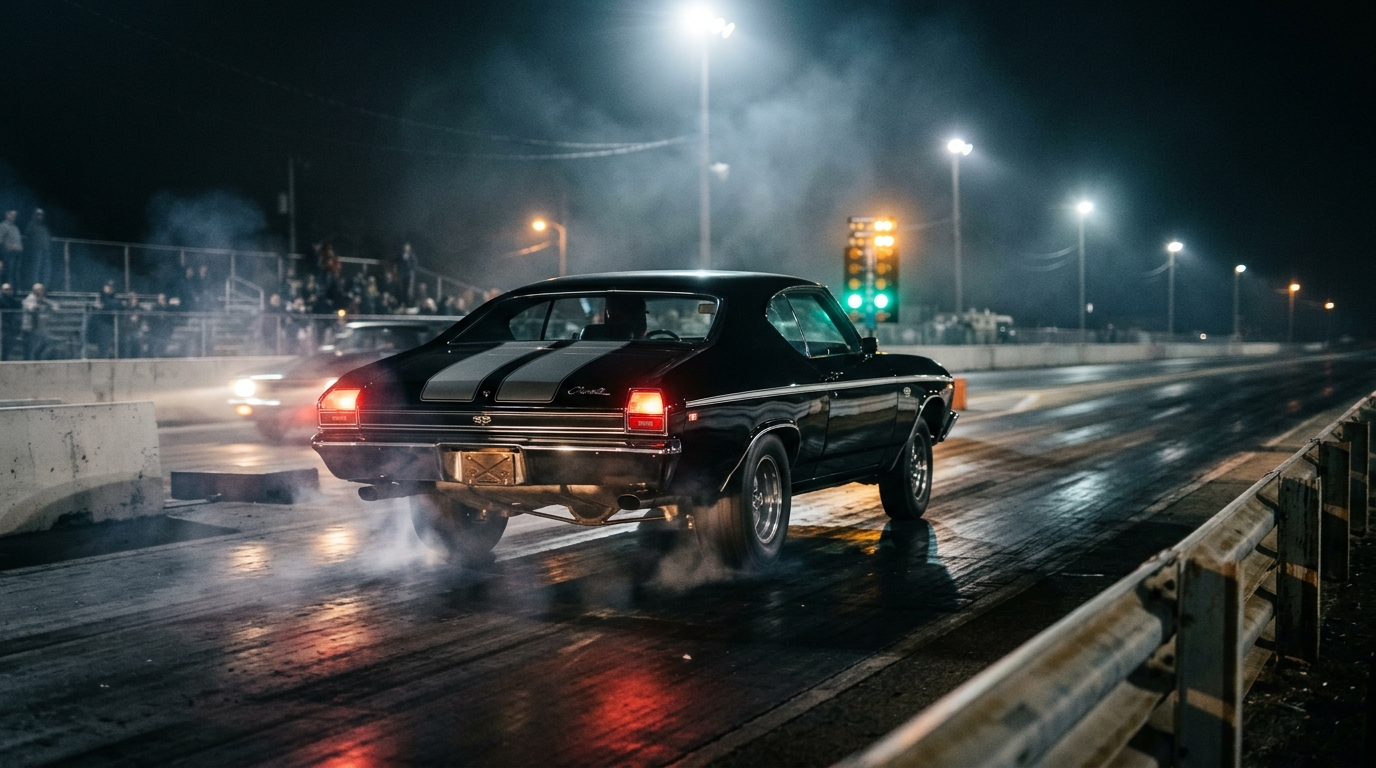
It is a quarter past midnight, the diner lot has emptied out, and the only sound on the empty four-lane is a big-block V8 burbling at idle through a pair of dual exhausts. This is the hour the 1969 Chevelle SS 396 was built for: sodium-lit asphalt, a long straight, and a stoplight that is about to turn green.
The Car Detroit Built for the Dark Hours
By 1969, the muscle car wars were at full boil, and the Chevelle SS 396 was one of the sharpest weapons in the fight. The Chevelle had been redesigned for 1968 with a shorter wheelbase on two-door models and a tight, Coke-bottle profile. For 1969, Chevrolet refined the look with a new grille, revised taillights and a cleaner overall face. Crucially, the SS 396 was no longer a mere trim package, as it had been in 1966 and 1967. In 1968 it became its own distinct model series, and in 1969 it carried that status forward with the 396 cubic-inch big-block as standard equipment.
The standard engine was the Turbo-Jet 396, rated at 325 horsepower. Step up the options list and you could have the L34 version at 350 horsepower or the L78 at 375 horsepower with solid lifters, a 11.0:1 compression ratio and a Holley four-barrel. The L78 is the one that earned the street reputation, and it is the engine we are focusing on here. Peak torque for the L78 was rated at 415 lb-ft.
Driving Impressions After Dark
Turn the key and the L78 wakes with a lumpy, mechanical rumble that carries across an empty parking lot. At night, the sound is half the experience. Without daytime traffic noise to mask it, you hear every valve tick of the solid lifter cam, and the dual exhaust note rolls off the brick walls of a sleeping industrial park like thunder on a delay.
The Muncie four-speed manual, specifically the close-ratio M21 or wide-ratio M20, is the transmission enthusiasts covet. The Hurst shifter, when equipped, snaps from gate to gate with a satisfying mechanical certainty. The clutch is heavy by modern standards, and the long-throw linkage demands deliberate inputs, but at midnight on an empty road, it is exactly the sort of ritual that makes a drive feel like an event. A Turbo-Hydramatic 400 automatic was also available for those who preferred to leave the shifting to the car.
Acceleration is the point, and the Chevelle delivers it with theatrical force. Contemporary tests put the L78 car in the low six-second range to 60 mph and through the quarter mile in the mid-14s, depending on tires, axle ratio and driver. Under full throttle the nose lifts, the rear squats, and the whole car sounds like it is inhaling the road. Rear gear options ranged widely, and cars equipped with the optional Positraction limited-slip and a steep rear gear felt properly ferocious off the line.
Let us be honest about the night-driving realities, though. The stock headlights are a pair of sealed-beam units, and by modern standards they cast a modest, yellowish pool of light. Push the speed up and you notice quickly that your reach into the darkness is shorter than your car’s ability to cover ground. The dash is a handsome, simple affair with a deep-set gauge cluster, and the instrument lighting gives off a soft glow that suits the mood perfectly, but it is not the sort of cockpit that does you any favors with glare or visibility. This is a car that rewards judgment and quiet roads.
Handling is competent for its era rather than sharp by any contemporary standard. The Chevelle rides on a coil-spring suspension at all four corners, with a boxed frame and a live rear axle located by trailing arms. Front disc brakes were an available option and are worth having, because the stopping power of an all-drum car feels optimistic at best when you are carrying big-block speed into a dark corner. Steering is slow, with plenty of play on center, so you drive the car with your hands and your attention rather than flicking it about. Treat it as a straight-line brawler with decent manners in the bends, and it is enormously rewarding.
Street Racing Lore
The Chevelle SS 396 sits at the center of an American tradition that predates the muscle car itself: the late-night run. Long before sanctioned drag strips became widespread, the quarter-mile was measured out on public roads, lit by headlights and settled by whoever got the better launch. The Chevelle’s combination of a lightweight mid-size body, a stout big-block and a price that working people could afford made it a natural fit. It was fast enough to be feared, common enough to be everywhere, and simple enough to be fixed in a garage on a Saturday.
That accessibility is part of why the car endures. Parts support remains excellent, the V8 is mechanically straightforward, and the community around these cars is large and welcoming. Clean examples have become serious collector property, with correctly documented L78 cars commanding strong prices, while more modest SS 396 cars remain within reach of dedicated enthusiasts.
The Engine in Context
The 396 itself belongs to the Mark IV big-block family, a design that debuted in 1965 and went on to power everything from Corvettes to full-size Chevrolets. In the Chevelle, it found arguably its most natural home. The L78 variant used a solid-lifter camshaft, a high-flow aluminum intake on some applications and forged internals, which gave it a high-revving character and a fussier idle compared to its hydraulic-lifter siblings. It is a loud, thirsty, wonderful engine, and it defined the car’s personality.
Editor’s verdict: The 1969 Chevelle SS 396 is not a precision instrument, and it does not pretend to be. It is a loud, honest, big-block bruiser whose best hour is midnight on an empty road, and it still delivers a thrill that no modern performance car can quite replicate.