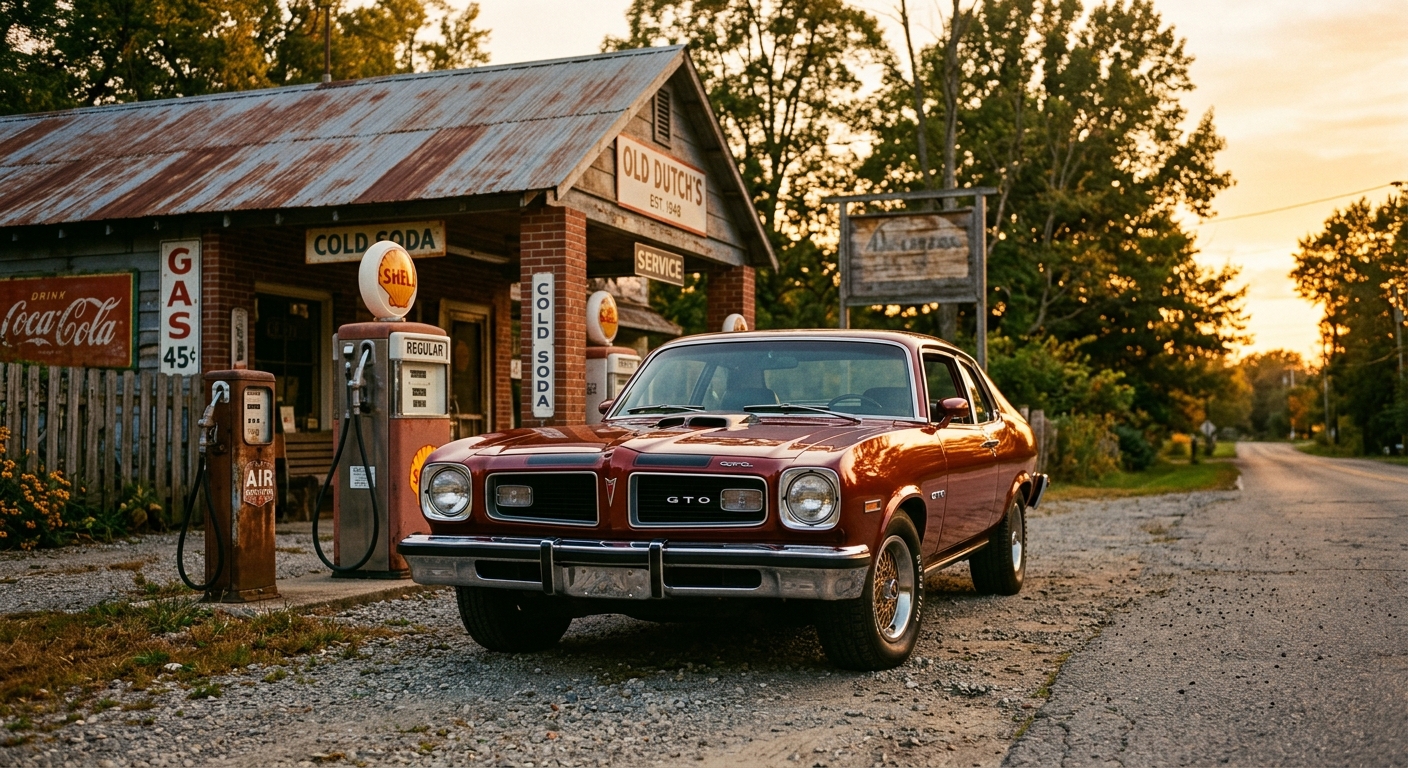
By 1974, the muscle car party was effectively over. Federal emissions regulations and insurance company pressures had neutered most of America’s V8 warriors, and the Pontiac GTO, once the undisputed king of the street, was no exception. Yet even in its twilight year, the GTO retained enough swagger to remind enthusiasts of what once was.
The End of an Era
The 1974 GTO would be the last to carry the hallowed nameplate until its brief revival in 2004. What made this final iteration particularly poignant was how it straddled two automotive worlds: the fading muscle car era and the emerging age of emissions compliance. Gone were the days of the 455 HO and Ram Air engines that had terrorized drag strips just a few years earlier.
Visually, the ’74 GTO was based on the Pontiac Ventura platform, a significant departure from the full-size intermediate chassis that had housed previous generations. This downsizing was partly a response to changing market demands and partly a cost-cutting measure as GM struggled with new regulatory requirements. The result was a car that looked more like a performance compact than a traditional muscle car.
Driving the Final GTO
Behind the wheel, the 1974 GTO tells the story of an industry in transition. The standard 350 cubic inch V8 produces a modest 200 horsepower, a far cry from the tire-shredding monsters of the late 1960s. The optional 455 cubic inch engine, while larger in displacement, was similarly strangled by emissions equipment, producing just 230 horsepower despite its substantial size.
The driving experience reflects these power limitations. Where early GTOs would bark their tires at will and surge forward with violent acceleration, the ’74 model feels more civilized, almost subdued. The four-speed manual transmission still connects you to the mechanical experience, but the reduced torque output means you actually have to work to get the most from the drivetrain.
Handling characteristics were actually improved over earlier generations thanks to the shorter wheelbase and revised suspension geometry. The car feels more nimble around corners, though the bias-ply tires of the era limit ultimate grip. The steering, while lacking power assist in base form, provides good feedback and a direct connection to the road.
Interior and Comfort
Inside, Pontiac made efforts to maintain the GTO’s performance image despite the external constraints. The Rally gauges remained an attractive and functional centerpiece of the dashboard, while the optional Rally wheels continued to be among the best-looking factory options available. The interior space was adequate for two adults up front, though rear passengers would find accommodations tight.
Build quality showed the typical GM characteristics of the mid-1970s, with some cost-cutting evident in materials and assembly. However, the essential GTO visual cues remained, from the dual exhaust outlets to the distinctive hood scoops, even if the latter were now largely cosmetic.
Historical Significance
The 1974 GTO’s importance lies not in its performance statistics but in its role as a historical marker. This was the car that closed the book on the original muscle car era that had begun with the 1964 GTO. It represented Pontiac’s final attempt to maintain performance credibility in an increasingly regulated automotive landscape.
Production numbers tell the story of the changing times: just 7,058 GTOs were built in 1974, a fraction of the peak years when the model regularly sold over 80,000 units annually. The writing was clearly on the wall, and Pontiac would focus on other models like the Trans Am to carry the performance banner forward.
The 1974 GTO may not have been the tire-smoking monster that made the nameplate famous, but it serves as a fascinating period piece and surprisingly solid driver’s car. For collectors seeking an affordable entry point into GTO ownership, the final-year model offers distinctive styling and reasonable running costs without the stratospheric prices of earlier examples.