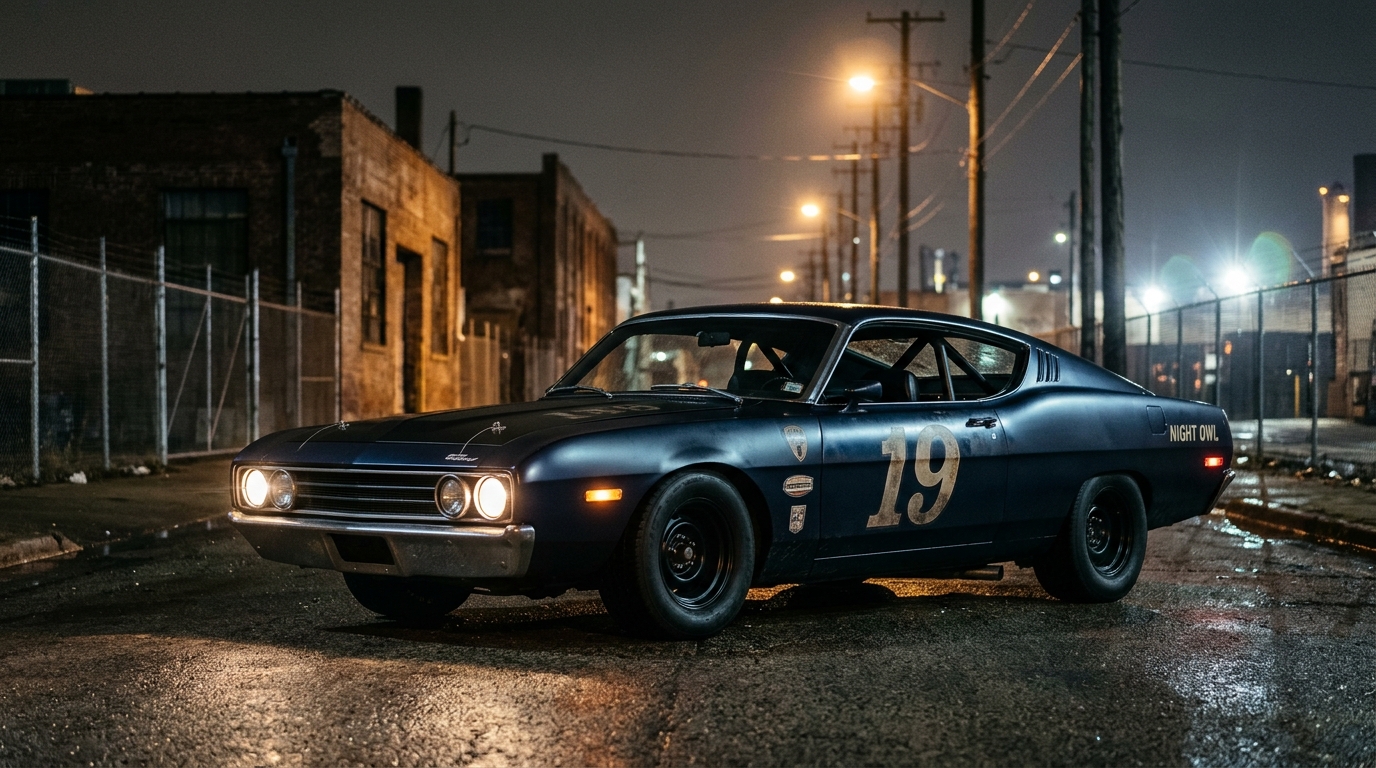
Picture a deserted two-lane at 1 a.m., the only light a pair of round headlights and a faint glow of dash gauges, while a 428 Cobra Jet burbles at idle through its dual exhaust. The 1969 Ford Torino Talladega was not designed for gentle cruising. It was designed to slice through the air at 190 mph on a NASCAR superspeedway, and Ford was legally required to sell a few hundred of them to people like you and me so it could race one.
Born from a Homologation Rule
The Talladega exists because of a rulebook and a rivalry. By 1969, Ford and Chrysler were locked in an aerodynamic arms race on NASCAR’s high banks. Chrysler had unveiled the Dodge Charger 500 and then the wild-winged Charger Daytona. Ford’s stock Torino fastback, the SportsRoof, was slippery for a muscle car but still not slippery enough. NASCAR required manufacturers to build at least 500 production versions of any body style they intended to race, so Ford set out to build a purpose-made aero special that regular customers could buy.
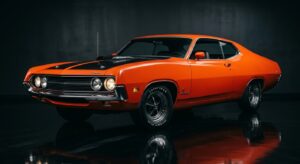
Ford named the car after the brand-new Talladega Superspeedway in Alabama, which opened in September 1969. The Talladega was effectively a Torino SportsRoof with a radically redesigned front end and some clever body tweaks. The grille was moved forward and recessed flush, extending the nose by roughly five inches, and the front bumper was replaced by a thin sloping unit that smoothed airflow. The rocker panels were rolled up by about an inch and a half to lower the effective ride height without hurting ground clearance, and the rear bumper was a Fairlane-sourced unit tucked in tighter. Every single change was in service of cheating the wind.
What It Feels Like After Dark
Climb in and the first thing you notice is how stripped down it feels. Ford spec’d the Talladega as a no-frills car: a bench seat, a basic vinyl interior, and relatively little brightwork. At night that austere cabin is oddly appealing. The round gauges glow a soft green-white, the thin steering wheel rim feels vast, and the long hood extends ahead of you like a runway.
Headlight performance is exactly what you would expect from the late sixties: sealed-beam units that throw a warm, yellowish, narrow pool of light. It is not the sort of illumination that turns night into day. On a dark country road you learn to pay attention, to drive a car-length ahead of your lights, and to respect the long nose that disappears into blackness past the glow. It makes the entire experience feel analog and engaged.
Turn the key on the base 428 Cobra Jet and the cabin fills with deep, loping V8 rumble. This was no show engine. Ford rated it at 335 horsepower, widely believed to be a conservative figure, and the 440 lb-ft of torque is what truly defines the experience. Roll into the throttle in third gear and the whole car squats and surges. The sound at night, bouncing off sleeping storefronts and empty overpasses, is intoxicating: a hard, mechanical bellow that no modern turbo engine can mimic.
Powertrain Options and Reality
The standard Talladega engine was the 428 cubic-inch Cobra Jet, backed by a four-speed manual or a C6 automatic. Many cars were also specified with the 3.25 or 3.50 rear gearing and a limited-slip differential. Ford’s aero engineers cared less about quarter-mile times and more about stability at sustained triple-digit speeds, and that priority shows. Straight-line tracking is composed, though the steering is slow and vague by modern standards. Understeer is the car’s natural tendency when pushed hard into a corner, and the drum-and-disc brake combination demands early, deliberate stops.
It is a big, heavy car, near 3,600 pounds, and it feels it in transitions. You steer it with your whole body, not just your wrists. At night, that physicality is part of the charm: you feel the road through the seat and the wheel, because there is nothing else to look at except the narrow tunnel of light ahead.
Racing Pedigree and Legacy
The Talladega’s racing exploits are the stuff of legend. Ford ran the aero Torino and its Mercury Cyclone Spoiler II cousin through the 1969 and 1970 NASCAR seasons. Drivers including David Pearson, Richard Petty (who famously jumped ship from Plymouth for a time), and Lee Roy Yarbrough campaigned the car. Pearson won the 1969 Grand National championship driving a Ford Torino Talladega, a result that justified every penny of Ford’s development budget. Chrysler’s response was the winged Dodge Daytona and Plymouth Superbird, and the aero-war era remains one of the most spectacular chapters in American motorsport.
Production numbers are small and often cited at around 750 units, enough to satisfy NASCAR homologation with a margin. Today it remains a collector’s prize, appreciated for its purposeful engineering and underdog charm next to the flashier winged cars.
Editor’s verdict: the Talladega is the muscle car for people who like their history with a side of engineering obsession. It is raw, loud, and a little awkward, and after dark with that 428 rumbling, it is pure magic.