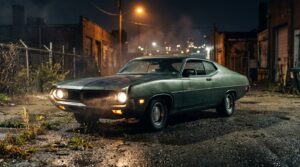
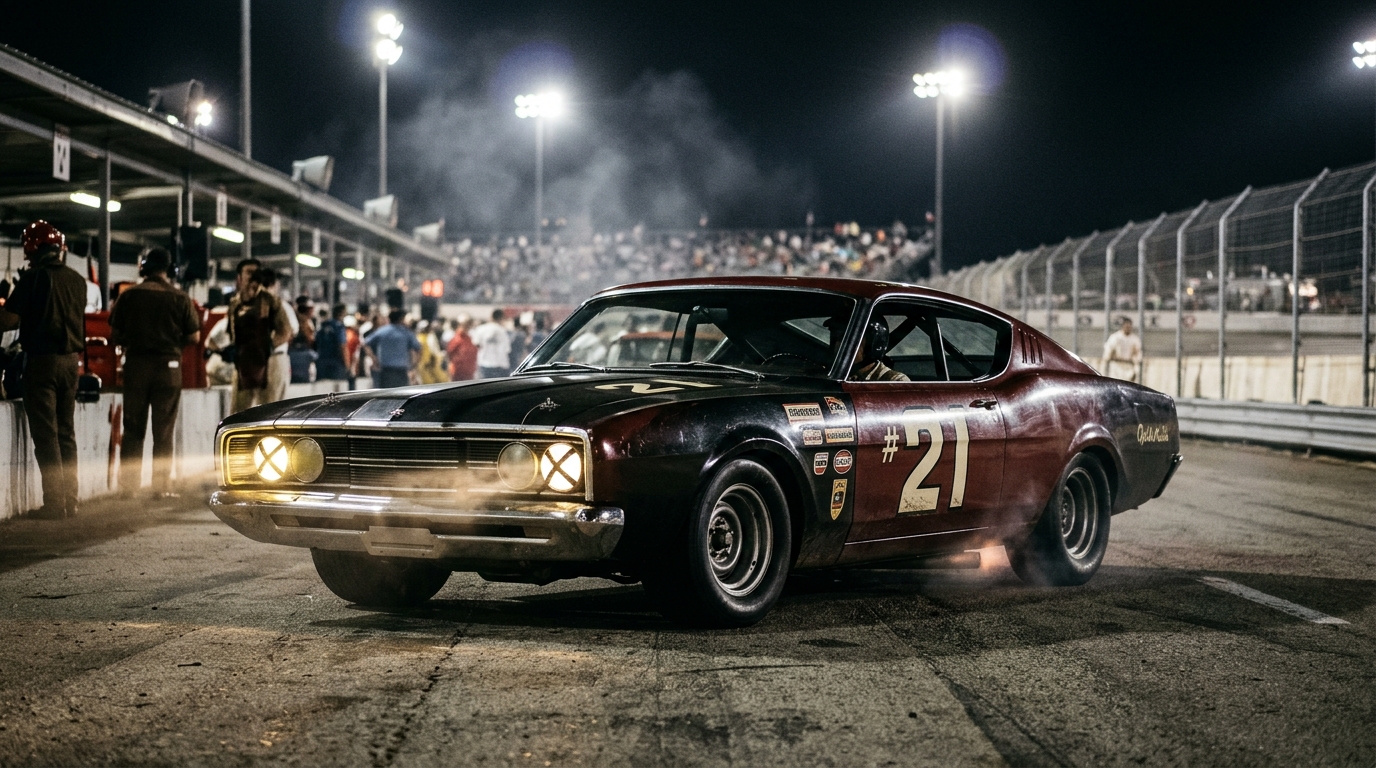
The grandstands at Darlington glow under floodlights, and a Mercury Cyclone with a number 21 on the door is hauling through turn four on a fat cloud of tire smoke and noise. Cale Yarborough would win the Southern 500 at that track in 1968 and 1969, and the Cyclone bodywork that carried him there was far more than a marketing exercise. Today we are looking at the street version, because a 1969 Cyclone idling at a stoplight after midnight has more menace than most modern cars manage at full throttle.
The Cyclone’s Racing Pedigree
Mercury’s performance story in the late 1960s is easy to overlook next to the Mustang and its Boss and Mach 1 variants, but the intermediate-sized Cyclone was Ford Motor Company’s aerodynamic ace. The 1968 and 1969 Cyclone fastback roofline was slippery by the standards of the day, and the Wood Brothers, Holman-Moody and the Cotton Owens crowd all learned that a Cyclone shape ran faster on the big ovals than the notchback Fairlane. Yarborough’s 1969 season with the Wood Brothers produced wins at Daytona, where he took the 1968 Daytona 500, and at the superspeedways in between. The Cyclone Spoiler and Spoiler II package that followed was a direct response to the aero wars.
For 1969 the Cyclone was a separate model line from the Montego, built on the same Ford intermediate platform that underpinned the Fairlane and Torino. It came as a fastback hardtop with an optional convertible variant also offered in some trims. The mid-year Cyclone CJ added the Cobra Jet engine and a ram-air hood scoop, which is the car most enthusiasts mean when they say Cyclone.
Behind the Wheel After Dark
Settle into the bucket seat of a 1969 Cyclone at night and the first thing you notice is how much the interior glows. The gauge cluster carries a warm green-white backlight, and the toggle and slider controls sit in a deep, hooded dash that feels like a cockpit built around a thick-rimmed steering wheel. Visibility is the usual period compromise: the fastback roofline and thick rear pillars leave blind spots, and the standard sealed-beam headlights are, frankly, dim by any modern comparison. A pair of round halogen conversion units transforms how confident you feel on a dark back road, and many owners quietly fit them.
Turn the key on a Cobra Jet car and the 428 wakes up with a lumpy, loping idle that rattles the mirrors and the fillings in your teeth. At night, with the streets empty, the sound carries and bounces off storefronts. Roll onto the throttle and the induction roar from the ram-air system gives way to a deep exhaust bellow that wraps around you. This is not a refined sound. It is a big-cube V8 doing exactly what Ford’s racing division wanted it to do.
Power and the Way It Delivers It
The Cobra Jet 428 was officially rated at 335 horsepower, a number widely understood to be conservative, with 440 lb-ft of torque on tap. Torque arrives low and stays flat, so the Cyclone surges forward without needing to be revved hard. A 4-speed manual was available alongside the three-speed SelectShift Cruise-O-Matic, and the manual cars are the ones that feel most alive on a midnight run. Quarter-mile times in the low 14-second range were typical in period testing, with trap speeds near 100 mph.
Handling and Brakes
Be honest about what this car is. The 1969 Cyclone is a straight-line machine with a front-heavy weight distribution, recirculating-ball steering, and drum brakes at the rear. Front discs were an available option and are essential if you plan on driving the car with any enthusiasm. On a winding road at night the Cyclone leans, understeers when pushed, and demands respect. Its better moods come on long, sweeping highways where the big motor can stretch its legs and the heavy steering settles into a comfortable rhythm.
Living With It Today
A well-kept Cyclone makes a better classic than its rarity suggests. Mechanical parts for the 428 and the Ford intermediate platform are well supported, and the community around Mercury muscle is small but passionate. The trade-off is that exclusive Cyclone trim and body pieces can be harder to source than their Ford Torino cousins. Rust is the usual enemy, particularly in the cowl, lower fenders and trunk floor. Buy the most solid body you can find, because mechanicals are simpler to fix than corrosion.
As a night driver, the Cyclone rewards patience. It is a loud, heavy, slightly crude machine that makes up for its manners with sheer presence. Pull into an empty parking lot beneath a flickering light and let the 428 settle into its idle, and you understand why people still chase these cars.
Editor’s verdict: The 1969 Mercury Cyclone CJ is the muscle car you buy when you want Detroit thunder without the crowd at every cruise night. It is loud, heavy and gloriously unrefined, and after dark it feels like the NASCAR legend it descends from.