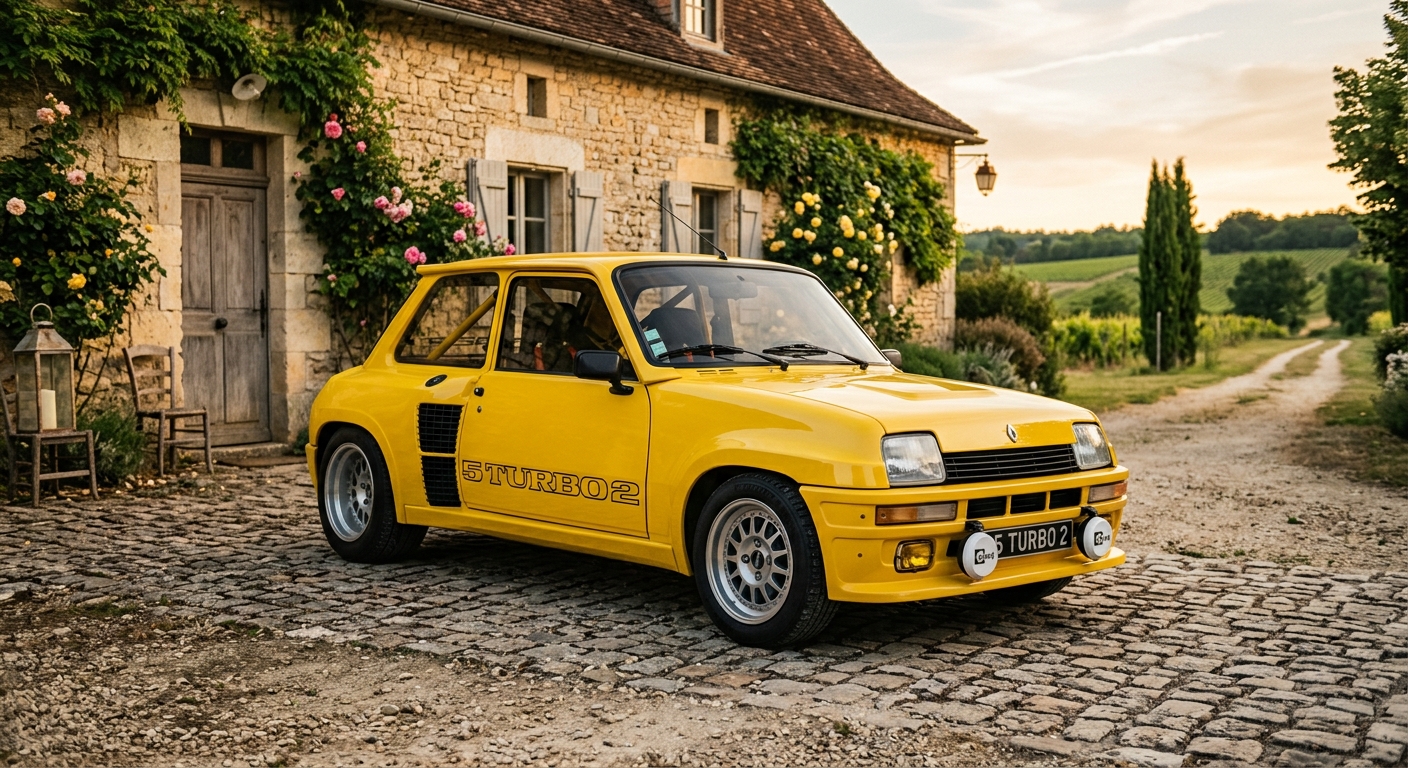
In the early 1980s, while most manufacturers were content to bolt turbochargers onto existing platforms and call it progress, Renault took a different approach entirely. They grabbed their humble 5 supermini, ripped out the rear seats, stuffed a turbocharged engine behind the driver, and created one of the most gloriously unhinged homologation specials ever built. The result was automotive anarchy wrapped in an innocent economy car body.
The Group B Connection
The Renault 5 Turbo wasn’t born from a desire to create the ultimate grocery getter. This was pure motorsport necessity, designed to homologate Renault’s Group B rally weapon. To compete in the World Rally Championship’s most insane category, manufacturers needed to build at least 200 road-going examples of their competition cars. Most played it safe with modified versions of existing models. Renault went completely off-script.
The original 5 Turbo of 1980 was a hand-built exotic that cost more than a Porsche 911. By 1983, the Turbo 2 arrived with a more rational production process and a slightly more accessible price point, though ‘accessible’ remained relative when you were asking customers to pay supercar money for what looked like a city car with a glandular problem.
Engineering Insanity
Everything about the 5 Turbo 2’s engineering defied conventional wisdom. The 1.4-liter turbocharged four-cylinder sat transversely behind the driver, where the rear seats should have been. This wasn’t some half-hearted engine swap, either. Renault repositioned the entire drivetrain, routing power to the rear wheels through a five-speed manual transmission mounted ahead of the differential.
The suspension received a complete overhaul, with independent MacPherson struts all around and anti-roll bars thick enough to serve as weapon. Those impossibly wide rear fender flares weren’t just for show, they housed 345/35VR15 rear tires that looked comically oversized next to the relatively narrow fronts. The result was a car that could generate serious lateral grip but required constant attention from the driver.
The Driving Experience
Climbing into a 5 Turbo 2 means accepting that normal automotive conventions no longer apply. The driving position feels oddly familiar until you fire up the engine and realize there’s a turbocharged four-cylinder humming directly behind your head. Throttle response is immediate and aggressive, the turbo spooling with the subtlety of an industrial compressor.
With 158 horsepower pushing just 2,160 pounds, the power-to-weight ratio rivaled contemporary Porsches. But unlike a 911, which masked its rear-engine layout with Germanic precision, the Renault wore its unconventional architecture like a badge of honor. Lift off mid-corner and the rear end would rotate with enthusiasm. Stay committed through the apex and you’d be rewarded with phenomenal traction and acceleration that embarrassed much more expensive machinery.
The steering was direct to the point of being twitchy, while the suspension transmitted every imperfection in the road surface directly to the driver’s spine. This wasn’t a car for the faint of heart or those seeking refinement. It was motorsport engineering applied to street driving with minimal compromise.
Cultural Impact
The 5 Turbo 2 represented a brief moment when manufacturers were willing to build genuinely insane homologation specials for public consumption. It existed in the same rarified air as the Lancia Delta S4 Stradale and Ford RS200, cars that brought genuine race technology to the street regardless of practicality or commercial sense.
Today, clean examples command serious collector attention, particularly as enthusiasts recognize the 5 Turbo’s significance in automotive history. It represents the end of an era when regulations allowed manufacturers to build road cars that were barely civilized versions of their race machines.
The Renault 5 Turbo 2 remains one of the most uncompromising homologation specials ever built, a car that prioritized racing pedigree over every comfort or convenience. It’s automotive extremism at its finest, wrapped in an innocuous French city car body. For collectors seeking something truly unique from the Group B era, few cars offer this combination of rarity, performance, and sheer audacity.