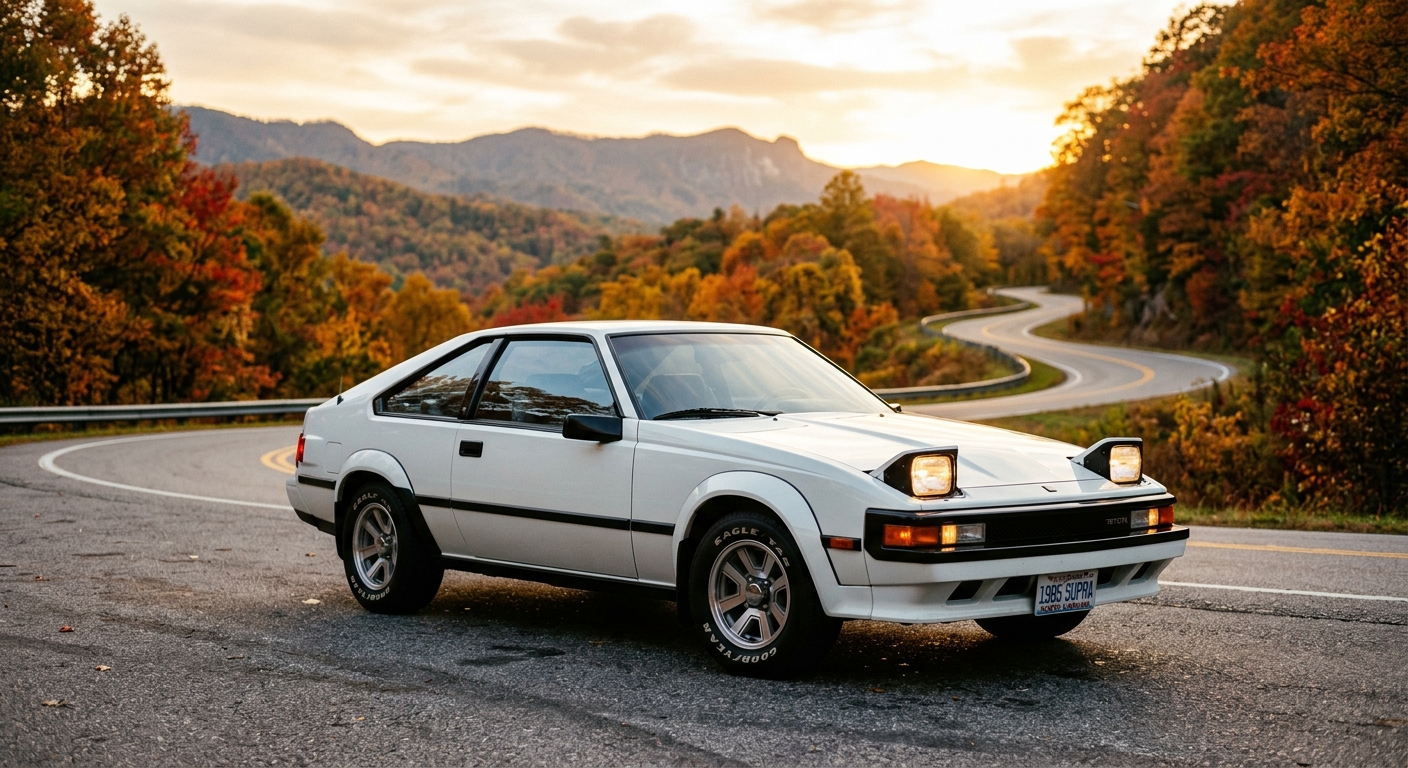
Before the Supra became synonymous with twin-turbo madness and Fast & Furious fame, it began life as something altogether more refined. The 1985 Toyota Supra represented Japan’s first serious attempt at creating a sophisticated grand touring car that could challenge European establishments on their own terms. With its silky inline-six engine and understated elegance, this first-generation Supra laid the foundation for one of the most celebrated nameplates in automotive history.
The Birth of a Legend
Originally sold as the Celica Supra in North America, the 1985 model marked the final year before Toyota spun the Supra off as its own distinct model line. Built on a longer wheelbase than the standard Celica, the Supra was Toyota’s answer to the Datsun 280ZX and a direct challenge to European grand tourers like the BMW 6 Series and Mercedes-Benz SL-Class.
The design was pure 1980s sophistication, with clean lines, pop-up headlights, and a distinctive “Coke bottle” silhouette that balanced aggression with elegance. Unlike many of its contemporaries that favored angular, wedge-shaped designs, the Supra maintained flowing curves that would age remarkably well over the decades.
Inline-Six Excellence
At the heart of the 1985 Supra was Toyota’s 5M-GE engine, a 2.8-liter naturally aspirated inline-six that produced 161 horsepower and 169 lb-ft of torque. While those numbers might seem modest by today’s standards, the engine’s character was its true strength. The inline-six configuration delivered the kind of smooth, linear power delivery that made highway cruising a genuine pleasure.
Paired with either a five-speed manual or four-speed automatic transmission, the Supra could accelerate from 0-60 mph in about 8.4 seconds and reach a top speed of 125 mph. More importantly, it felt refined and composed at all speeds, with none of the harshness or vibration that plagued some of its competitors.
Grand Touring Excellence
What set the 1985 Supra apart was its focus on long-distance comfort without sacrificing driving dynamics. The independent rear suspension, a rarity in this price class, provided excellent ride quality while maintaining sharp handling characteristics. The steering was precise and well-weighted, giving drivers confidence through mountain passes or city streets alike.
Inside, the Supra offered a level of equipment and refinement that rivaled cars costing significantly more. Digital instrumentation, automatic climate control, and a premium sound system were available, along with supportive bucket seats that could handle both spirited driving and cross-country tours. The build quality was exemplary, with fit and finish that put many European competitors to shame.
Cultural Impact and Legacy
The 1985 Supra arrived at a pivotal moment in automotive history, when Japanese manufacturers were transitioning from economy car specialists to luxury and performance credible alternatives. This first-generation Supra proved that Toyota could build a sophisticated sports car that didn’t rely on raw power or flashy styling to make its point.
Perhaps most importantly, it established the Supra’s reputation for reliability and daily usability. While exotic European competitors required constant maintenance and careful handling, the Supra could serve as both weekend sports car and daily driver without compromise. This practical approach to performance would become a hallmark of Japanese sports cars for decades to come.
The 1985 Toyota Supra stands as a testament to the power of restraint and refinement in an era of excess. It proved that Japan could build world-class grand touring cars without losing the reliability and practicality that made their economy cars so successful. For enthusiasts seeking an accessible entry into classic Japanese sports cars, few offer the Supra’s combination of daily drivability, solid construction, and timeless design.