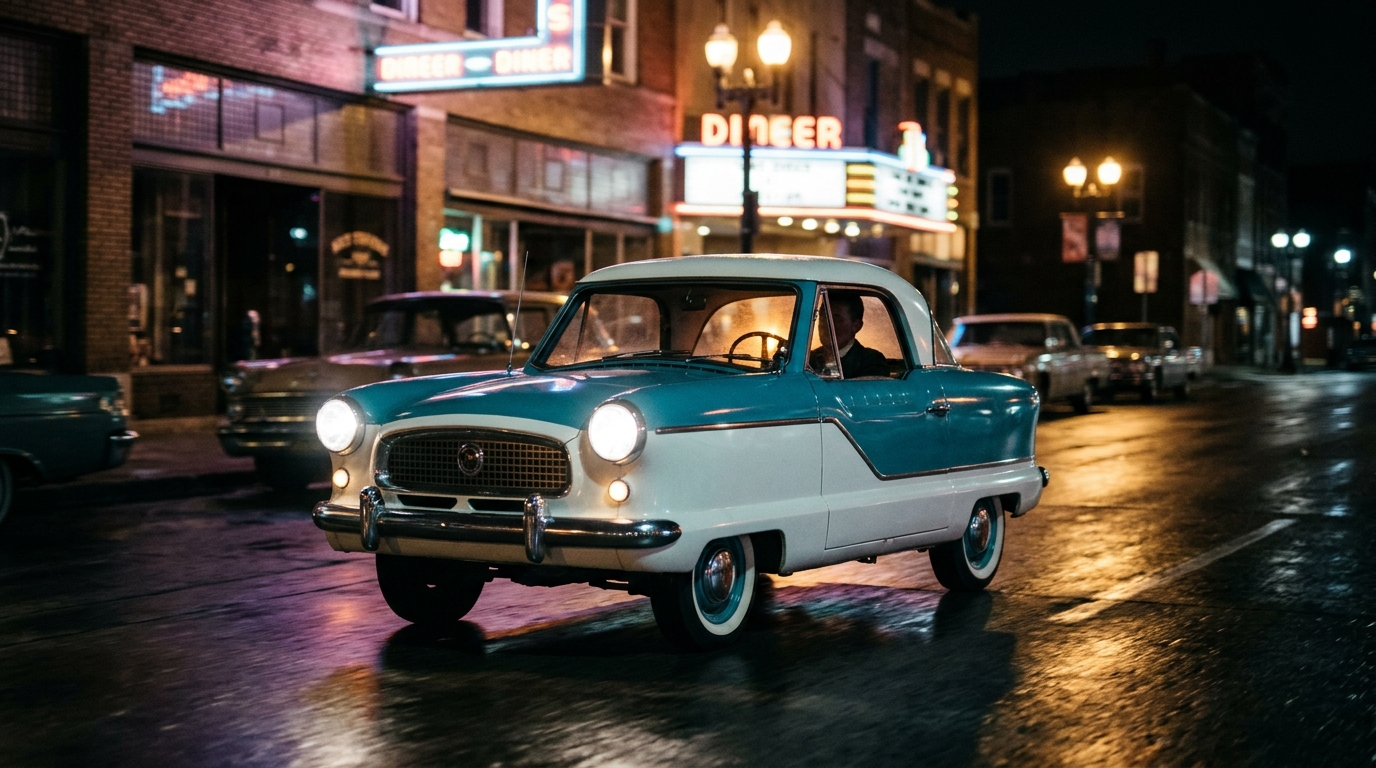
It is a little after midnight, the main street is empty, and the only thing moving is a pastel-painted bubble with a 1950s grin and a four-cylinder hum. The Nash Metropolitan was never meant to be fast. It was meant to be charming, and under a sodium streetlight at this hour, charm turns out to be a very effective weapon.
A Strange Little American Idea
The Metropolitan is one of the great oddities of postwar motoring. Nash-Kelvinator, and later American Motors after the 1954 merger with Hudson, wanted a genuine small car for American roads, and they wanted it to be a second family car rather than a stripped-down penalty box. Nash designer William Flajole styled the body, and the whole thing was engineered with help from Austin in Britain. Production took place at Austin’s Longbridge plant in England, and the cars were shipped across the Atlantic. That makes every Metropolitan a transatlantic hybrid: American styling and marketing, British hardware and assembly.
The 1964 model year matters because it was the last. By then the car was sold under the Metropolitan name alone, with Nash badging long gone from the brand portfolio, and AMC was concentrating on its Rambler lineup. Final cars were sold during 1961 in many markets, but registrations and dealer stock meant many examples were titled as 1962, 1963, and even 1964 models. If you find a car titled as a 1964, you are looking at a late-stock survivor of the final production run.
What It Is Like After Dark
Slide behind the thin-rimmed wheel and the first thing you notice is how close everything is. The cabin is intimate, with a bench-style seat, a simple painted dash, and a dial layout that looks like it was designed by someone who really liked toys. The second thing you notice is how little light you are working with. Period sealed-beam headlamps are modest by modern standards, and the original six-volt-era electrical thinking, updated to a twelve-volt system on later cars, means the glow ahead of you is warm, yellow, and short on reach. On a dark country road you drive within your lights, and that suits the car perfectly.
The engine is the 1,489 cc Austin B-series four-cylinder, an overhead-valve unit that made roughly 52 horsepower. It is not an engine that shouts. It thrums, a busy and slightly gruff sound that carries beautifully on a quiet night. The three-speed manual, with a column shifter on most cars, is an easy and light-handed gearbox, and first gear is not synchronized on the earliest versions, so you learn to be deliberate about it. Later cars gained a full set of synchros across the ratios, which makes late-model examples nicer to live with.
At 40 mph the Metropolitan feels like it is going quite quickly, because the car is tiny, the steering is direct, and the road is right there under you. At 60 mph it feels busy. At its top speed in the mid-70s it feels like a commitment. But night traffic is thin, nobody is in a hurry, and the little Nash rewards you for slowing down and noticing things: the neon of a closed diner, the glow of a drive-in screen that is no longer there, the smell of warm vinyl and engine heat.
Handling and Ride
The suspension is simple: independent coil springs up front, a live rear axle on semi-elliptic leaf springs. The ride is livelier than you might expect for a vehicle with such a short wheelbase, and the body leans in corners in a friendly, communicative way. The drum brakes need planning, and you leave room. The steering is slow but light, and parking is effortless, because the car measures roughly 149 inches nose to tail.
Living With One
A Metropolitan is a hobby car in the best sense. Parts for the Austin-derived mechanicals are well supported, particularly through the British car community, while bodywork and trim pieces are the real challenge. Rust is the enemy, as with any car of this era, and the floors, door bottoms, and lower rear quarters deserve a flashlight and a magnet before you buy. Clubs and owners are enthusiastic and generous with advice, which is a large part of the appeal.
It will not carry a family, it will not win a stoplight sprint, and it will not make a motorway commute feel relaxing. What it will do is make people smile at red lights and ask questions at gas stations. At midnight, with the streets empty and the headlights glowing like candles, that is more than enough.
The Metropolitan is slow, small, and gloriously out of step with everything else on the road, which is exactly why it is unforgettable after dark. Buy it for the smiles, the stories, and the quiet midnight runs, and forget the stopwatch entirely.