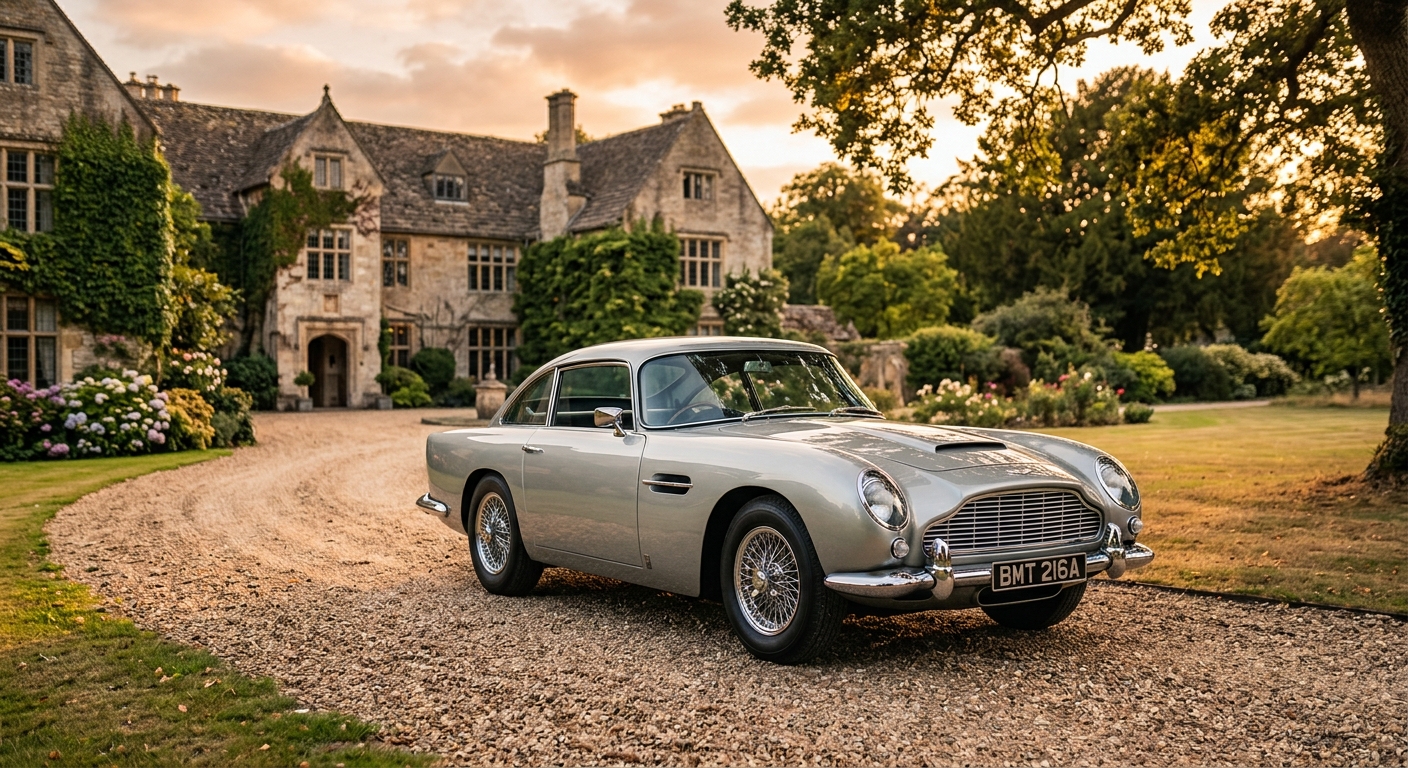
Before the DB5 became a cinematic icon, it was already the pinnacle of British automotive refinement. This is the car that established Aston Martin as the thinking man’s sports car manufacturer, blending Italian-inspired styling with English craftsmanship and German engineering precision.
Design That Defined a Decade
Carrozzeria Touring’s superleggera construction philosophy reached its zenith in the DB5. The aluminum body panels are stretched over a lightweight tubular frame, creating proportions that remain timelessly elegant sixty years later. Every line serves a purpose, from the pronounced fender flares that house the wire wheels to the subtle rear spoiler integrated into the boot lid.
The interior represents the absolute best of British luxury craftsmanship. Connolly leather adorns every surface that matters, while Wilton carpets cushion your feet. The dashboard, a masterclass in functional elegance, places every control exactly where your hands expect to find them. This is automotive interior design before focus groups and cost-cutting ruined everything.
The Heart of the Beast
Under that long, sensuous bonnet lies Tadek Marek’s masterpiece: the 4.0-liter straight-six engine. This isn’t just any inline-six, but a thoroughly modern design with dual overhead cams, hemispherical combustion chambers, and triple Weber carburettors. The result is 282 horsepower delivered with the smoothness of silk and the authority of a sledgehammer.
The engine note is pure poetry, a cultured growl at idle building to a soprano wail at the 5,500 rpm redline. This is the sound that made a generation fall in love with British engineering, before reliability concerns and emissions regulations began their slow strangulation of character.
Dynamic Excellence
Behind the wheel, the DB5 reveals its dual nature as both grand tourer and sports car. The steering is wonderfully communicative, transmitting every nuance of the road surface through the thin-rimmed wheel. There’s no power assistance here, just mechanical precision that builds arm muscles and driving skill in equal measure.
The suspension strikes an inspired balance between comfort and control. On smooth motorways, the DB5 devours miles with serene composure. When the road turns challenging, it responds with surprising agility for a car weighing over 1,600 kilograms. The limited-slip differential ensures power reaches the ground effectively, while the four-wheel disc brakes provide stopping power that was genuinely advanced for 1964.
Cultural Impact Beyond Cinema
While James Bond undoubtedly elevated the DB5’s profile, the car earned its reputation on merit long before Hollywood came calling. This was the first Aston Martin to break the 1,000 units per year production barrier, proving that British luxury could compete with Ferrari and Mercedes on both performance and desirability.
The DB5 represented a new kind of sophistication in the automotive world. Where Italian exotics prioritized raw speed and German cars emphasized engineering excellence, Aston Martin offered something uniquely British: understated elegance combined with genuine performance capability.
The DB5 remains the template for everything Aston Martin has built since, a perfect synthesis of British craftsmanship and continental sophistication. This is automotive nobility at its finest, a car that wears its age not as a burden but as a badge of honor earned through six decades of unwavering elegance.