The Jaguar XJ-S was never meant to be subtle. Launched in the mid-1970s as the successor to the legendary E-Type, it carried an impossible burden: follow one of the most beautiful cars ever made. By 1986, however, the XJ-S had found its identity not as a sports car, but as the ultimate grand touring machine for those who valued refinement over raw performance.
The V12 Experience
At the heart of every XJ-S V12 lies Jaguar’s magnificent 5.3-liter V12 engine, a powerplant that defined luxury motoring in the 1980s. This isn’t an engine that screams for attention like its Italian contemporaries. Instead, it whispers sweet nothings through twin exhaust pipes, delivering 295 horsepower with the smoothness of silk. The V12 pulls from idle with barely a tremor through the steering wheel, gathering momentum with the inexorable force of a freight train dressed in Savile Row tailoring.
Fire up the V12 and you’re greeted by a subtle rumble that speaks of engineering prowess rather than brute force. The powerplant settles into an idle so smooth you might question whether it’s actually running. Press the accelerator and the XJ-S responds with a surge of torque that feels endless, accompanied by the most civilized V12 soundtrack this side of a Rolls-Royce.
Grand Touring Grace
The 1986 XJ-S represents the model’s mature years, when Jaguar had worked out the early reliability issues and refined the driving experience. The car’s mission becomes clear within the first mile: this is a machine built to devour continents in supreme comfort. The suspension soaks up road imperfections with typical British compliance, while the steering provides just enough feedback to keep the driver engaged without becoming tiresome on long journeys.
Inside, the XJ-S cocoons occupants in an environment of hand-stitched leather, burled walnut, and that unmistakable aroma of British luxury. The seats are supportive without being aggressive, perfect for the 500-mile days this car was designed to handle. Instrumentation is comprehensive yet elegant, with gauges that look more like jewelry than mere information displays.
Distinctive Design Legacy
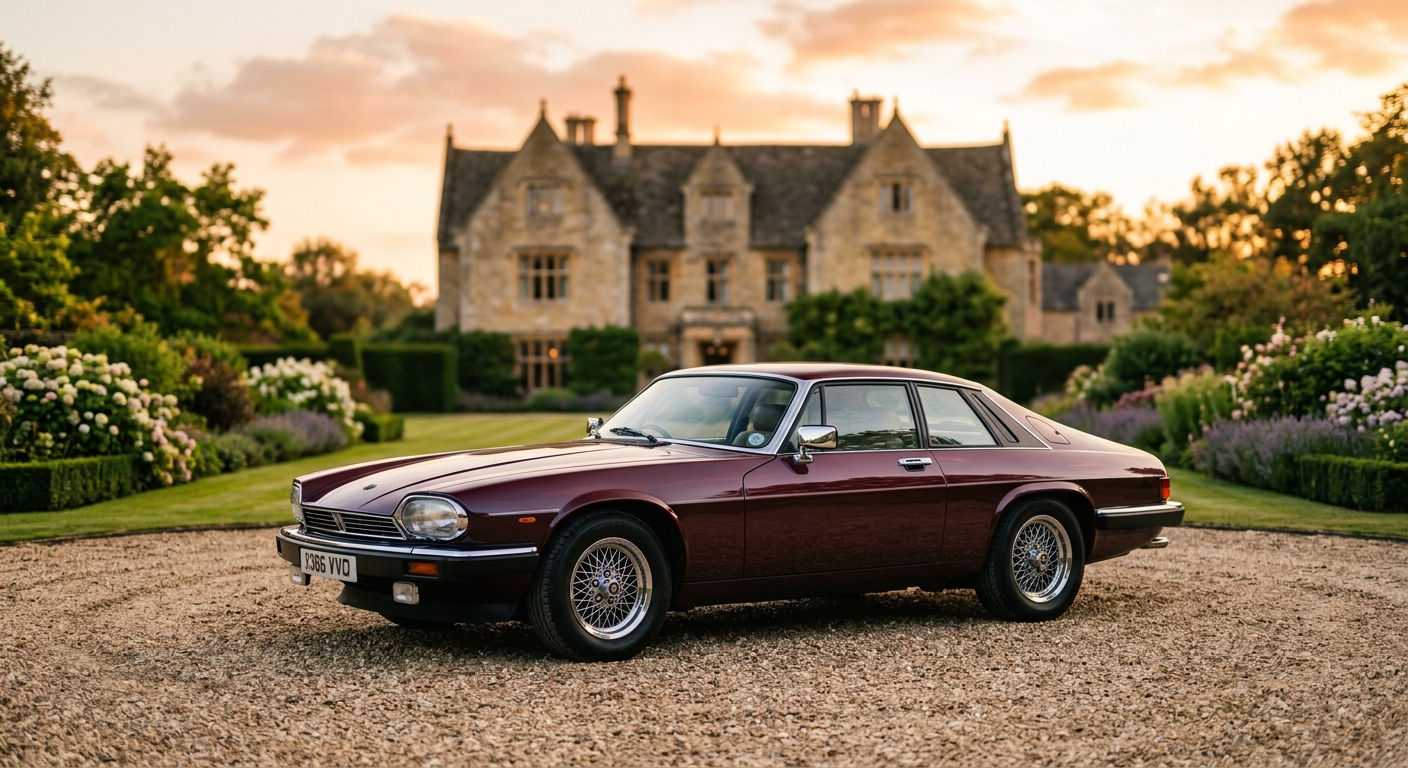
Malcolm Sayer’s design for the XJ-S was controversial when new, but time has been kind to its distinctive silhouette. The buttressed rear window treatment, while polarizing, gives the car an unmistakable profile that stands out even today. The long hood speaks to the V12 nestled underneath, while the relatively compact greenhouse emphasizes the car’s sporting pretensions.
By 1986, detail refinements had addressed some of the early styling criticisms. The proportions work particularly well in darker colors, where the car’s dramatic lines are emphasized rather than the various design elements that break up the visual flow. Chrome wire wheels and subtle body-colored bumpers help integrate the design into a cohesive whole.
The Jaguar Character
What sets the XJ-S apart from its German and Italian competitors isn’t ultimate performance or razor-sharp handling. Instead, it’s the intangible quality the British call character. This is a car with personality, one that rewards patience and understanding. The V12 needs time to warm up properly, the automatic transmission prefers smooth inputs to aggressive demands, and the overall experience is best savored rather than attacked.
On the right road, at the right time, with the right mindset, few cars can match the XJ-S for sheer motoring pleasure. It’s a car that makes ordinary journeys feel special, that transforms the driver into a gentleman adventurer bound for Monte Carlo or the Scottish Highlands with equal aplomb.
The 1986 Jaguar XJ-S V12 represents British grand touring at its most refined, offering a driving experience that prioritizes character over clinical perfection. Today, these magnificent V12 cats represent exceptional value for those seeking classic luxury with genuine usability. Just remember to budget for maintenance: like all great British cats, they require proper care and feeding.