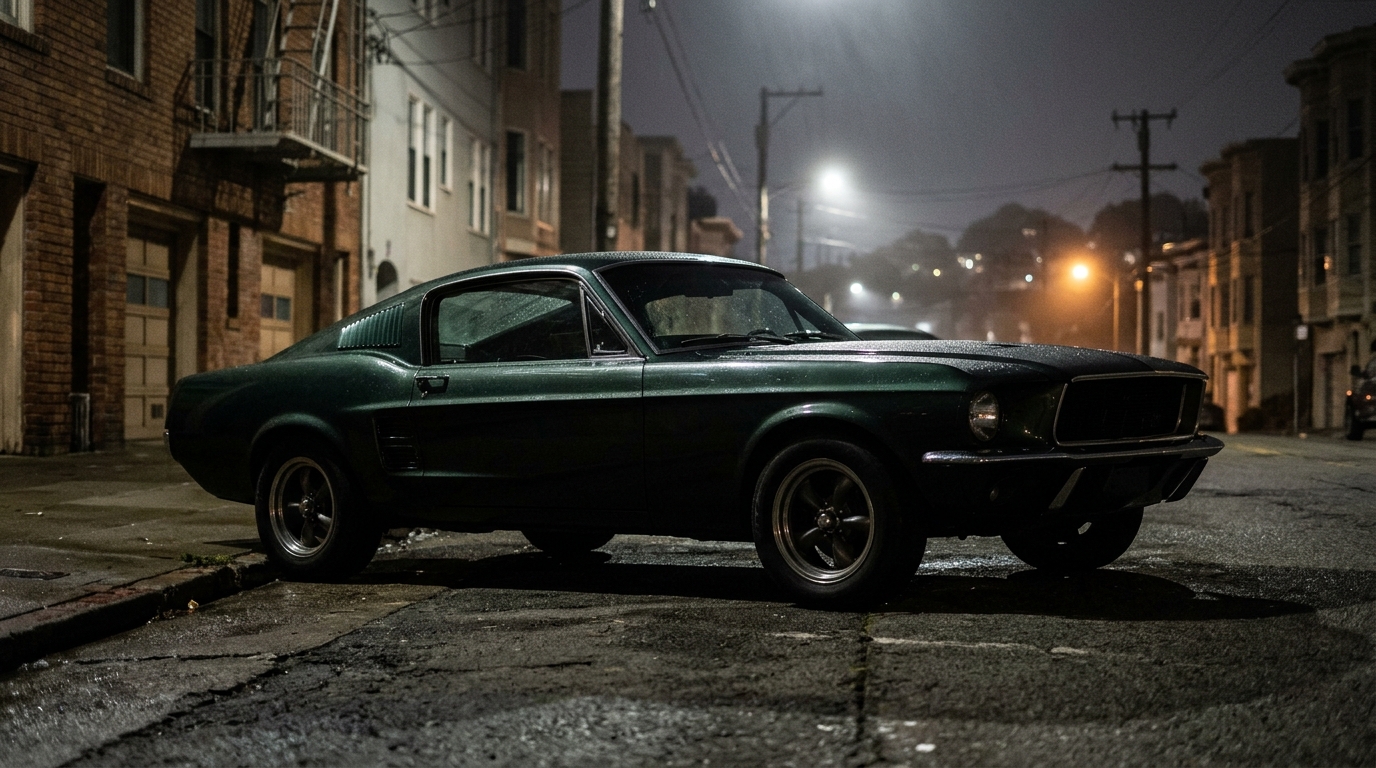
It is a little after midnight, the rain has just stopped, and the hills are slick under a haze of sodium streetlights. Somewhere ahead of you, a green fastback is crouching at the bottom of a grade, and the only sound in the world is a big Ford V8 burbling through its dual exhausts. The 1968 Mustang GT Fastback is not just a car, it is a mood, and it belongs to the dark.
The Car in Bullitt’s Shadow
Every 1968 Mustang fastback lives under the long shadow of one film. Bullitt, released in October 1968, put Steve McQueen behind the wheel of a Highland Green GT Fastback and sent it flying across the hills of San Francisco in a chase that still defines the genre. It is easy to forget that the car McQueen drove was an everyday showroom model: a 390 cubic inch V8, a four-speed manual, a GT equipment group. The legend came from the driving, not from exotic parts.
That ordinariness is what makes the car so approachable. A 1968 Mustang GT is not a trailer queen. It is a car built to be driven hard and driven often, and it still rewards that treatment today.
The 1968 Model Year Explained
The 1968 model year sits at an interesting moment for the Mustang. The car had grown from its 1964.5 origins, and the 1967 redesign had added size and the big-block option. For 1968, Ford refined the formula with federally mandated safety changes, including side marker lights, shoulder belt provisions, and a energy-absorbing steering column. Ford also introduced the 302 cubic inch V8 as a new small-block option, replacing the 289.
The GT package for 1968 was the performance and appearance group. It added the 2-barrel 302 as a minimum, though most enthusiasts associate the GT with the 390 four-barrel, rated at 325 horsepower and 427 lb-ft of torque. The GT package included power front disc brakes, a heavy-duty suspension with stiffer springs and a front sway bar, fog lamps mounted in the grille, a GT badge on the fender and gas cap, and the signature reflective C-stripe along the lower body sides. Dual exhausts with chrome quad outlets were part of the package too.
Behind the Wheel After Dark
Settle into the driver’s seat at night and the first thing you notice is the glow. The 1968 Mustang’s instrument cluster is wonderfully simple: a pair of round pods with a soft amber-green illumination that feels like a vintage radio. Nothing is distracting. It is a cockpit designed for a driver who wants to keep his eyes on the road.
Fire up the 390 and the whole car shivers. The idle is lopey and deep, with a burble that rolls off the quad exhaust tips and bounces back at you from every garage door and brick wall. At night, with the streets empty and the air cool, sound carries further and the engine seems to grow in volume. Roll on the throttle and the 390 pulls with a thick, muscular surge rather than a frantic scream. It is a torque motor, built to shove the car forward in a rolling wave.
The four-speed manual has a long, notchy throw that rewards deliberate shifts. Third gear in the dark, with the tach swinging toward five grand and the exhaust booming off a row of parked cars, is one of those moments that makes you forget the twenty-first century exists.
Headlights, Visibility and the Dark
Here is where the honest part of the review comes in. The 1968 Mustang’s sealed-beam headlights are a product of their time. The standard setup uses a pair of round sealed units, and their output is modest by modern standards. On a dark country road they illuminate a short, warm-yellow cone, and you learn quickly to drive within what you can see. Many owners fit modern halogen or LED replacements in the same housings, which transforms night driving without changing the look.
The fastback roofline does hurt rear visibility. The sloping glass and thick C-pillars create real blind spots, and at night the narrow rear window can feel like a mail slot. Thankfully the large side mirrors and wide mirror-view of the cabin help. The upside of that fastback shape is how it looks under streetlights: the roof catches and bends the light in a long, graceful highlight that no other car of the era quite matches.
Handling and Brakes
Do not expect a modern sports car. The 1968 GT leans in corners, the steering is slow and vague on center, and the unassisted-feeling manual setup demands muscle at parking speeds. But the GT’s stiffer suspension and front discs help considerably, and once you learn the car’s rhythm it is wonderfully playful. Ease off into a corner, feel the nose settle, and squeeze the throttle. The back end will rotate if you ask it to. On a damp midnight road, that playfulness is half the fun.
Braking with front discs and rear drums is adequate for the era but demands planning. Leave extra room, especially in the wet.
Living With a Legend
Ownership of a 1968 Mustang GT Fastback is a pleasant surprise. Parts support is outstanding, with nearly every component available as a reproduction. The mechanicals are simple and robust, and a competent home mechanic can maintain one. The cost is the buy-in: genuine GT Fastbacks with the 390 have become serious collectibles, and Bullitt-style Highland Green cars command a premium. Watch for rust in the cowl, floor pans, and the rear quarter panels, and verify the VIN and data plate to confirm an original GT.
Editor’s verdict: The 1968 Mustang GT Fastback is not the fastest or sharpest car of its era, but nothing else matches its mix of sound, style, and sheer movie-star charisma after dark. Find a good one, fit some modern headlight bulbs, and go chase your own shadow down an empty midnight road.