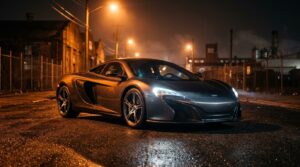
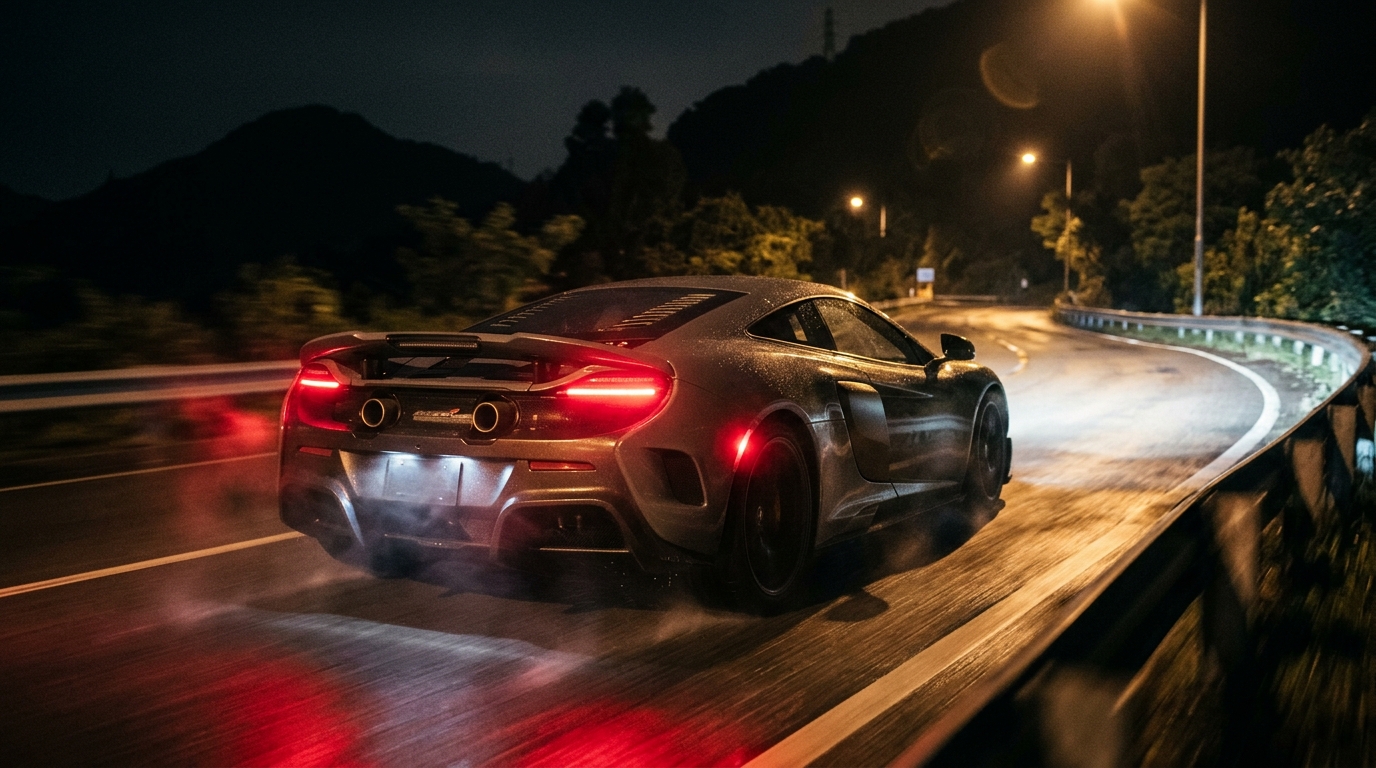
It is 1 a.m. on an empty mountain road, and the only light in the world is what the 675LT throws ahead of itself. The cabin is quiet except for a low turbo rumble ticking over behind your shoulders, and you know that in a few seconds the whole valley is going to hear about it.
Why the Longtail Matters After Dark
McLaren has used the Longtail name sparingly. The original was the 1997 F1 GTR Longtail, a stretched, aerodynamically tuned racer built to win Le Mans. The 675LT revived the idea in 2015 as a road car, taking the 650S as its base and chasing the same philosophy: less weight, more downforce, more focus. The numbers are the 650S’s story told with the volume turned up. Power rises to 666 PS (657 hp in the American way of counting), and McLaren claims a dry weight of about 2,863 lb, roughly 220 lb lighter than the 650S.
That is not a cosmetic diet. The 675LT carries a new carbon fiber front splitter, a longer rear body section with a deployable active rear wing, titanium exhaust components, lightweight carbon seats, thinner glass and even a lighter-weight infotainment setup. McLaren says around 30 percent of the car’s parts are new or changed over the 650S. Night driving shows you what that means, because with less to see and less to distract you, the car’s changes become easier to feel.
The Sound Is the Headline
At night, with fewer ambient noises, the 675LT’s 3.8-liter twin-turbocharged V8 sounds enormous. The M838TL engine makes 666 PS at 7,100 rpm and 516 lb-ft of torque, and McLaren fitted a new titanium exhaust that is distinctly louder and more mechanical than the 650S. Roll through a tunnel at 2 a.m. and the noise comes back at you with a hard, flat-plane-style crackle that makes you laugh out loud. Upshifts pop and bark. Lifting off the throttle in Sport or Track sets off a stream of overrun pops that echo off cut rock and concrete barriers.
It is not a pure, high-revving scream like a naturally aspirated Ferrari. It is a dense, forceful, brass-band sound, and in the dark it reads as pure drama.
Steering You Can Feel in the Dark
The 675LT’s single biggest gift to the analog romantic is its hydraulic steering rack. Where almost every modern supercar has gone electric, McLaren stuck with hydraulic assistance here, and on a dark road with the headlights picking out only the next 50 yards, that choice pays off massively. You feel the front tires scrabbling for grip. You feel the road camber and the slight tugs of surface changes long before they become a problem. It builds confidence you simply cannot get from a numb rack.
Combined with a bespoke carbon monocoque tub (the MonoCell), a proper double-wishbone front and rear suspension with ProActive Damping Control, and optional Pirelli P Zero Trofeo R tires, the car feels sharp without being nervous. Body control at night is superb, and the ride on Normal is surprisingly forgiving for something that weighs under 3,000 lb.
Seeing and Being Seen
The 675LT uses LED headlights with a distinctive eyebrow DRL signature, and on a pitch-black road they deliver a bright, clean white beam with good spread. They are not adaptive in the way a modern luxury sedan’s are, and the car’s low nose means you are always conscious of dips and crests. The cabin is stark at night: the central portrait infotainment screen glows softly, the digital cluster flips between Normal, Sport and Track layouts, and the minimalist interior never fights for your attention. Rear visibility is limited, as in every mid-engine exotic, but the pop-up rear window makes small adjustments and the mirrors are good.
The Gearbox and the Launch
A seven-speed Seamless Shift dual-clutch transmission handles gear changes, and McLaren claims shifts so fast the car’s own driver can barely notice. In reality, the box is lightning quick at full throttle and a little occasionally jerky at parking speeds. At night, though, the rapid-fire upshifts become a sort of rhythm, a mechanical heartbeat. Launch control delivers 0 to 60 mph in about 2.8 seconds, and 0 to 124 mph in 7.9 seconds according to McLaren. Top speed is 205 mph.
The Last of a Type
The 675LT arrived at a moment when supercars were becoming digital. Production was limited to 500 coupes (a Spider followed), and the whole run sold out quickly. In hindsight it feels like the high-water mark of the analog McLaren: hydraulic steering, a manic twin-turbo V8, low weight and a track-bred focus. Later McLarens became faster, more technological and more refined. None of them quite match the 675LT’s raw, slightly feral appeal after midnight.
The 675LT is one of the last great analog-feeling McLarens, a hydraulic-steered, carbon-tubbed, turbo-barking Longtail that comes alive after dark. If you can find a clean one, buy it before the legend finishes writing itself.