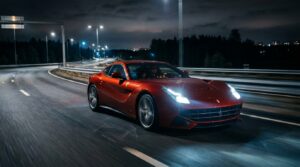
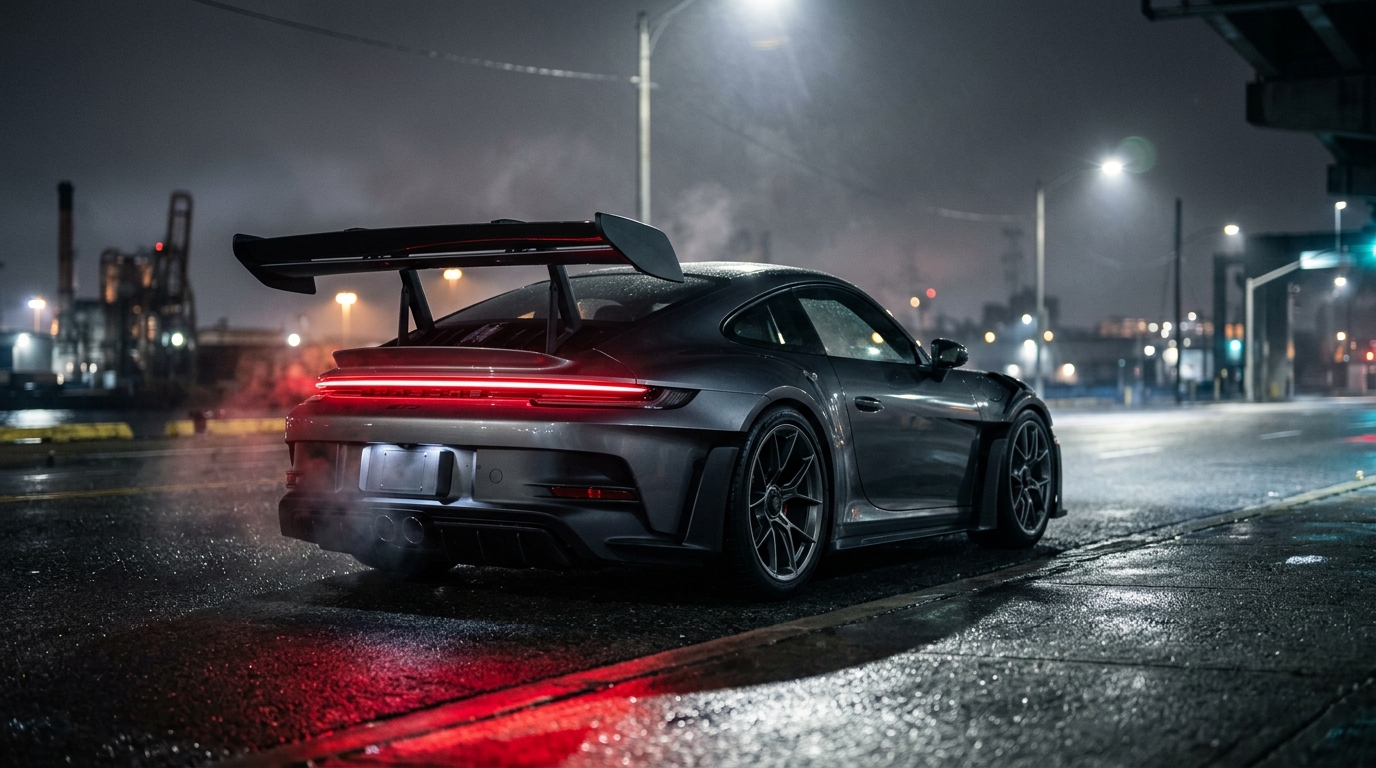
Past midnight, the canyon road is empty and cold, and the only light comes from the pair of LED headlamps pulling the 911 GT3 up the mountain. Then the flat-six climbs past 7,000 rpm and the night stops being quiet. This is what a naturally aspirated Porsche was built to do after dark.
The Last Great Screamer
The 992-generation GT3 arrived for the 2021 model year with a 4.0-liter naturally aspirated flat-six making 502 horsepower at 8,400 rpm and 346 lb-ft of torque at 6,100 rpm. The redline sits at 9,000 rpm. In an era of turbochargers, hybrid assist and silent electric launches, Porsche’s Motorsport division kept the old formula alive: big displacement, high revs, and an engine that begs to be wrung out. At night, with the windows cracked on a quiet road, the induction howl bouncing off rock walls is the best argument for combustion left on sale.
Downforce After Dark
The headline hardware is the swan-neck rear wing, mounted from above rather than below, which lets the underside of the wing work cleanly in the airflow. Together with the front diffuser and rear underbody work, the GT3 generates serious downforce, and Porsche has quoted figures at speed that would embarrass many dedicated track cars. The front suspension uses a double-wishbone layout, a first for a 911, borrowed from the 911 RSR race car. On a dark, unfamiliar road, that front end is a confidence machine. The nose goes exactly where you point it, and feedback through the steering is detailed enough that you feel the surface change under the headlights before you see it.
Seeing Where You Are Going
Night driving exposes how good a car’s lighting and cabin ergonomics really are. The GT3 uses LED headlights as standard, with a crisp, wide cutoff that illuminates corner entries well. The gauge cluster stays clear and legible in the dark, with the central rev counter dominating the view, and the narrow A-pillars and low scuttle keep sightlines honest. Visibility out the back is limited by the wing, but the GT3’s compact proportions make it easy to place on a dark, tight road.
PDK or Pure Manual
Buyers can choose a seven-speed PDK dual-clutch or, in a nod to purists, a six-speed manual. The PDK is the quicker option, hitting 60 mph in about 3.2 seconds, and its shifts are so well timed that you stop thinking about them. The manual, with its short throws and rev-matching option, trades a few tenths for a deeper connection. Both feed a limited-slip rear differential and rear-axle steering that sharpens turn-in and calms the car at speed. Either way, a midnight run through a tunnel with the engine at 8,500 rpm is something you remember.
Daily Use, Mostly
Porsche still makes the GT3 surprisingly livable. The ride is firm but never brutal on the standard adaptive dampers, the cabin is well built, and the car can be driven to dinner without drama. A front-axle lift system helps with steep driveways. The trade-off is fuel economy, which hovers around 15 mpg combined, and a tire noise level that reminds you this is a track-bred machine. Still, when the sun sets and the roads clear, no other car feels more at home.
The 2021 GT3 proves that downforce, revs and a manual option still matter. Drive it at night, windows down, and it makes a strong case as the best driver’s car on sale.