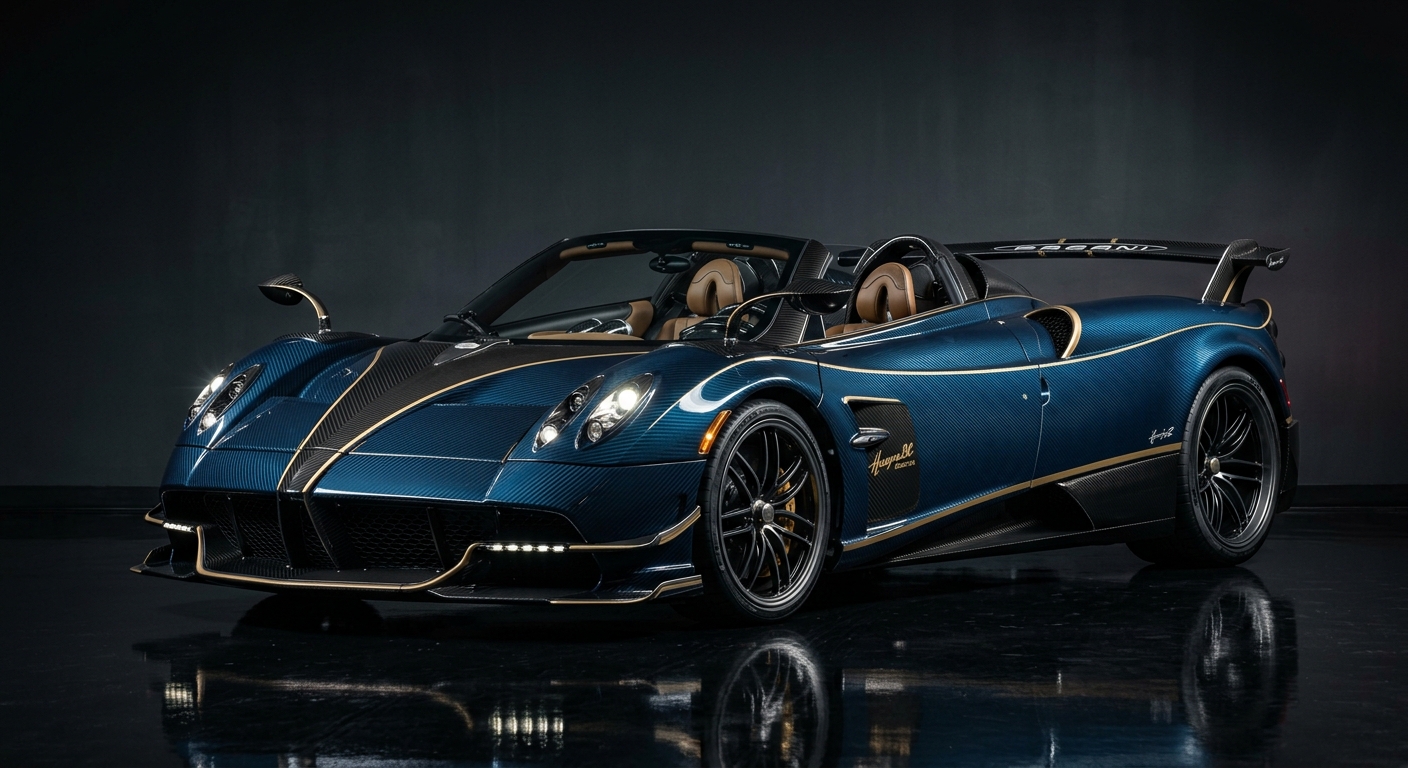
In the rarified world of Italian hypercars, Pagani stands as the ultimate fusion of art and engineering. The 2020 Huayra BC Roadster represents the apex of Horacio Pagani’s vision: a track-focused machine that loses its roof but none of its fury. With only 40 examples ever built, this is exclusivity redefined.
Sculptural Perfection in Motion
The BC Roadster is not merely a convertible version of the standard Huayra: it’s a complete reimagining. Every surface has been resculpted, every vent repositioned, and every aerodynamic element optimized for maximum downforce. The result is a car that looks like it’s moving even while stationary, its carbon fiber skin rippling with purposeful aggression.
The active aerodynamics are a masterpiece of engineering theater. Four wing flaps at each corner dance in response to driving conditions, while the massive rear wing adjusts its angle based on speed and cornering forces. It’s automotive ballet performed at 200 mph.
AMG Heart, Italian Soul
At the heart of this carbon fiber sculpture beats Mercedes-AMG’s hand-built 6.0-liter twin-turbo V12, but in its most potent form. Producing 791 horsepower and 774 lb-ft of torque, it’s an engine that rewards commitment. The power delivery is intoxicating: smooth and linear at low revs, then increasingly savage as the tachometer sweeps toward redline.
The seven-speed automated manual transmission, sourced from Xtrac, shifts with mechanical precision that puts modern dual-clutch units to shame. Each gear change is an event, accompanied by explosive pops and crackles from the titanium exhaust system.
Track Weapon, Open Air
Removing the roof presented Pagani’s engineers with a monumental challenge: maintaining structural rigidity while preserving the BC’s track focus. The solution involved extensive use of carbo-titanium throughout the monocoque, resulting in a roadster that actually weighs less than the original Huayra coupe.
The suspension setup borrows heavily from the racing world, with Ohlins dampers providing multiple adjustment points for compression, rebound, and ride height. On track, the BC Roadster feels like a street-legal prototype racer, its responses immediate and its limits stratospheric.
Interior Artistry
Step inside and you’re greeted by an interior that feels more like a luxury aircraft than a traditional supercar. Every switch, dial, and surface is machined to perfection. The steering wheel alone contains dozens of controls, each milled from solid aluminum and engraved by hand.
The seats, upholstered in the finest Italian leather, provide race-car support while remaining comfortable enough for grand touring duties. Carbon fiber trim pieces are woven into intricate patterns that catch the light like precious metal.
The Ultimate Expression
On public roads, the BC Roadster requires restraint and respect. Its 791 horsepower can overwhelm even modern traction control systems, and its track-tuned suspension transmits every imperfection in the tarmac. But find the right road, at the right time, and few experiences in motoring can match the sensation of this machine at full song.
The sound alone is worth the seven-figure asking price: a complex symphony that begins with turbocharger whistles, builds through V12 harmonics, and crescendos with titanium exhaust notes that seem to rearrange your internal organs.
The Huayra BC Roadster isn’t just a car: it’s a rolling sculpture that happens to be the fastest way to experience wind in your hair. At $3.4 million, it asks serious money for serious thrills, but delivers an experience that borders on transcendental. This is automotive artistry at its most pure and uncompromising.