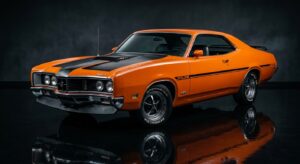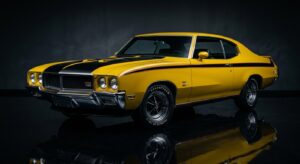
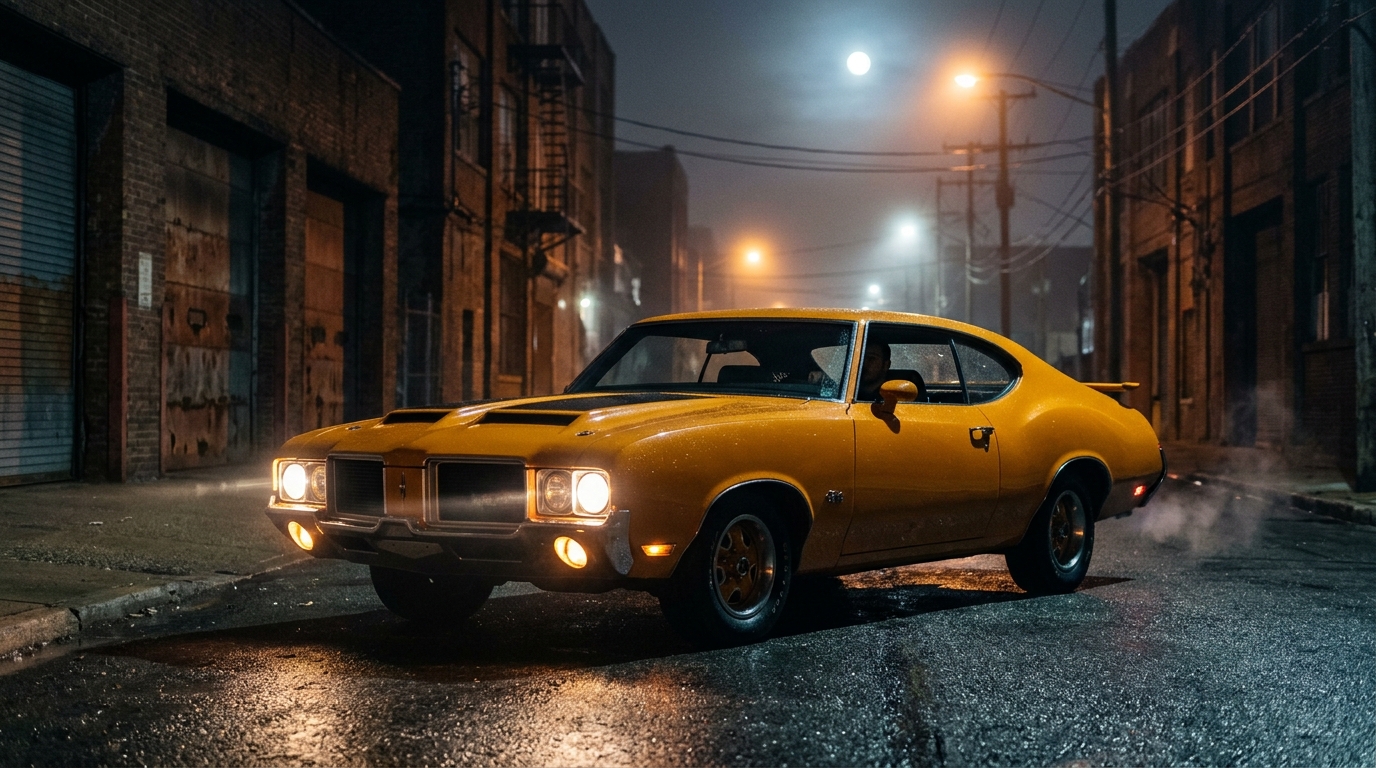
It is just past midnight, the streetlights are throwing that tired amber glow across empty pavement, and something loud, bright, and slightly absurd is idling at the curb. The 1970 Oldsmobile Rallye 350 was built for exactly this hour, when the lot of the local burger stand clears out and the only thing left to settle is who has the nerve to go first.
The Cheap Seat at Detroit’s Muscle Table
By 1970, Oldsmobile’s performance reputation rested on the mighty 442 and its 455 Rocket V8. But insurance companies were punishing young buyers for big-engine cars, and not everyone could afford a 442 anyway. Oldsmobile’s answer was the Rallye 350, a package that put the visual drama of a muscle car on a car with a more modest engine and a far friendlier price tag. Think of it as the 442’s younger, louder-dressed cousin, and it was priced and positioned accordingly, a car for the young buyer who wanted to be seen.
The Rallye 350 was offered on the Cutlass S coupe and sport coupe, and the headline feature was impossible to miss. Every example wore a single, vivid color scheme: Sebring Yellow, a bright, almost fluorescent hue that Oldsmobile paired with bold black and contrasting accents. The package added a fiberglass-look front end treatment, the cool-air-style hood scoops, special striping, and Rallye wheels with the signature dished design. Nobody parked one of these quietly, and that was the whole point.
After Dark: How It Lives at Night
Here is where a bright yellow car becomes a different animal. In daylight it shouts. Under sodium vapor streetlights, that Sebring Yellow turns a deep, molten gold, and the black accents disappear into the shadows so the car seems to float. Roll through a quiet downtown at 1 a.m. and the lights wash across the hood scoops and the long, flat hood in a way modern cars with their sculpted sheet metal simply cannot match.
The headlights are period-correct sealed beams, and they are exactly as modest as you would expect. They cut a dim, yellowish cone ahead of you, nothing like the laser-bright projectors on a new car. On unlit back roads you learn to respect your speed, because the cheap physics of 1970 lighting means you are driving a little faster than you can see. That is part of the charm, and part of the humility. It rewards smooth, deliberate driving.
The soundtrack is where the Rallye 350 earns its keep after dark. The Rocket 350 does not have the thunder of a big-block, but it has a clean, throaty burble through the exhaust, and in the stillness of a late-night street it carries. Echo it off a row of closed storefronts and a Rallye 350 suddenly sounds much bigger than its displacement suggests.
Under the Hood and Behind the Wheel
The 350 Rocket V8 was a solid, torquey small-block-sized unit by Oldsmobile standards, rated at 310 horsepower in its high-output form for the Rallye 350, paired with a healthy 390 lb-ft of torque. That was more than enough to put the Cutlass S through the quarter-mile in the low 15-second range and provide genuine, usable passing power, even if it could not match the 442’s brute force. A four-barrel carburetor fed the engine, and a dual-exhaust system with a distinct note was part of the package.
Power went to the rear wheels through your choice of a three-speed manual, a four-speed manual, or the three-speed Turbo Hydra-Matic automatic. The four-speed is the one to find. Shifts are positive, the throw is short, and it keeps you right in the meat of the torque band on a winding road when the traffic has thinned out to nothing.
Steering is slow and numb by modern standards, and the body leans in corners. Brakes were front discs on many examples, which helps, but you will still plan your stops with generous margin. This is not a car you attack through an apex. It is a car you cruise, steer with two fingers, and enjoy as the center of attention.
Why It Matters Now
The Rallye 350 is a fascinating piece of muscle car history precisely because it is not the headline act. It shows how the industry adapted to a changing market, giving younger buyers the style and attitude without the insurance penalty. Production numbers were modest, and surviving, correctly restored examples are increasingly sought after by collectors who appreciate the story behind the sticker. As a way into Oldsmobile muscle without the 442 price, it remains one of the great bargains of the era, a loud-colored, slightly rebellious reminder that fun was always the point.
The Rallye 350 will not win a drag race against a 442 or a Hemi, and it does not care. It is a loud-colored, light-on-its-feet slice of 1970 attitude that costs a fraction of its big-block siblings and delivers a bigger grin per dollar than almost anything from the era. Find a Sebring Yellow one, take it out after midnight, and let the streetlights do the rest.