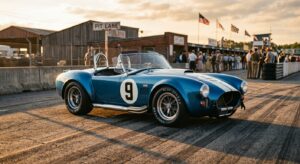
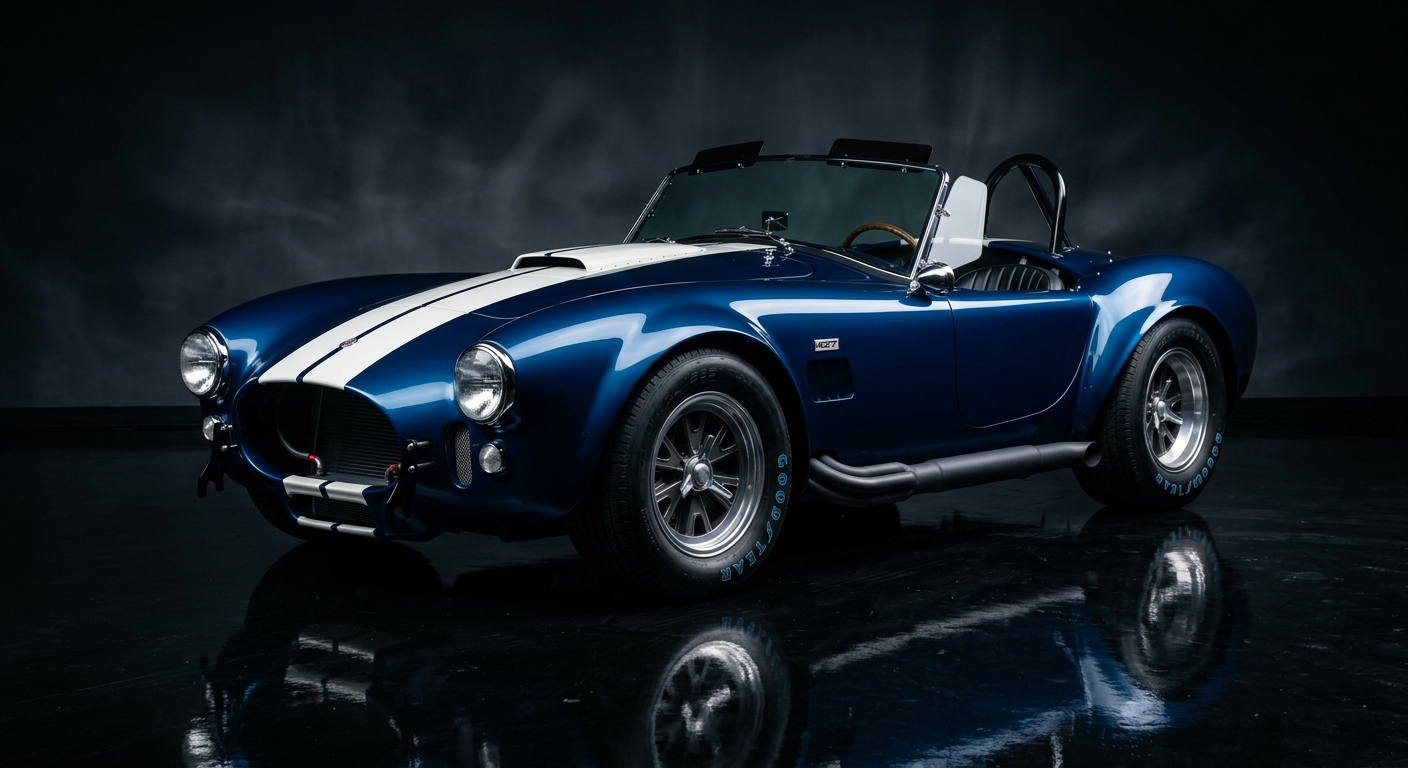
In the pantheon of American automotive legends, few cars command the visceral respect of the 1967 Shelby Cobra 427 S/C. This wasn’t just a car: it was Carroll Shelby’s fever dream made manifest, a brutal marriage of British lightweight engineering and American big-block fury that redefined what a sports car could be.
The Birth of a Legend
By 1967, Carroll Shelby had already proven his formula with the small-block 289 Cobra, but he wasn’t satisfied. The Semi-Competition (S/C) model represented the ultimate evolution of his AC Cobra concept, stuffed with Ford’s monstrous 427 cubic-inch side-oiler V8. This was the street-legal version of Shelby’s competition cars, built for those brave enough to handle 425 horsepower in a 2,400-pound package.
The S/C differed from the standard street Cobra in crucial ways. It featured the competition chassis with larger frame rails, a Toploader four-speed transmission, Halibrand knock-off wheels, and most importantly, the 427 side-oiler engine that was virtually identical to what powered Shelby’s racing machines. Only 348 of these monsters were ever built, making each one a rolling piece of American performance history.
Driving the Beast
Climbing into a 427 S/C is like strapping yourself to a barely contained explosion. The cockpit is spartan and purposeful, with simple Smiths gauges, a wood-rimmed steering wheel, and little else to distract from the business at hand. Fire up the side-oiler, and the entire car vibrates with malevolent energy as 427 cubic inches of displacement announce their presence through the side pipes.
On the road, the S/C is an exercise in controlled violence. The torque is biblical, arriving with such force that it can easily overwhelm the rear tires at any speed. The steering is direct and unfiltered, communicating every nuance of the road surface through your fingertips. There’s no power steering, no anti-lock brakes, no electronic aids: just you, the road, and 425 horsepower waiting to bite back if you’re not careful.
The acceleration is simply savage. Zero to 60 mph arrives in under four seconds, a figure that was nearly unthinkable in 1967. But it’s not just the straight-line speed that impresses: the S/C’s relatively sophisticated independent rear suspension allows it to corner with surprising composure, at least until the power overwhelms the chassis dynamics and reminds you exactly what you’re dealing with.
The Sound and the Fury
Nothing prepared you for the aural assault of a 427 S/C at full chat. The side pipes deliver an unfiltered soundtrack that ranges from a lumpy idle rumble to a full-throat roar that can be heard for miles. It’s a sound that announces your arrival long before you’re visible, a mechanical war cry that speaks to something primal in any enthusiast’s soul.
The 427 side-oiler engine itself is a masterpiece of American muscle. With its deep-sump oil pan, solid lifters, and race-bred internals, it was designed to survive the punishment of competition use. In street trim, it produced 425 horsepower and 480 lb-ft of torque, figures that were simply outrageous for the era.
Legacy and Impact
The 427 S/C represented the end of an era. By 1967, safety regulations and insurance concerns were already beginning to strangle the performance car market. The Cobra’s complete lack of modern safety equipment and its reputation for killing inexperienced drivers made it a liability in the changing automotive landscape.
Yet this danger was part of its appeal. The S/C demanded respect, skill, and a healthy dose of courage. It was automotive Darwinism at its purest: only the skilled survived. This uncompromising character has made surviving examples incredibly valuable, with pristine S/C models commanding well over a million dollars at auction.
The 1967 Shelby Cobra 427 S/C remains the ultimate expression of the American muscle car ethos: maximum power, minimal weight, and absolutely no compromise. It’s a machine that demands everything from its driver and rewards skill with an experience that no modern car can replicate. For those fortunate enough to drive one, it’s a reminder of what cars were like when they were built to be driven, not just owned.