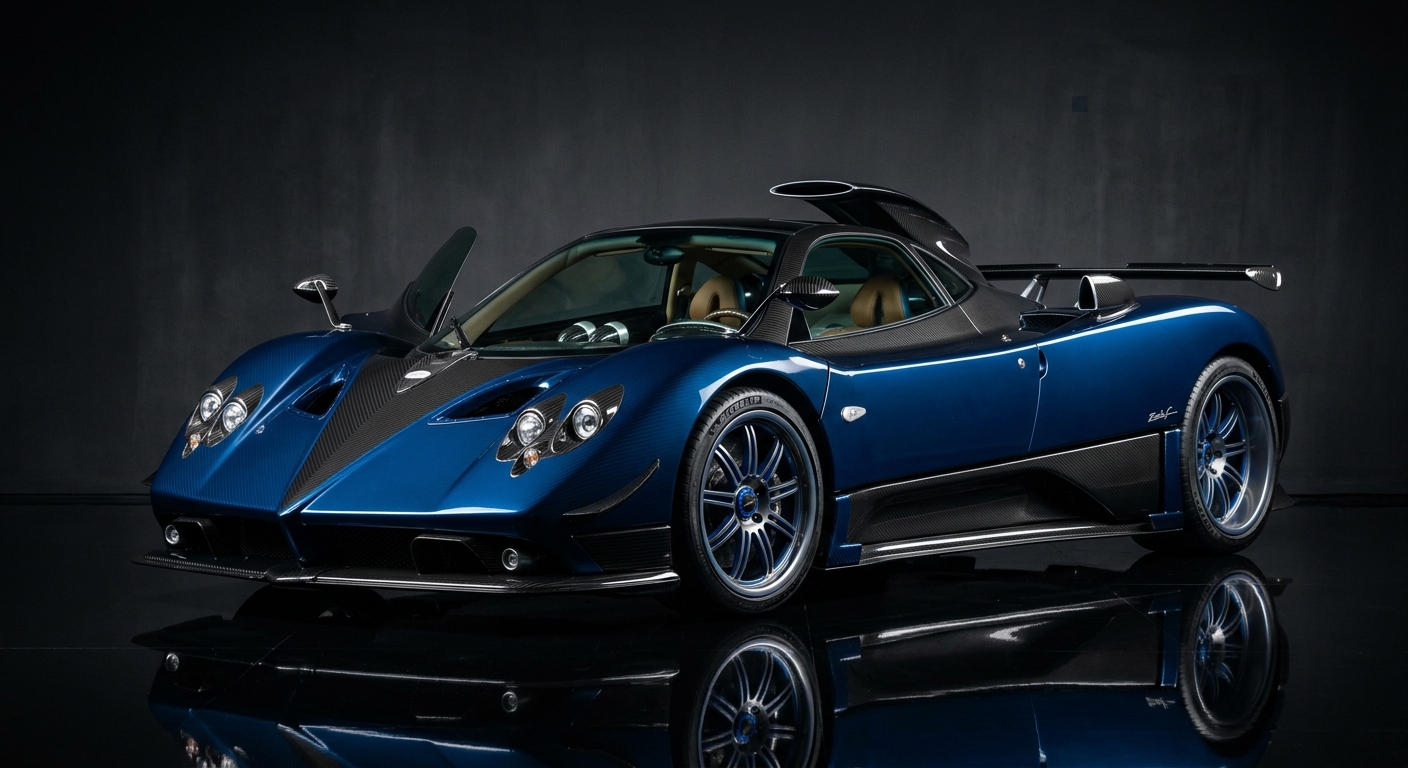
In an era when supercars are increasingly dominated by computers and electronic aids, the 2006 Pagani Zonda F stands as a monument to analog purity. This is Horacio Pagani’s love letter to the golden age of supercars, where driver skill mattered more than launch control algorithms. With its naturally aspirated Mercedes-AMG V12 and deliberately minimal electronic intervention, the Zonda F represents the last gasps of the analog supercar era.
The Artist’s Canvas
Horacio Pagani didn’t just build a supercar with the Zonda F; he sculpted automotive poetry. Every surface tells a story of obsessive attention to detail, from the exposed carbon fiber weave that forms the monocoque to the machined aluminum components that feel more like jewelry than car parts. The F designation wasn’t just marketing speak – it honored Formula 1 legend Juan Manuel Fangio, Pagani’s mentor and inspiration.
The Zonda F’s design philosophy centers on functional beauty. Those dramatic air intakes aren’t just for show – they feed the hungry 7.3-liter V12. The rear spoiler isn’t a styling exercise – it generates genuine downforce. Even the iconic gullwing doors serve a purpose, providing easier access to the carbon fiber cockpit while maintaining structural rigidity.
AMG Thunder
At the heart of the Zonda F beats a Mercedes-AMG masterpiece: a hand-built 7.3-liter naturally aspirated V12 producing 594 horsepower and 560 lb-ft of torque. This isn’t just an engine; it’s a mechanical symphony that builds to a crescendo at 7,500 rpm. The sound alone justifies the Zonda F’s existence – a raw, unfiltered wail that modern turbocharged mills simply cannot replicate.
Power delivery is linear and predictable, building progressively rather than hitting you with a sudden turbo surge. The six-speed manual transmission connects you directly to that AMG V12, with a gated shifter that requires deliberate, mechanical inputs. No paddle shifters, no dual-clutch wizardry – just pure mechanical connection between driver and machine.
Track-Focused Dynamics
The Zonda F wasn’t designed to coddle its occupants. The suspension setup prioritizes track performance over comfort, with adjustable dampers and anti-roll bars allowing fine-tuning for different circuits. The steering lacks power assistance, demanding real muscle input at low speeds but rewarding drivers with unfiltered feedback at track velocities.
Weighing just 2,976 pounds, the Zonda F achieves a power-to-weight ratio that modern hypercars still chase. Carbon fiber construction keeps mass low while maintaining incredible rigidity. The result is a car that changes direction with telepathic precision, rewarding smooth inputs and punishing ham-fisted driving.
Cockpit Artistry
Step inside the Zonda F and you enter Pagani’s vision of automotive luxury. Every surface showcases the finest materials: exposed carbon fiber, hand-stitched leather, and machined aluminum controls that feel like precision instruments. The dashboard layout prioritizes function, with analog gauges providing critical information at a glance.
The driving position is pure sports car, with a low-slung seat that holds you in place during aggressive cornering. Visibility is surprisingly good for a mid-engine supercar, though the dramatic styling does create some blind spots. Climate control and creature comforts exist, but they’re clearly secondary to the driving experience.
Rarity and Legacy
With only 25 Zonda F coupes produced, exclusivity comes standard. Each car was essentially hand-built in Pagani’s small Italian facility, with months-long construction processes that emphasized quality over quantity. This rarity, combined with the Zonda’s growing reputation as the last analog supercar, has made the F highly sought after by collectors.
The Zonda F represents the end of an era – the final flowering of naturally aspirated, manually transmitted supercars before electronic aids became mandatory. It’s a time capsule from when driving skill mattered more than computer algorithms, when supercars were built for enthusiasts rather than spec sheet warriors.
The 2006 Pagani Zonda F exists as automotive poetry, a machine that prioritizes emotional connection over clinical perfection. In a world increasingly dominated by electronic interference, Pagani’s masterpiece reminds us why some of us fell in love with supercars in the first place. This is analog perfection at its absolute peak.