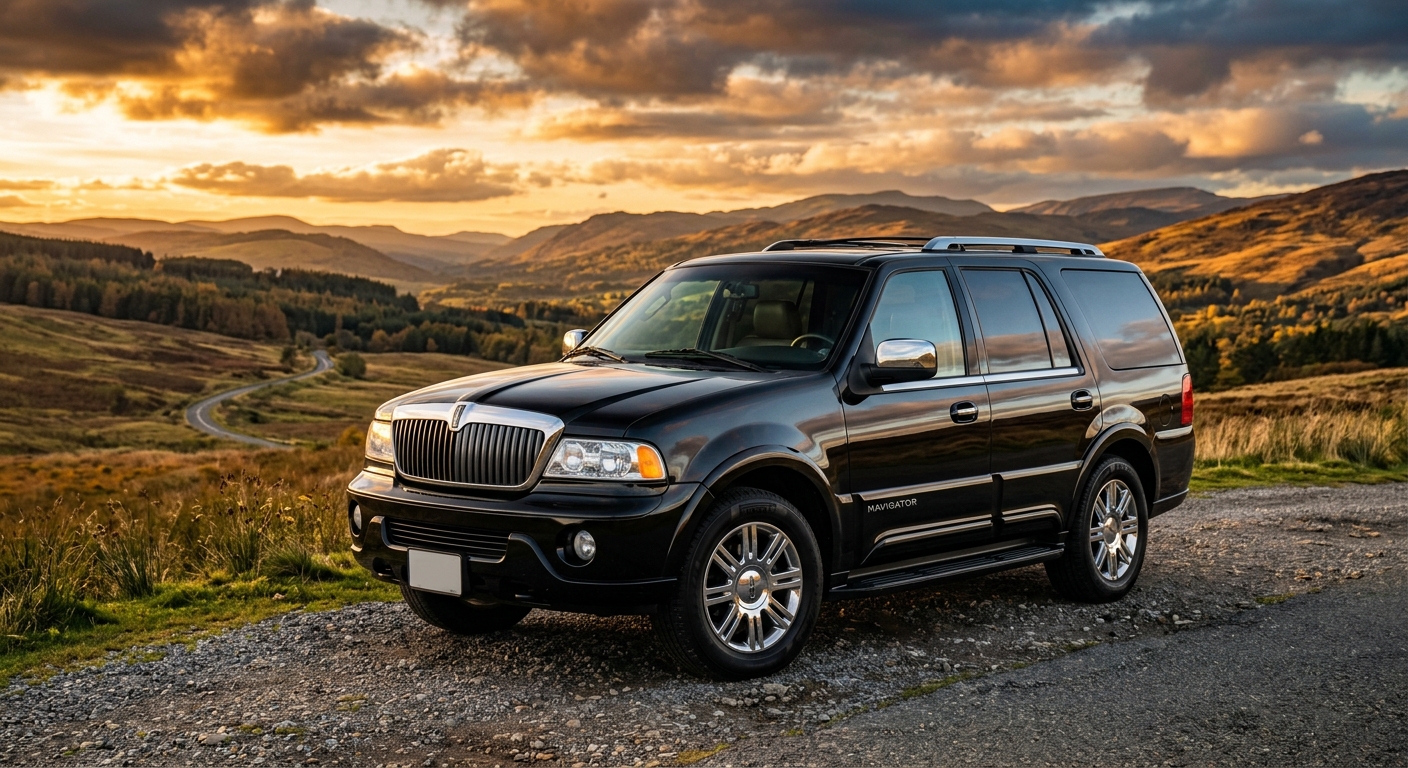
Before the Escalade became a status symbol and the Range Rover conquered suburban driveways, there was the Lincoln Navigator. Launched in 1998 and refined by 2001, this full-size SUV single-handedly created the luxury truck segment that every premium brand now considers essential. Built on Ford’s proven truck platform but wrapped in Lincoln’s most opulent materials, the Navigator proved that Americans wanted their utility vehicles to feel like living rooms on wheels.
The 2001 model year brought subtle refinements to Lincoln’s flagship SUV, including updated interior trim and improved build quality. More importantly, it represented the Navigator at its most confident, before the luxury SUV market became crowded with competitors trying to capture its magic.
Command Performance
Slide behind the wheel of a 2001 Navigator, and you’re immediately struck by the commanding view of the road. The driving position feels more like piloting a ship than driving a car, with expansive glass areas and a dashboard that stretches toward the horizon. The 5.4-liter Triton V8 provides effortless acceleration, moving the Navigator’s considerable bulk with surprising ease. While not exactly sporty, there’s something deeply satisfying about the smooth, linear power delivery and the subtle V8 rumble that accompanies acceleration.
The four-wheel-drive system operates transparently, automatically shifting torque where needed without drama or fuss. On highway cruises, the Navigator settles into a relaxed gait that makes mile-eating effortless. The suspension soaks up road imperfections with the kind of isolated comfort that luxury car buyers expect, though enthusiastic cornering reveals the laws of physics still apply to three-ton vehicles.
Living Room on Wheels
Step inside the Navigator’s cabin, and you’ll find what was genuinely revolutionary for 2001: truck capability wrapped in genuine luxury. The leather seats are plush and supportive, with power adjustments and heating that work intuitively. The second row offers limousine-like space, while the third row actually accommodates adults for short trips. Climate control reaches every corner of the cabin, and the premium audio system delivers concert-quality sound.
Lincoln didn’t just add leather to a truck interior; they completely reimagined what a utility vehicle could be. Real wood trim, soft-touch surfaces, and attention to detail that rivals contemporary luxury sedans created an environment that felt special rather than utilitarian. The cargo area, when not occupied by passengers, swallows family vacation gear with room to spare.
Cultural Impact
The Navigator’s influence extends far beyond its mechanical specifications. It created the template for the modern luxury SUV: body-on-frame construction for capability, truck-based V8 power for effortless performance, and car-like luxury appointments for daily comfort. Every luxury SUV since has followed this basic formula, from the Cadillac Escalade to the Range Rover Sport.
More than just transportation, the Navigator became a cultural statement. It represented American optimism and prosperity at the turn of the millennium, when gas was cheap and bigger was universally considered better. The Navigator didn’t apologize for its size or thirst; it celebrated them as features rather than compromises.
The Competition Responds
By 2001, other luxury brands were scrambling to match Lincoln’s success. Cadillac would launch the Escalade in 1999, though early versions felt more like rebadged Tahoes than genuine luxury vehicles. Mercedes-Benz and BMW were still years away from their full-size SUV offerings. The Navigator had established the beachhead and was enjoying the spoils of being first to market with a genuinely compelling product.
What set the Navigator apart wasn’t just its luxury appointments, but how seamlessly Lincoln integrated them into a capable truck platform. This wasn’t a car pretending to be a truck or a truck pretending to be a car; it was something entirely new that happened to excel at both missions.
The 2001 Lincoln Navigator stands as proof that sometimes being first is more important than being fastest. It created a market segment that didn’t exist and established Lincoln as a legitimate player in the luxury game for a brief, shining moment. While later competitors may have surpassed it in refinement or capability, none matched its pioneering spirit or cultural impact. This is American luxury at its most unapologetic.