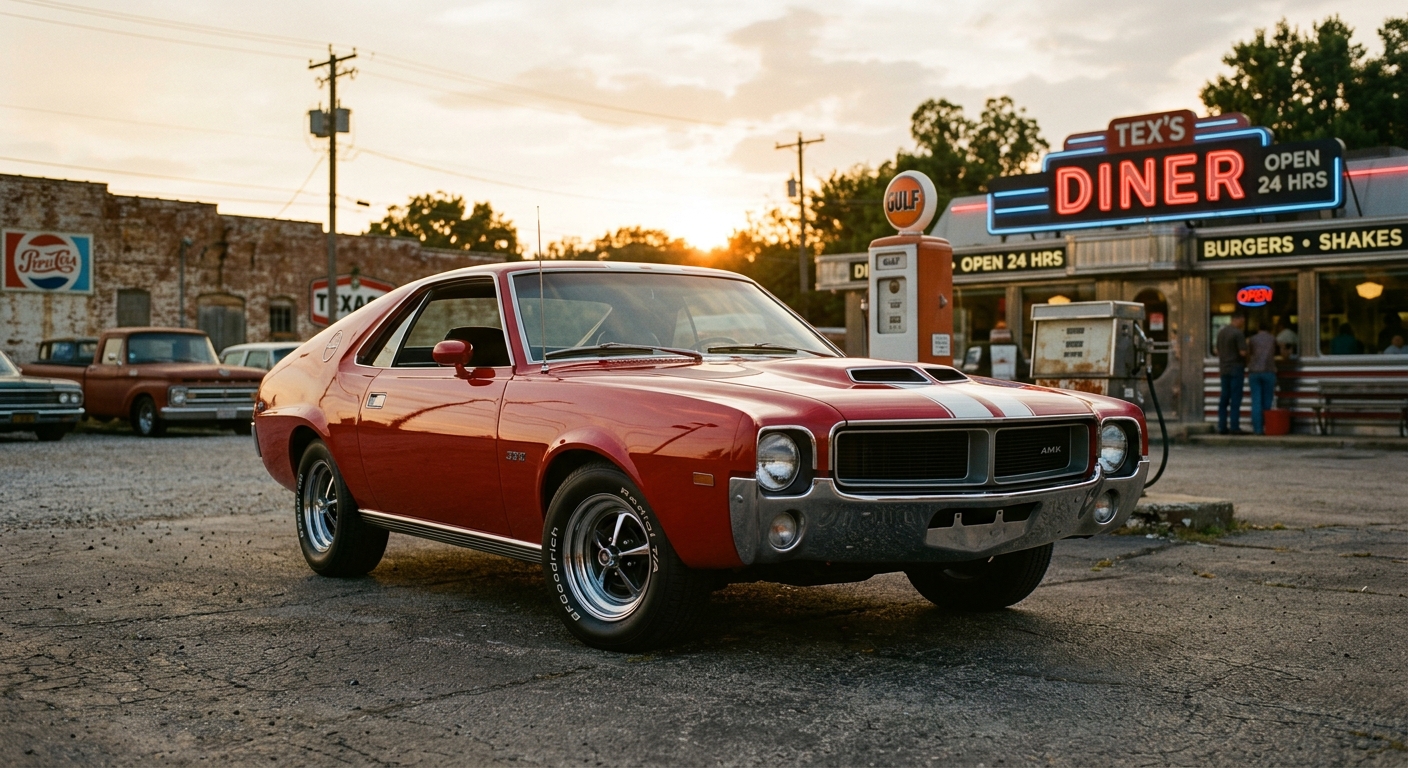
In 1969, when most of Detroit was playing it safe with conventional four-seat muscle cars, American Motors Corporation threw caution to the wind and created something truly audacious: a two-seat sports car that could go toe-to-toe with Chevrolet’s Corvette. The AMX wasn’t just another pretty face in the muscle car crowd; it was a bold statement from a company that had everything to prove and nothing to lose.
Built on a shortened Javelin platform, the AMX represented AMC’s most ambitious attempt to shed its economy car image and compete with the performance giants of the era. With its aggressive stance, distinctive styling, and potent V8 power, the AMX carved out a unique niche in the American automotive landscape that has never been replicated.
Design That Dared to Be Different
The AMX’s visual impact was immediate and undeniable. Dick Teague’s design team created a car that looked like it was moving even while standing still, with a long hood, short deck proportions that perfectly captured the classic American sports car aesthetic. The distinctive side exhaust outlets, aggressive front air dam, and subtle rear spoiler weren’t just styling exercises; they were functional elements that hinted at the performance lurking beneath the surface.
What set the AMX apart from its contemporaries wasn’t just its looks, but its proportions. At 97 inches, the wheelbase was a full 12 inches shorter than the Javelin’s, creating a taut, purposeful stance that communicated serious intent. The wide track and low profile gave the AMX a planted, athletic appearance that backed up its performance credentials.
Heart of a Warrior
The 1969 AMX’s standard powerplant was AMC’s robust 290 cubic inch V8, but the real excitement came with the optional engines. The 343 V8 provided spirited performance, but it was the top-tier 390 cubic inch V8 that transformed the AMX into a legitimate muscle car contender. Producing 315 horsepower and 425 lb-ft of torque, the 390 could propel the relatively lightweight AMX from 0-60 mph in just 6.6 seconds.
The engine’s character was distinctly different from the high-revving small blocks favored by other manufacturers. The 390 was a torque monster that delivered its power in a smooth, relentless wave that perfectly suited the AMX’s grand touring pretensions. Mated to either a four-speed manual or three-speed automatic transmission, the powertrain provided flexibility for both spirited driving and comfortable cruising.
Racing Heritage
AMC didn’t just build the AMX for show; they proved its mettle on racetracks across America. The company’s racing program, spearheaded by legendary driver Mark Donohue, demonstrated that the AMX could compete with the best sports cars of its era. The racing success wasn’t just about bragging rights; it provided valuable real-world testing that improved the production cars.
The track-bred improvements included enhanced cooling systems, stronger transmissions, and suspension tweaks that found their way into the street cars. This racing pedigree gave AMX owners the satisfaction of knowing their cars shared DNA with genuine competition vehicles.
Driving Experience
Behind the wheel, the 1969 AMX delivered an experience that was uniquely American yet surprisingly sophisticated. The driving position was excellent, with supportive bucket seats and well-placed controls that made the driver feel immediately at home. The steering was precise for the era, offering good feedback and reasonable effort levels for parking lot maneuvers.
The suspension struck an admirable balance between comfort and performance. While it couldn’t match the razor-sharp handling of European sports cars, the AMX provided a distinctly American interpretation of the sports car experience: fast, comfortable, and confidence-inspiring on both highways and twisty back roads.
Legacy and Rarity
The AMX’s production run was brief but significant. Built from 1968 to 1970, with 1969 representing the model’s peak year, the AMX proved that innovation and ambition could come from unexpected corners of the automotive world. Today, these cars represent one of the most interesting chapters in American automotive history, combining rarity with genuine performance credentials.
For collectors and enthusiasts, the 1969 AMX offers something special: a chance to own a piece of automotive rebellion. It’s a car that dared to challenge the established order and largely succeeded, creating a legacy that continues to inspire automotive enthusiasts more than five decades later.
The 1969 AMC AMX stands as proof that automotive greatness can emerge from the most unlikely places. While AMC may have lacked the resources of the Big Three, they more than compensated with vision, creativity, and sheer determination. Today, the AMX remains one of America’s most distinctive and underappreciated sports cars, offering collectors the rare opportunity to own a piece of genuine automotive rebellion.