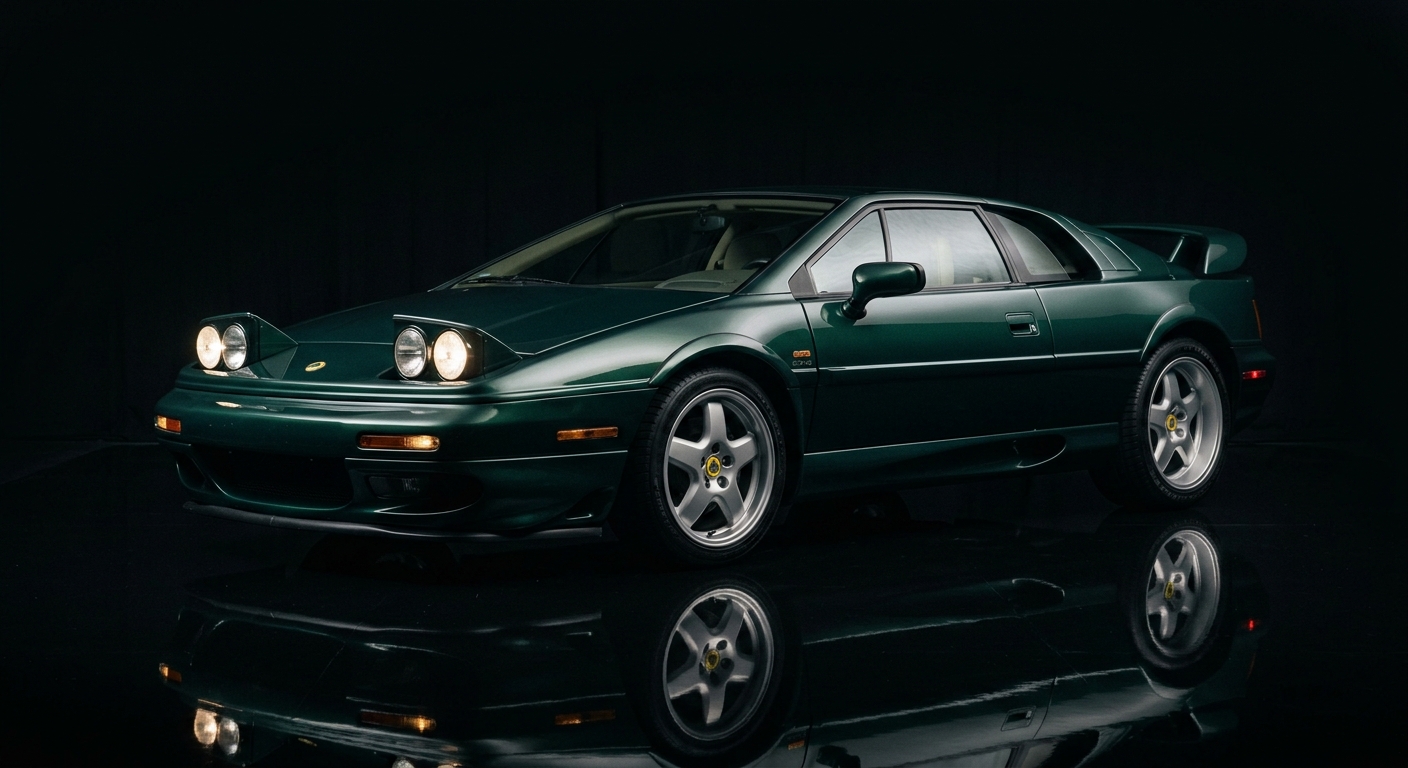
By 1994, the Lotus Esprit had evolved into something extraordinary. What began as Giugiaro’s angular vision in the 1970s had matured into the S4s, a car that represented the absolute pinnacle of the wedge-shaped supercar era. This wasn’t just another iteration of Colin Chapman’s mid-engine masterpiece, it was the distillation of two decades of refinement into 264 turbocharged horsepower wrapped in fiberglass poetry.
The Last of the True Believers
The S4s arrived at a pivotal moment in automotive history. While competitors were embracing electronic aids and computer-controlled everything, Lotus doubled down on their core philosophy: add lightness, subtract complexity. At just 2,950 pounds, the S4s was a featherweight compared to its contemporaries, yet it packed enough punch to embarrass cars costing twice as much.
The heart of the S4s was Lotus’s own 2.2-liter turbocharged four-cylinder, producing 264 horsepower and 261 lb-ft of torque. These numbers might seem modest by today’s standards, but in a car this light, they translated to genuine supercar performance. The turbo didn’t just add power; it added character, with a distinctive whoosh and surge that became part of the driving experience.
Driving the Dream
Behind the wheel of an S4s, you immediately understand what made Lotus special. The driving position is low and purposeful, with excellent visibility through the large greenhouse. The steering is unassisted and utterly alive, transmitting every nuance of the road surface directly to your palms. This is analog feedback in its purest form, something increasingly rare even by 1994 standards.
The engine comes alive with a distinctive four-cylinder growl that builds to a crescendo as the turbo spools up. Power delivery isn’t linear, it’s theatrical. There’s a momentary pause as you plant your foot, then the boost builds and launches you forward with surprising violence. The sensation is intoxicating, a reminder of when turbos were wild, unpredictable beasts rather than smooth, sanitized power adders.
Corner Carving Excellence
Where the S4s truly shines is in the corners. The mid-engine layout provides exceptional balance, while the relatively narrow tires and lack of electronic aids create a pure, unfiltered connection between driver and machine. You can feel exactly what each wheel is doing, sense the weight transfer, and adjust your inputs accordingly. It’s a level of communication that modern supercars, for all their speed and sophistication, struggle to match.
The suspension strikes an excellent balance between comfort and control. It’s firm enough for serious canyon carving yet compliant enough for daily driving duties. The car feels alive beneath you, constantly communicating its limits and encouraging you to explore them.
The Final Flourish
The S4s represented the end of an era for Lotus. Soon, the company would abandon the Esprit’s distinctive wedge shape for more conventional curves, and the analog purity that defined cars like this would give way to electronic sophistication. In many ways, the S4s was Lotus’s farewell letter to the supercar purists who believed that connection trumped perfection.
Today, the S4s occupies a unique position in automotive history. It’s not the fastest Esprit ever made, nor the most refined. But it might be the most honest, a car that delivered everything Lotus promised: lightweight construction, brilliant handling, and an emotional connection that transcended mere transportation.
The S4s stands as a monument to analog purity in an increasingly digital world, delivering raw driving emotion that modern supercars can only dream of replicating. This is Lotus at their absolute best: lightweight, focused, and utterly intoxicating. For those seeking genuine connection over clinical perfection, few cars have ever done it better.