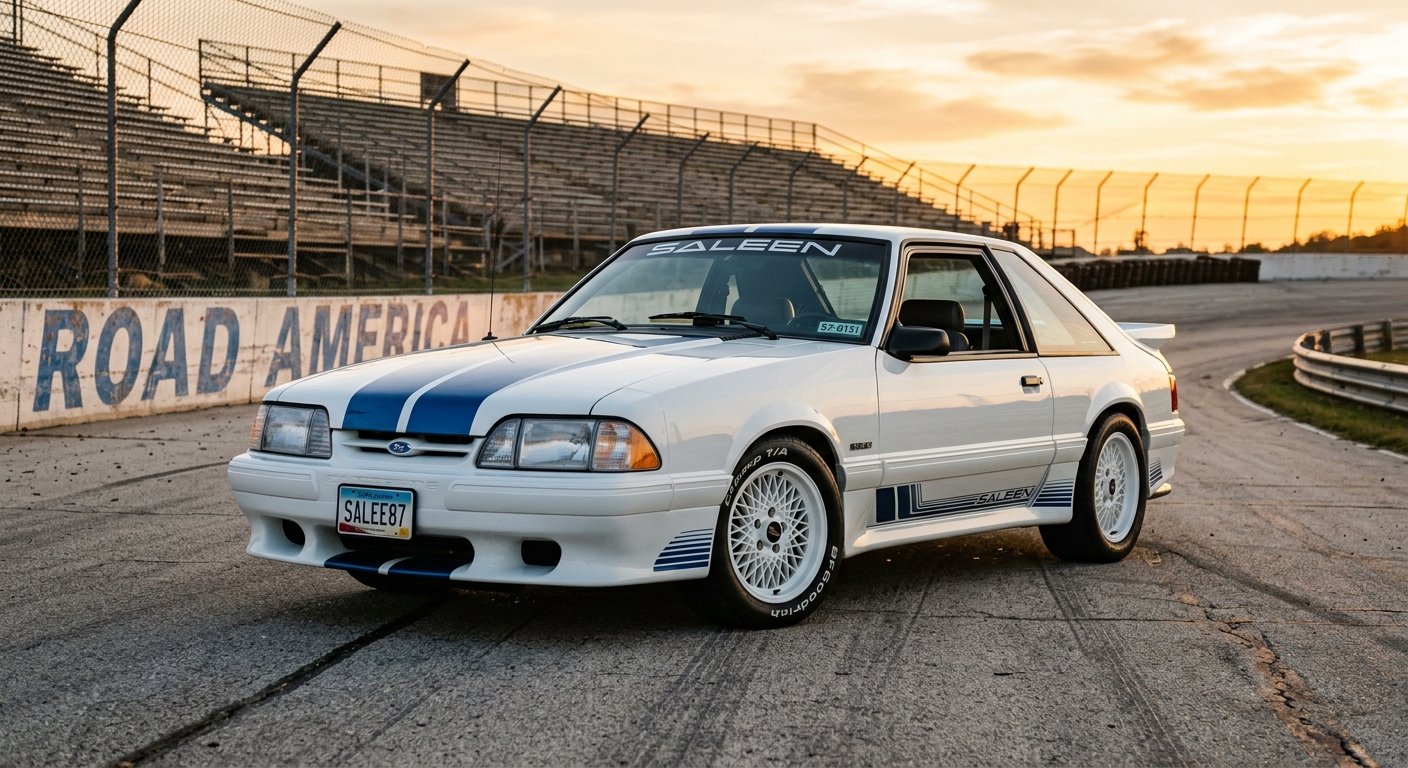
In 1987, while Detroit’s automakers were still figuring out how to build proper performance cars in the post-malaise era, a former race car driver named Steve Saleen was quietly revolutionizing what a small-volume manufacturer could achieve. His modified Mustangs weren’t just cosmetic exercises, they were comprehensive reimaginings of Ford’s pony car that delivered genuine supercar-level performance wrapped in distinctly American sheet metal.
The 1987 Saleen Mustang represented the third year of Steve Saleen’s ambitious project to transform Ford’s Fox-body platform into something that could embarrass Ferraris and Porsches on both road and track. With only 146 examples built that year, each car was essentially hand-assembled in Saleen’s California facility, receiving extensive modifications that touched every aspect of the driving experience.
Racing DNA in Street Clothes
What separated Saleen’s approach from other tuners of the era was his racing background. Steve Saleen had competed professionally, understanding that true performance required more than just horsepower. The 1987 model received a comprehensively reworked suspension with revised spring rates, Bilstein dampers, and carefully engineered geometry changes that transformed the Fox-body’s notorious handling quirks into genuine sports car precision.
The aerodynamic package wasn’t merely for show either. The front air dam, side skirts, and rear spoiler were developed through actual wind tunnel testing, reducing lift and improving high-speed stability. At a time when most aftermarket body kits were purely cosmetic, Saleen’s modifications delivered measurable performance benefits.
Power with Purpose
Under the hood, Ford’s 5.0-liter V8 received careful attention rather than brute force modifications. Saleen’s engineers focused on breathing improvements, installing a cold air induction system, headers, and a performance exhaust that raised output to approximately 290 horsepower. More importantly, the power delivery was refined, with improved throttle response and a broader torque curve that made the car more usable in real-world driving.
The five-speed manual transmission was retained but received improved shift linkage and a more aggressive final drive ratio. The result was a car that could accelerate from 0-60 mph in under 6 seconds, impressive performance for 1987 that put it in company with European exotics costing twice as much.
Interior Refinement
Inside, Saleen addressed the Fox-body’s typically spartan interior with leather upholstery, custom gauges, and sport seats that provided genuine support during aggressive driving. The attention to detail extended to small touches like embroidered Saleen logos and unique trim pieces that distinguished these cars from standard Mustangs.
The driving position was excellent, with the added gauges providing useful information about engine vitals. Unlike many modified cars of the era, the Saleen retained full functionality of all standard equipment while adding performance-oriented features.
Track-Bred Handling
On the road, the 1987 Saleen Mustang felt like a completely different animal than the standard Fox-body. The suspension modifications eliminated the floaty, disconnected feel that plagued many American performance cars of the era. Instead, the Saleen offered precise steering feedback, controlled body motions, and genuine confidence-inspiring handling that could exploit the available power.
The braking system, upgraded with larger rotors and performance pads, provided strong stopping power with excellent pedal feel. This was crucial, as the increased performance capabilities demanded equally impressive deceleration.
Cultural Impact
The significance of cars like the 1987 Saleen Mustang extends beyond their performance specifications. They proved that small, specialized manufacturers could deliver world-class performance cars using American components and engineering. This paved the way for the boutique performance car industry that would flourish in subsequent decades.
Steve Saleen’s approach of comprehensive vehicle development, rather than simple modifications, established a template that influenced countless tuners and small-volume manufacturers. The attention to detail and racing-derived engineering credibility set these cars apart from typical aftermarket offerings.
The 1987 Saleen Mustang stands as proof that vision and expertise can transform an ordinary platform into something extraordinary. With values still reasonable compared to European exotics of the era, these cars represent both automotive history and genuine driving pleasure. Steve Saleen’s boutique approach created something Detroit couldn’t: a true driver’s car with American soul and European precision.