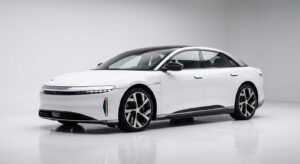
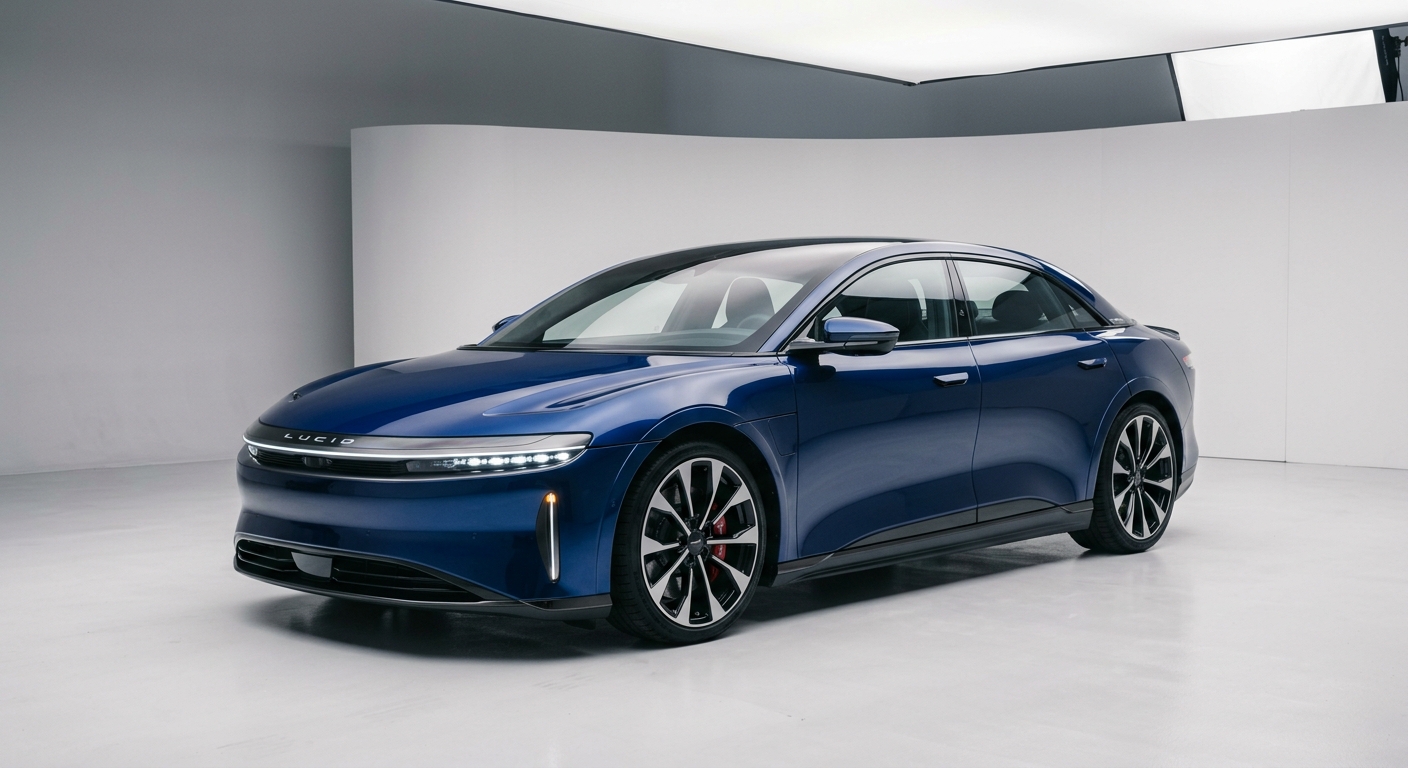
There’s something almost unsettling about the way the Lucid Air Sapphire accelerates. It doesn’t roar or snarl like traditional supercars, instead delivering its 1,234 horsepower with the clinical precision of a particle accelerator. This is what happens when Silicon Valley engineering meets luxury sedan ambitions, creating something that makes a Tesla Model S Plaid seem quaint.
The Physics of Brutality
The Sapphire’s tri-motor setup is a masterclass in electric propulsion engineering. Two motors drive the rear wheels independently, while a single unit handles the front, creating a sophisticated torque-vectoring system that can shift power between wheels in milliseconds. The result is a 2.8-second sprint to 60 mph that feels less like acceleration and more like teleportation.
What sets the Sapphire apart from other electric rockets isn’t just raw power, but how that power is delivered. The sophisticated suspension system, borrowed from Lucid’s motorsport ambitions, keeps this 5,200-pound sedan planted through corners that would upset lesser machines. The carbon-ceramic brakes, essential given the performance envelope, provide stopping power that matches the acceleration drama.
Range Anxiety? What Range Anxiety?
Despite packing enough power to embarrass most hypercars, the Sapphire still manages over 400 miles of EPA range thanks to Lucid’s industry-leading efficiency technology. The 118-kWh battery pack, coupled with the company’s advanced thermal management system, proves that performance and practicality need not be mutually exclusive in the electric age.
Charging capabilities are equally impressive, with the Sapphire supporting up to 300kW DC fast charging. This means adding 200 miles of range in about 12 minutes under optimal conditions, making long-distance luxury touring a genuine possibility rather than an exercise in route planning around charging infrastructure.
Luxury Redefined
Step inside the Sapphire and you’re greeted by an interior that rivals anything from Stuttgart or Munich. The cabin features premium materials throughout, from the sustainably sourced leather to the real wood trim that feels substantial rather than decorative. The 34-inch curved Glass Cockpit display serves as command central, running Lucid’s intuitive UX system that actually enhances the driving experience rather than complicating it.
Rear passengers are treated to executive-level accommodations, with massage seats, individual climate controls, and enough legroom to shame traditional luxury sedans. The glass roof creates an airy atmosphere that makes the cabin feel even more spacious than its generous dimensions suggest.
The Driving Experience
On the road, the Sapphire offers multiple personalities. In its most aggressive Track mode, it becomes a barely civilized missile that can lap circuits with serious sports cars. Dial things back to Smooth mode, and it transforms into a whisper-quiet luxury cruiser that glides over broken pavement with supernatural composure.
The steering is precise without being overly heavy, providing just enough feedback to communicate what the front wheels are doing without transmitting unwanted road imperfections. The ride quality strikes an impressive balance between comfort and control, never feeling disconnected from the road despite its luxury pretensions.
The 2024 Lucid Air Sapphire represents a paradigm shift in what we expect from luxury performance sedans. It delivers hypercar acceleration wrapped in a package that can comfortably transport four adults across continents. This is the future of high-performance motoring, and it’s arrived ahead of schedule.