
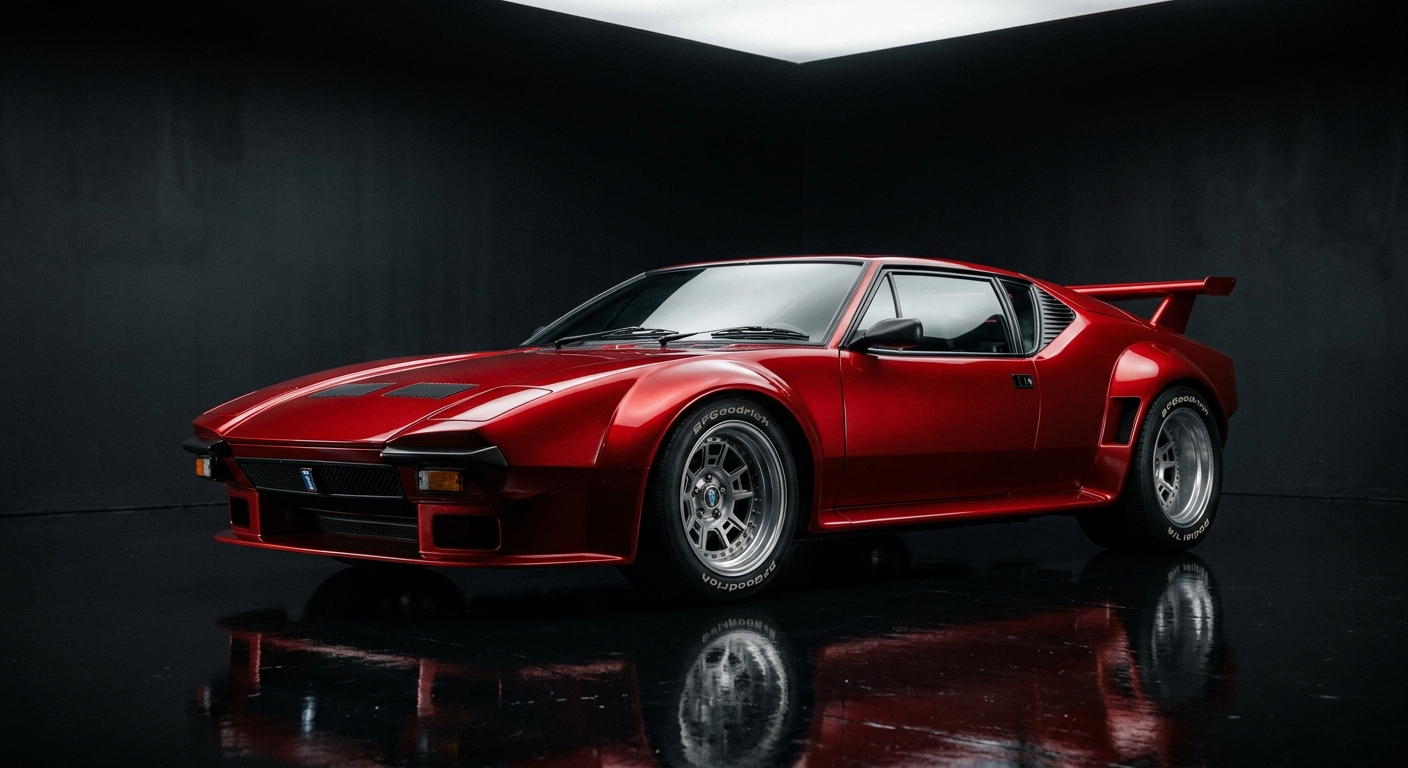
In the dying days of the original supercar era, when turbocharged excess was giving way to electronic sophistication, De Tomaso delivered one final statement of analog brutality. The Pantera GT5-S represented the ultimate evolution of Alejandro de Tomaso’s mad science experiment: stuffing Ford’s biggest V8 into a mid-engine Italian exotic and seeing what happened.
The Final Evolution
By 1987, the Pantera had been in production for nearly two decades, evolving from Marcello Gandini’s original sleek wedge into something far more extreme. The GT5-S took the already wild GT5 and turned the aggression up to 11, with flared fenders that could house aircraft landing gear and a front splitter that looked ready to carve up the tarmac.
Under that dramatically flared bodywork sat Ford’s 351 Cleveland V8, now producing around 350 horsepower in its final configuration. This wasn’t the most powerful engine available in 1987, but in a car weighing just 3,200 pounds and positioned mere inches behind your head, it felt like riding a controlled explosion.
Driving the Beast
Starting a GT5-S is an event. The Cleveland V8 rumbles to life with a sound that’s part muscle car, part exotic, and entirely intimidating. The cabin is tight, with a driving position that puts you low and forward, surrounded by Italian switchgear of questionable reliability but undeniable character.
On the road, the GT5-S delivers an experience that modern supercars have sanitized out of existence. The steering is heavy and communicative, the clutch requires genuine effort, and the throttle response is immediate and violent. There are no electronic aids, no traction control, and no forgiveness for ham-fisted inputs.
The performance is still genuinely quick by today’s standards. That mid-mounted V8 launches the GT5-S from standstill to 60 mph in just 5.2 seconds, with a top speed north of 160 mph. But the numbers don’t capture the visceral nature of the experience: the way the engine note changes as you climb through the revs, the mechanical precision of the gated shifter, or the raw feedback transmitted through every control surface.
The Last of Its Kind
What makes the GT5-S special isn’t just its performance, but its timing. This was arguably the last traditional supercar, built when exotic meant exotic and compromise was a dirty word. No focus groups tested the ergonomics, no safety regulations tamed the design, and no computer simulations optimized the experience.
The build quality reflects its era and price point. Panel gaps vary, electrical systems have moods, and the air conditioning is more suggestion than reality. But these flaws are part of its character, reminders of when supercars were built by small teams of enthusiasts rather than corporate committees.
Legacy and Rarity
De Tomaso built fewer than 250 GT5-S models before ending Pantera production in 1992, making survivors increasingly valuable. Today, clean examples command six-figure sums, with the best cars approaching $200,000. For collectors seeking the ultimate analog supercar experience, few alternatives offer the GT5-S’s combination of rarity, performance, and pure mechanical theater.
The Pantera GT5-S represents the end of an era: when supercars were dangerous, difficult, and absolutely intoxicating. In a world of increasingly sanitized exotics, it stands as a monument to an time when driving fast required genuine skill, considerable courage, and an acceptance that things might go spectacularly wrong.
The Pantera GT5-S is automotive theater at its most dramatic: impractical, uncompromising, and absolutely unforgettable. While modern supercars may be faster and certainly more reliable, none deliver the pure visceral experience of De Tomaso’s final masterpiece. For those brave enough to own one, it offers a direct connection to the last days of the analog exotic, when supercars were genuinely super and more than a little scary.