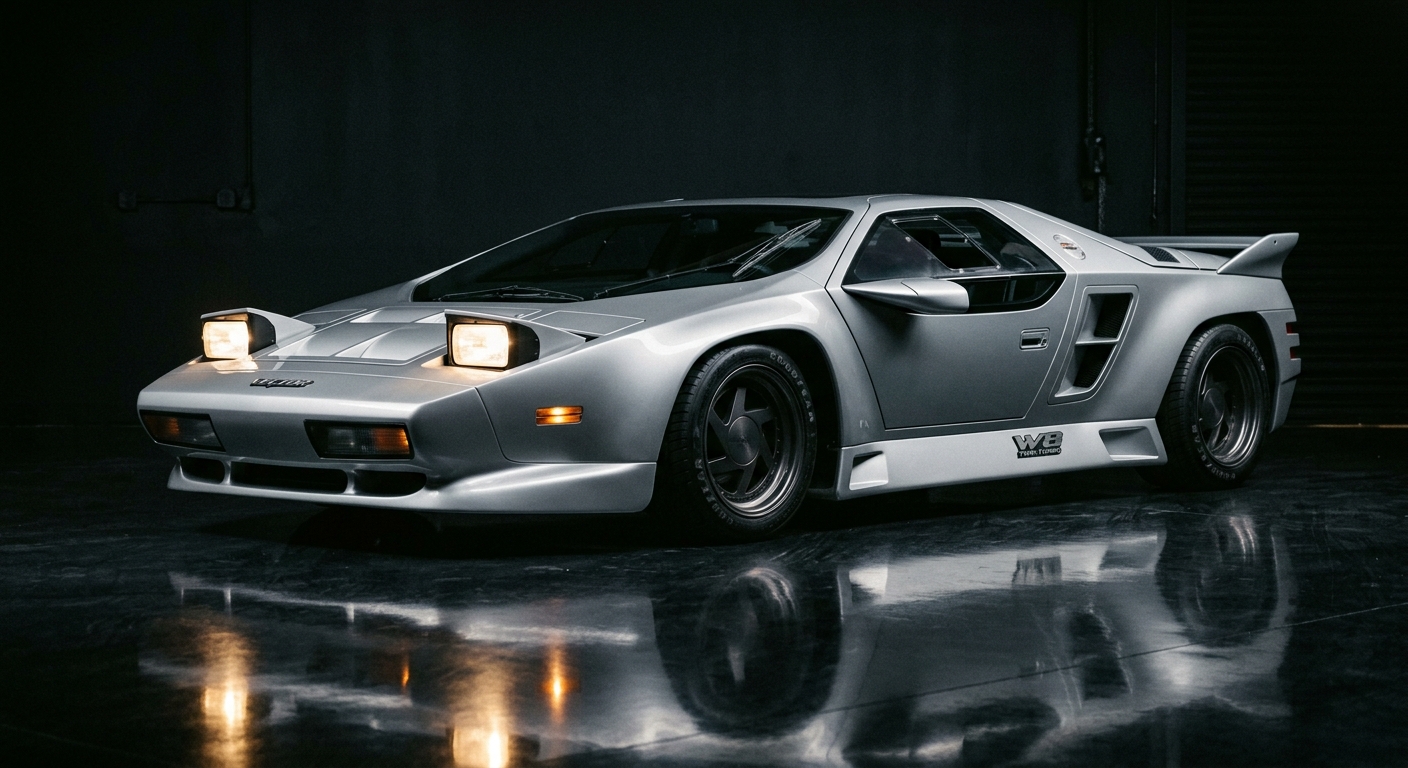
In the early 1990s, when Ferrari and Lamborghini dominated supercar dreams, one American company dared to build something even more outrageous. The Vector W8 wasn’t just different from its European rivals; it was completely unhinged, a rolling testament to American excess wrapped in the most angular bodywork ever to grace four wheels.
The Genesis of Insanity
Vector Aeromotive Corporation, founded by Gerald Wiegert, had one singular mission: to build the fastest, most advanced supercar on Earth. The W8, which finally reached production in 1989 and continued through 1993, represented nearly two decades of development that began with sketches inspired by fighter jets and moon landers.
The design language was unlike anything else on the road. Where Italian exotics flowed with sensuous curves, the W8 attacked the eye with razor-sharp angles and geometric aggression. Every surface was a study in acute geometry, from the knife-edge nose to the truncated Kamm tail. Pop-up headlights sat flush in the wedge-shaped front end, while side vents and scoops were carved into the bodywork with surgical precision.
American Muscle Meets Space Age Tech
Under the W8’s carbon fiber and Kevlar body sat a heavily modified 6.0-liter Chevrolet small-block V8, twin-turbocharged and intercooled to produce a claimed 625 horsepower. This wasn’t just any LS engine swap; Vector’s powerplant featured extensive internal modifications, custom turbocharger systems, and engine management that pushed the boundaries of early 1990s technology.
The transmission was equally exotic: a three-speed GM Turbo-Hydramatic 425 automatic, chosen not for convenience but for its ability to handle massive torque loads. While purists scoffed at the automatic-only configuration, Vector claimed the transmission was the strongest available and perfectly suited to the W8’s brutal power delivery.
Fighter Jet Cockpit
Sliding into the W8’s cockpit was like entering a fighter aircraft. The dashboard featured an array of digital displays, toggle switches, and warning lights that wouldn’t look out of place in an F-16. Aircraft-style seats held occupants firmly in place, while the driving position was extremely low and forward, giving an almost ground-level perspective of the road ahead.
The steering wheel itself was a work of art, featuring a unique semi-rectangular design with integrated controls. Every surface was either brushed aluminum, carbon fiber, or leather, creating an atmosphere that was equal parts luxurious and military-spec functional.
Performance That Matched the Drama
Vector claimed the W8 could reach 60 mph in 4.2 seconds and achieve a top speed of 218 mph, figures that put it in direct competition with the Lamborghini Diablo and Ferrari F40. Independent testing suggested these numbers were optimistic but not entirely fictional; the W8 was genuinely quick, with brutal acceleration accompanied by a soundtrack that mixed turbo whistle with American V8 thunder.
The handling was a mixed bag. The W8’s wide track, low center of gravity, and sophisticated suspension geometry provided impressive grip and stability at speed. However, the car’s extreme proportions and twitchy nature demanded respect and skill from its driver. This wasn’t a forgiving supercar; it was a machine that rewarded precision and punished mistakes.
Rarity and Legacy
Only 19 Vector W8s were ever completed, making it one of the rarest supercars ever built. Production challenges, financial difficulties, and Gerald Wiegert’s perfectionist tendencies combined to keep numbers extremely low. Each car was essentially hand-built, with no two examples being exactly identical.
Today, the W8 stands as a fascinating footnote in automotive history. It proved that American companies could build exotic supercars, even if they couldn’t build them profitably or in meaningful numbers. The car’s extreme design has aged remarkably well, looking more like a concept car from the future than a product of the early 1990s.
The Vector W8 stands as automotive proof that America could build something truly exotic, even if it couldn’t build it affordably or reliably. With only 19 examples ever completed, it remains one of the most exclusive supercars ever made and a fascinating glimpse into what happens when uncompromising vision meets unlimited ambition. For sheer character and visual drama, nothing else has ever looked quite like Gerald Wiegert’s angular fever dream.