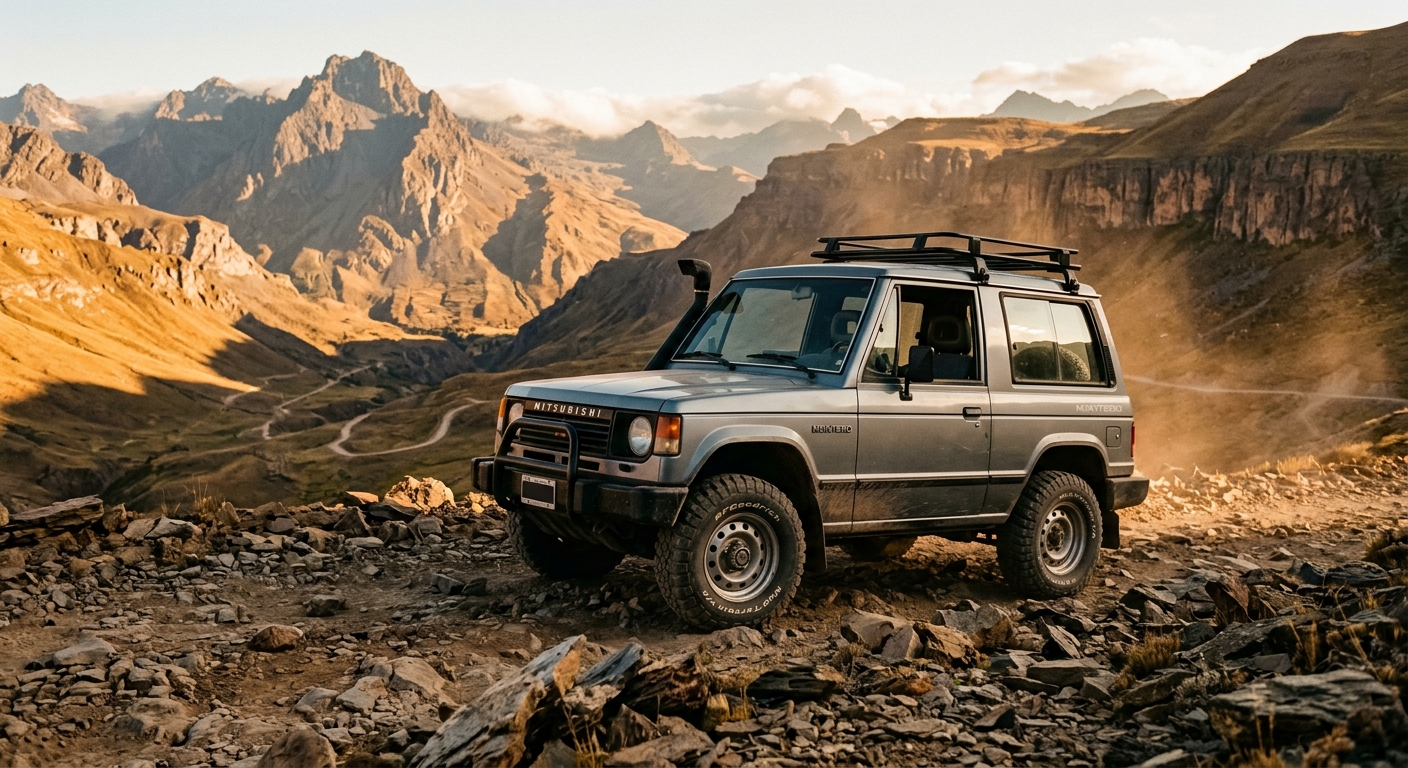
While America was falling in love with the luxurious Range Rover and the utilitarian Chevy Blazer, Japan quietly unleashed an SUV that would redefine what affordable off-road capability could look like. The 1988 Mitsubishi Montero arrived as an unassuming box on wheels, but beneath its pragmatic exterior lay the heart of a Dakar Rally champion and the soul of a mountain goat.
This wasn’t just another pretty face trying to look tough in suburban driveways. The Montero had already proven itself in the world’s most punishing off-road competition, claiming victory in the Paris-Dakar Rally and establishing Mitsubishi as a serious player in the global SUV game.
Rally-Bred Engineering
The Montero’s DNA traces directly back to Mitsubishi’s dominance in rally racing. Unlike many SUVs of its era that started as work trucks and grew creature comforts, the Montero was engineered from the ground up to be both civilized and capable. Its ladder frame construction provided the strength needed for serious off-roading, while independent front suspension offered a ride quality that put many contemporary trucks to shame.
The 2.6-liter four-cylinder engine might seem modest by today’s standards, but in 1988, it represented a sweet spot of reliability and efficiency. Producing 109 horsepower and 142 lb-ft of torque, it was never going to win any drag races, but paired with Mitsubishi’s Super Select 4WD system, it could tackle terrain that would leave more powerful rivals stranded.
Super Select Innovation
What truly set the Montero apart was its pioneering Super Select 4WD system. This wasn’t the crude part-time 4WD found in most trucks of the era. Instead, Mitsubishi offered four distinct drive modes: 2WD for normal driving, 4H for slippery conditions on pavement, 4HLc with a locked center differential for serious off-road work, and 4LLc for rock crawling with low-range gearing engaged.
This system gave the Montero a versatility that few competitors could match. You could drive to the trailhead in comfortable 2WD mode, engage 4H for forest service roads, and switch to 4LLc when the going got truly tough, all without leaving the driver’s seat.
Interior Pragmatism
Step inside the 1988 Montero and you’re greeted by an interior that prioritizes function over flash. The dashboard is a study in Japanese efficiency, with clearly marked controls and a layout that makes sense even when you’re bouncing through boulder fields. The seats, while not luxurious, provide good support during long off-road sessions and fold flat to create a surprisingly spacious cargo area.
What the Montero lacked in premium materials, it made up for in thoughtful design. Cup holders were properly positioned, storage cubbies were placed where you’d actually use them, and the rear seats could accommodate actual humans rather than serving as mere gestures toward passenger capacity.
Real-World Capability
Behind the wheel, the Montero reveals its true character on challenging terrain. The steering is direct and communicative, letting you feel exactly what the front wheels are encountering. Ground clearance is generous, approach and departure angles are well-sorted, and the relatively compact dimensions make it easier to thread through tight trails than larger American SUVs.
The engine, while never exciting, proves remarkably robust and willing to rev. It’s the sort of powerplant that might not impress at a stoplight but will faithfully haul you up mountain passes for decades without complaint. The five-speed manual transmission (an automatic was available but rarely chosen by serious off-roaders) offers precise shifts and good gear spacing for both highway cruising and technical crawling.
Dakar Dominance
The Montero’s competition credentials weren’t just marketing fluff. Mitsubishi’s rally team used lightly modified versions of the production SUV to dominate the Paris-Dakar Rally throughout the 1980s, winning the event multiple times and proving that Japanese engineering could conquer the world’s toughest automotive challenge.
This racing success wasn’t just about bragging rights; it validated the Montero’s fundamental design philosophy. While other manufacturers built separate platforms for racing and road use, Mitsubishi demonstrated that their production SUV was tough enough to handle the Sahara Desert with minimal modifications.
The 1988 Mitsubishi Montero stands as proof that capability doesn’t require complexity or premium pricing. While its 109 horsepower won’t impress anyone today, its pioneering Super Select 4WD system and rally-proven durability created an SUV that could tackle serious terrain without breaking the bank or your back. It may not have the cachet of a Range Rover or the brute force of a Bronco, but the Montero delivered exactly what it promised: honest, reliable adventure in an unpretentious package.