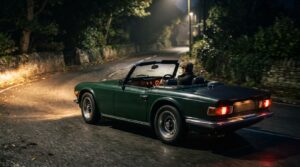
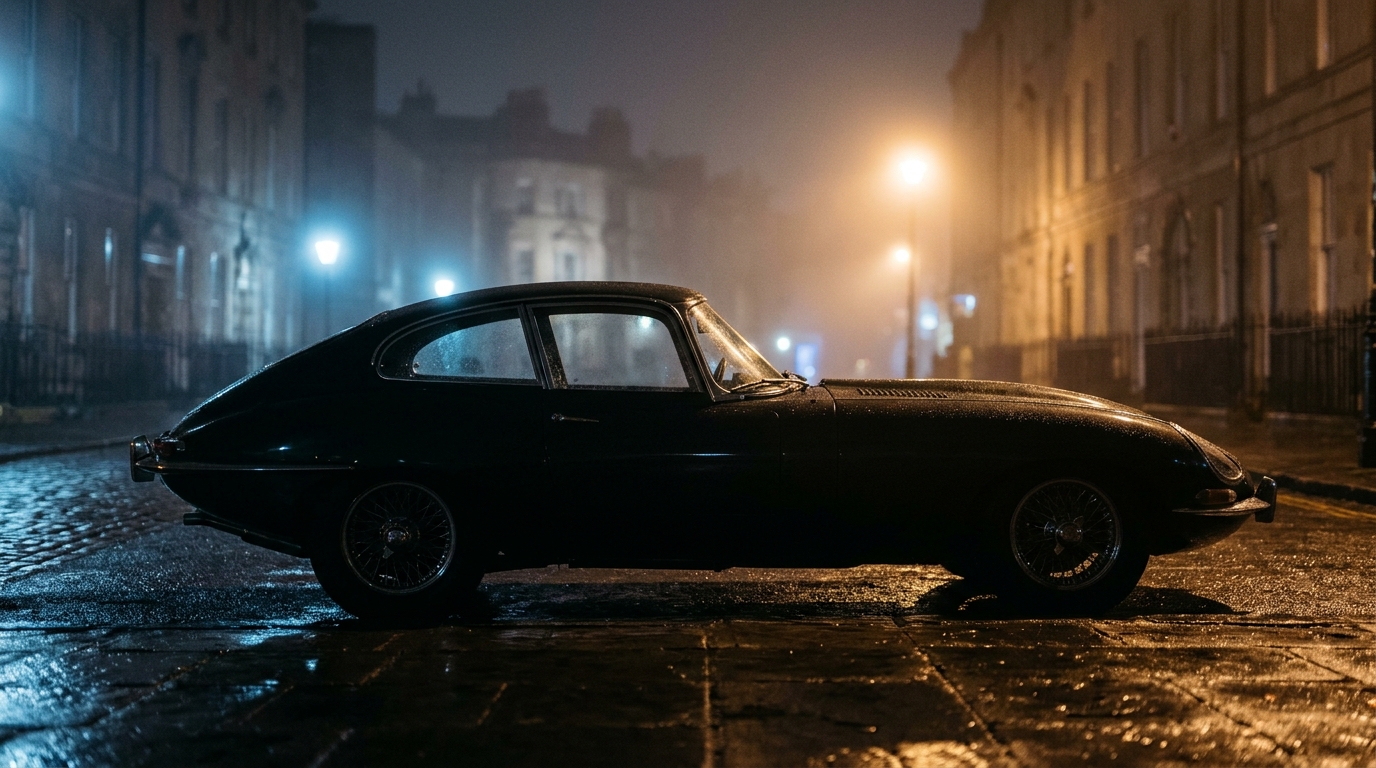
Somewhere past midnight, with the rain just stopped and the streetlights smearing orange across the asphalt, a 1965 E-Type does something no modern car can: it turns an empty road into a film set. That long, impossibly low bonnet catches every glimmer of sodium light and throws it back like liquid, and you realize you are driving a shape that was designed to be seen at exactly this hour.
The Shape That Owns the Dark
Enzo Ferrari reportedly called the E-Type the most beautiful car ever made, and nowhere does that claim feel more convincing than after sunset. Aerodynamicist Malcolm Sayer, who came to Jaguar from the aircraft industry, shaped the body using mathematical curves rather than clay and intuition. The result is a profile of pure tension: a tapering tail, a bonnet that seems to stretch toward the next county, and not a single straight line on the whole car. Under a streetlamp, the highlights roll along the body in one unbroken ribbon. Park it by a kerb at night and people will walk across the road to look at it.
The 1965 model year is a special one. This is the Series 1 at its most refined, still wearing the covered headlamps, slim chrome bumpers and delicate tail lights that purists treasure, but now fitted with the larger 4.2-litre engine introduced in October 1964. It sits in the sweet spot before the safety-driven changes of the late 1960s.
Headlights Behind Glass
Those faired-in headlamps are both a styling triumph and a night-driving quirk. The perspex covers keep the nose smooth, but they add a layer of glass between the bulb and the road, and the era’s sealed-beam units were modest by today’s standards. Expect a warm, yellowish pool of light that illuminates well enough for a spirited drive but never feels generous. You learn to read the road earlier, to trust the car’s balance, and to keep your speed honest on unlit country lanes. A few owners fit modern LED or halogen conversions for safety, but the original character, a soft amber glow dancing ahead of that long bonnet, is part of the romance.
The cockpit at night is equally evocative. Chrome-ringed dials glow dimly, the toggle switches are set in a brushed aluminium-look panel, and the thin, large-diameter wood-rimmed wheel falls naturally into your hands. Everything is low, snug and theatrical.
The 4.2 and Its Soundtrack
The 1965 car’s heart is the 4.2-litre XK straight-six, a twin-overhead-cam design with roots stretching back to 1948. For the 4.2 Jaguar kept the 3.8’s 3,781cc design philosophy but increased displacement to 4,235cc by lengthening the stroke and boring the block. The quoted output remained 265 bhp (SAE gross) at 5,400 rpm, but torque rose to around 283 lb-ft at 4,000 rpm, giving the engine a notably fatter midrange. Three SU HD8 carburettors feed it, and when you roll onto the throttle in the quiet of the night, the induction howl and the metallic bark from the twin exhausts bounce off every wall and hedgerow. At night, with the world asleep, that sound feels enormous.
The other major upgrade in this period was the gearbox. The 4.2 replaced the old Moss unit, which had no synchromesh on first gear, with a fully synchronised all-synchro four-speed. It is a vast improvement: shifts are positive and far more forgiving, and first gear no longer requires an apology. Brakes also improved, with a new Girling servo-assisted system replacing the earlier Dunlop setup, which matters when a spooked deer appears at the edge of the headlights.
On the Road After Dark
The E-Type’s independent rear suspension, with its inboard rear discs and double wishbones, was revolutionary in 1961 and still delivers a surprisingly supple ride. At night, on empty roads, the car feels light and communicative. The steering, a rack-and-pinion setup with plenty of lock, is chatty through the thin rim. Body roll is present but progressive, and the car loves a steady, flowing pace more than frantic point-and-squirt driving. The famed 150 mph top speed claim of the early cars is optimistic, as independent tests of production cars showed roughly 150 mph on the best days, but even 120 mph in the dark behind that long bonnet feels like flying low over a dark landscape.
Live with one and the compromises appear. The cockpit is tight for taller drivers, the footwells are narrow, and the heat soaking through the transmission tunnel on a warm night can be real. Visibility out of the coupe’s rear is limited, and the roadster’s soft top is a fiddly affair. But none of it dents the romance.
A Brief History
The E-Type debuted at the Geneva Motor Show in March 1961, with Jaguar famously arranging for a press driver to rush a car there overnight for the launch. It was a sensation: a car capable of around 150 mph at roughly half the price of an Aston Martin or Ferrari. Production ran for 14 years across three series, with the 1965 cars forming part of the Series 1 era, built until 1968. Today the Series 1 is the most coveted, and the early open two-seaters command the highest premiums.
Editor’s verdict: The 1965 E-Type is not the fastest or most practical classic you can buy, but after dark it is one of the most magical. Its silhouette under a streetlamp, the XK’s howl in a quiet street, and that sense of floating behind a never-ending bonnet make it a car you remember long after the engine ticks cool.