In the pantheon of automotive what-ifs, few stories are as compelling as the BMW M1. Born from ambition, nearly killed by corporate politics, and saved by pure determination, BMW’s first supercar emerged from development hell to become one of the most significant sports cars of the 1970s. This wasn’t just Bavaria’s answer to Ferrari and Lamborghini: it was proof that German engineering could build something with genuine soul.
The M1 project began with grand racing ambitions but evolved into something far more important: a statement that BMW could play in the supercar game and win on its own terms.
A Supercar Born From Racing Dreams
The M1’s genesis lies in BMW’s desire to compete in Group 4 racing, which required road-going homologation specials. The project started as a collaboration with Lamborghini, who would build the chassis while BMW provided the engine. When Lamborghini faced financial troubles in 1978, BMW was left scrambling to complete their first supercar independently.
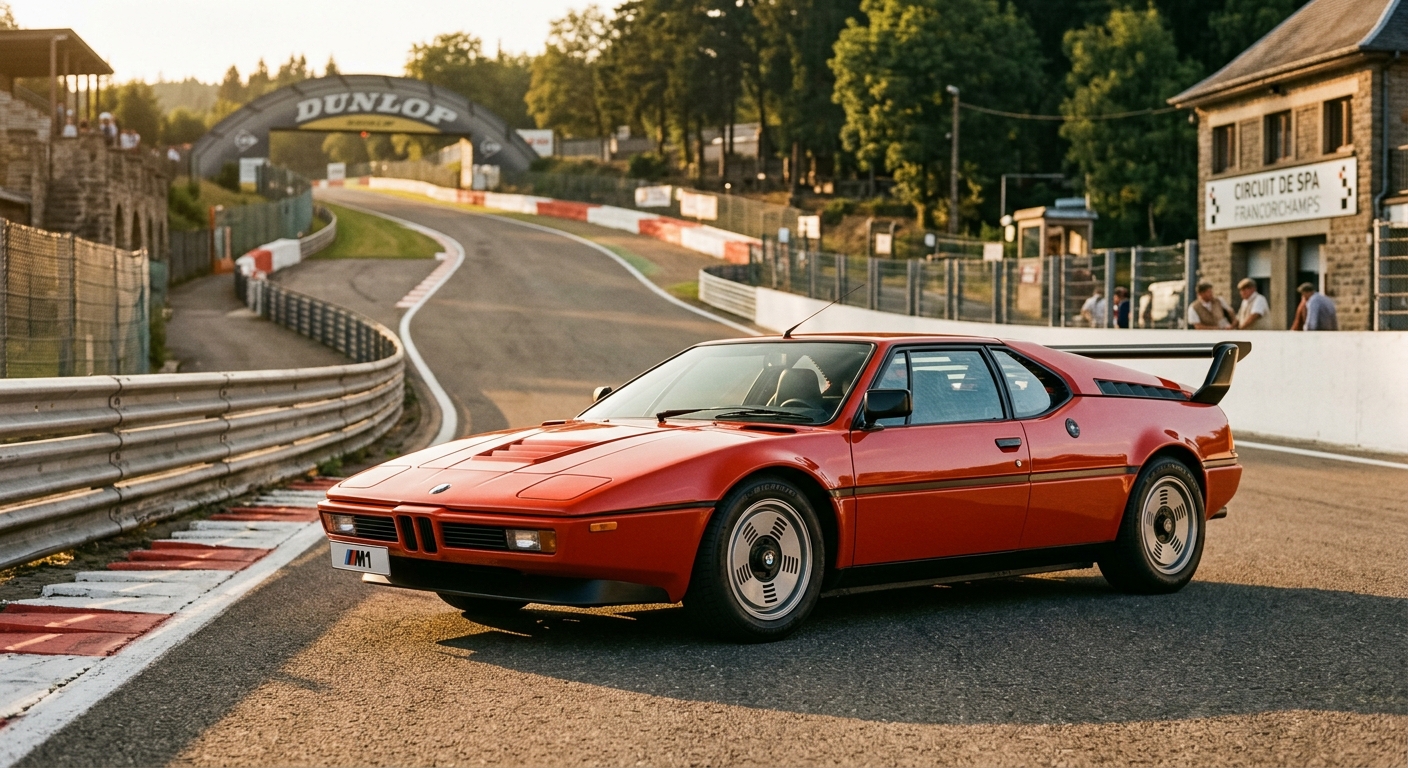
The result was worth the struggle. Marcello Gandini’s angular design, executed during his tenure at Bertone, created a wedge-shaped masterpiece that looked fast standing still. The M1’s proportions were perfect: low, wide, and aggressive without being cartoonish. Those distinctive side vents and the subtle rear wing weren’t just for show, they were functional elements that helped cool the mid-mounted engine and provide stability at speed.
Engineering Excellence in Mid-Engine Form
Under the M1’s dramatic bodywork sat BMW’s first purpose-built racing engine: the M88 inline-six. This 3.5-liter twin-cam unit produced 273 horsepower in street trim, making it one of the most powerful naturally aspirated sixes of its era. The engine’s character was distinctly BMW: linear power delivery, incredible smoothness, and a soundtrack that built to a glorious crescendo at the 6,500 rpm redline.
The chassis was equally impressive. The tubular steel spaceframe, clothed in fiberglass bodywork, provided exceptional rigidity while keeping weight to a reasonable 3,122 pounds. The suspension used racing-derived double wishbones at all four corners, giving the M1 handling that could shame contemporary Ferraris. This was a car engineered without compromise, built to dominate both road and track.
The Driving Experience: Pure and Focused
Sliding into the M1’s cockpit feels like entering a fighter jet. The driving position is perfect, with every control exactly where it should be. The steering wheel, pedals, and gear lever all communicate directly with the chassis in a way that modern cars, for all their sophistication, struggle to match.
On the road, the M1 rewards commitment. The steering is heavy at low speeds but loads up beautifully as pace increases. The engine pulls cleanly from low revs but comes alive above 4,000 rpm, delivering power with a linearity that makes it easy to exploit the car’s full potential. The five-speed manual gearbox has a mechanical precision that makes every shift an event.
What sets the M1 apart from its Italian contemporaries is its usability. While Lamborghinis of the era were temperamental exotics, the M1 combined supercar performance with German reliability. This was a car you could drive across Europe without drama, then unleash on a race track with confidence.
The BMW M1 remains the ultimate expression of what happens when German precision meets Italian passion. Four decades later, it still looks modern, still sounds magnificent, and still serves as BMW’s high-water mark for pure, uncompromised performance. This is the car that launched BMW Motorsport and defined what an M car should be.