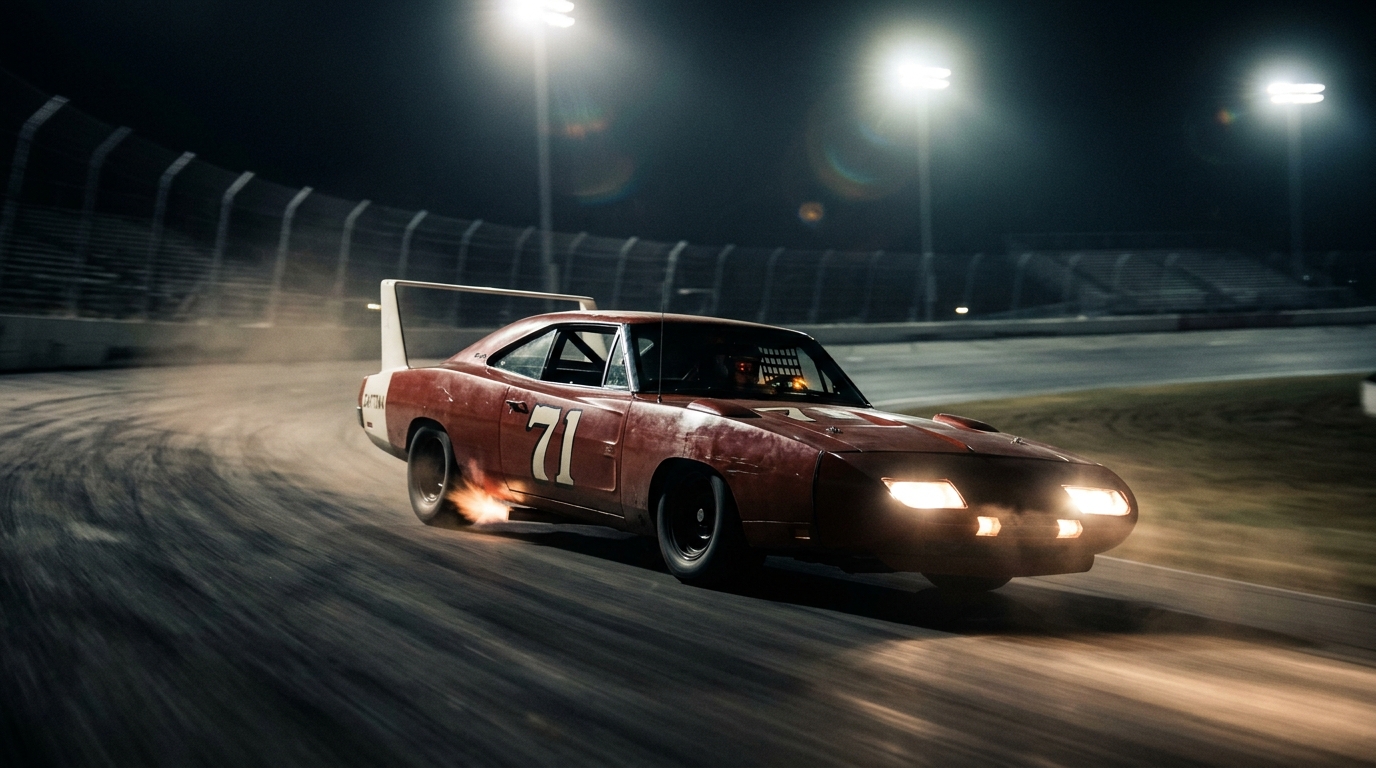
Picture an empty superspeedway after the grandstands have gone dark, the only light a pale wash from a few lamps and a million stars. A pointed, nose-coned shape sits on the apron with a rear wing standing nearly three feet above the trunk lid, looking less like a car and more like something that wandered out of a wind tunnel. This is the 1969 Dodge Charger Daytona, and it was built for one purpose: to be the first car to officially break 200 mph on a closed circuit.
Born in the Wind Tunnel
By 1968, Dodge had a problem. The standard Charger was fast, but the 1968 Charger’s recessed rear window and flush grille turned out to be aerodynamically messy on the big NASCAR ovals, and Ford’s slippery Torino Talladega and Mercury Cyclone were stealing the show. Chrysler’s answer was the Charger 500, then a far more radical idea: the Charger Daytona. Engineers, with help from aerodynamicists at Chrysler’s wind tunnel work and Lockheed-Georgia-era thinking, penned a long fiberglass nose cone and a huge rear stabilizer wing. The nose added roughly 18 inches to the car, and the wing was mounted on tall struts so it would sit in clean air above the turbulent flow off the roofline.
The wing height was not styling. It was set so that the trunk lid could still open, and so the wing worked in undisturbed air. Dodge also faired in the rear window and added a flush-mounted rear glass plug, and fitted special fender scoops to give clearance for the tires. Production began in the second half of the 1969 model year, and Dodge built roughly 503 street versions to satisfy NASCAR homologation, with the racing cars derived from them.
The Night Record Run
The famous record came on March 24, 1970, at Talladega, when Buddy Baker became the first driver to officially exceed 200 mph on a closed course in a Daytona, with a run of about 200.447 mph. Speedway record attempts and test sessions were often run in cooler, calmer conditions, and that logic is why early morning and late evening runs are so prized: denser, cooler air gives the engine more oxygen, and quiet air means steadier handling at the extreme. The Daytona thrived in those conditions, and a few of the early test and qualifying stints ran into dusk with headlights not even on the agenda.
Driving It After Dark
On the street, a Daytona is a theatrical car. At night, the long nose and nearly flat hood push your eyes down a dark tunnel of road, and the stock sealed-beam headlights, which were hidden behind the retractable nose-cone panels on the Daytona, give you a dim, warm view by modern standards. The rear wing is large enough that it sometimes blocks a slice of your mirror, but in a dark parking lot it catches every sodium light and glows amber.
The sound is the real nighttime event. The 440 Magnum or 426 Hemi V8, depending on the car, thunders through a dual exhaust, and with the long nose out ahead of you, the engine note seems to arrive a beat before the car does. Steering is slow, the drum and disc brake setup demands planning, and the ride is firm and live. You do not rush a Daytona through a midnight canyon; you cruise it, you listen to it, and you let strangers at a red light take photographs.
Engines and Variants
The standard street Daytona used the 440 Magnum V8 rated at 375 hp, with the 426 Hemi rated at 425 hp available as an option, and a small number of cars were fitted with the 440 Six Pack. Only a handful of Hemi street cars were built, which is why those examples now command extraordinary money. Both engines used a TorqueFlite three-speed automatic as the default, with a four-speed manual also available.
Why It Still Matters
The Daytona and its Plymouth Superbird sibling ended the so-called aero wars. NASCAR responded by restricting engine sizes for winged cars, effectively banning them after 1970. In a few short seasons, though, the Daytona proved that wind tunnel science could beat raw horsepower, and it changed how every race car since has been designed. Today, it is one of the most recognizable shapes in American automotive history, and a nighttime encounter with one is a reminder of how wild that era was.
Editor’s verdict: The Daytona is not a car you buy for comfort, it is a car you buy because it dared to be absurd in the name of speed. Its thunderous V8 and outlandish wing make it the most theatrical shape to ever haunt a dark speedway, and it still stops people in their tracks. If you ever find one humming under the lights at night, stop and look, because they truly do not build them like this anymore.