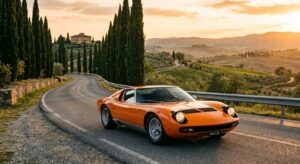
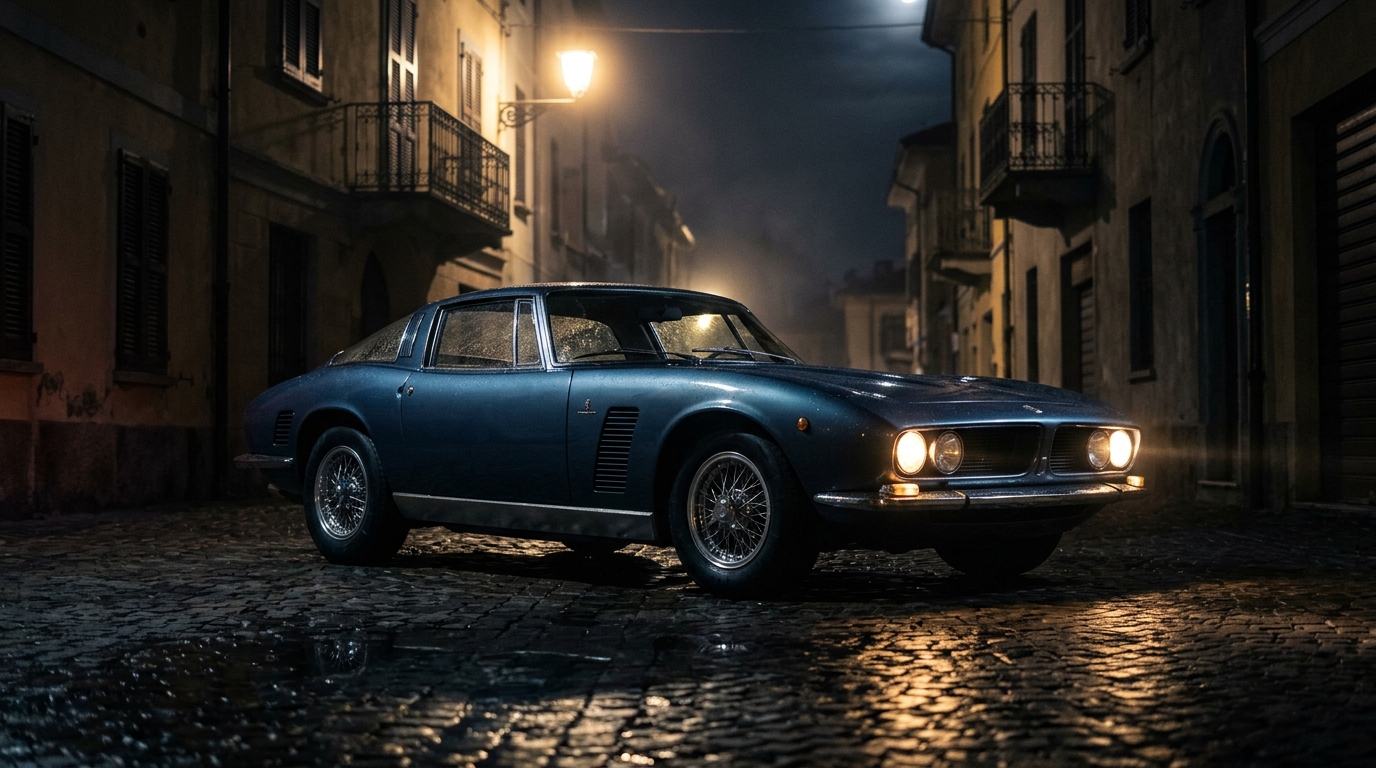
Picture an empty autostrada at 1 a.m., the sodium lamps ticking past like a slow strobe, and a long-nosed coupe sliding through the orange glare with a deep American V8 rumble echoing off the guardrails. That coupe is not a Ferrari or a Maserati. It is the 1969 Iso Grifo, the Italian grand tourer that almost nobody remembers and everybody should.
The Refrigerator Maker Who Built a Supercar
Iso Rivolta began as an Italian maker of refrigerators and scooters, and in the early 1950s it produced the Isetta bubble car (licensed later to BMW). Owner Renzo Rivolta wanted something grander. In 1962 he launched the Iso Rivolta IR 300, a four-seat GT powered by a Chevrolet small-block V8. The recipe was simple and brilliant: Italian style and chassis engineering, American reliability and torque.
The Grifo, which debuted at the 1963 Turin Motor Show, was the sharper, sportier expression of that idea. Chief engineer Giotto Bizzarrini, formerly of Ferrari and architect of the 250 GTO, developed the chassis. A young Giorgetto Giugiaro, then at Bertone, penned the body. Those two names alone should have made the car famous.
1969: The Car in Its Prime
By 1969 the Grifo had matured into the Series I at its best. Early cars used the 327 cubic inch (5.4 liter) Chevrolet V8 in the GL 300 and GL 350 trims. The 7 Litri, known as the GL 400 in some markets, offered the big-block 427 cubic inch (7.0 liter) Chevrolet. Our spec sheet below covers the common GL 350 configuration with the 5.4 liter small-block making roughly 300 horsepower, though big-block cars made substantially more.
The body is a low, wide fastback with a long hood and a short tail, and the hallmark Giugiaro touch is the clean, tight surfacing that avoids the fussiness of many period Italian designs. The nose is wonderfully pointed, and in 1969 the car was still showing off its distinctive faired-in headlight treatment.
How It Feels After Dark
Night is when a car like this earns its keep. The cabin is intimate, with deep-set instruments glowing amber and white against black, and the long hood stretches ahead like an aircraft carrier deck. Headlights of the era are modest by modern standards, so you drive with your ears as much as your eyes. At low revs the Chevrolet V8 burbles with a gentle menace, and as the revs climb the note hardens into a smooth, urgent roar that bounces off tunnel walls like applause.
The de Dion rear suspension, a sophisticated layout for the 1960s, keeps the rear wheels planted. That matters when you are feeling your way along a dark mountain road with only a pool of yellow light ahead. The steering is heavy at parking speeds but communicative on the move, and the Grifo settles into a long-legged, confident stride. This is a car built to cross a continent at night, arriving rested in the morning, even if the cabin warms up in traffic.
Visibility and Practicality
Do not expect modern conveniences. Visibility to the rear is limited by the sloping roofline, and the brakes demand planning. But the Grifo carried genuine four-seat intent in its early life, and the trunk is usable for weekend luggage. It is a proper GT in the old sense: fast, comfortable and slightly unruly.
A Rare and Rewarding Classic
Fewer than 500 Grifos of all series were built between 1965 and 1974, which makes it genuinely rare. The model stayed in production until Iso’s financial troubles in the 1970s, and a bad run of luck ended the company. Today the Grifo sits in the shadow of the better-known Ferraris and Lamborghinis of its day, though prices have climbed steadily. For the enthusiast, that obscurity is part of the charm. When you pull up at a late-night gathering in a Grifo, the crowd is always asking the same question: what is that?
Editor’s verdict: The Iso Grifo is the connoisseur’s Italian GT, with Giugiaro’s shape, Bizzarrini’s chassis and Chevrolet’s thunder in one rare package. It is imperfect, a little raw and utterly intoxicating after midnight. If you want the car nobody else at the meet owns, this is the one to find.