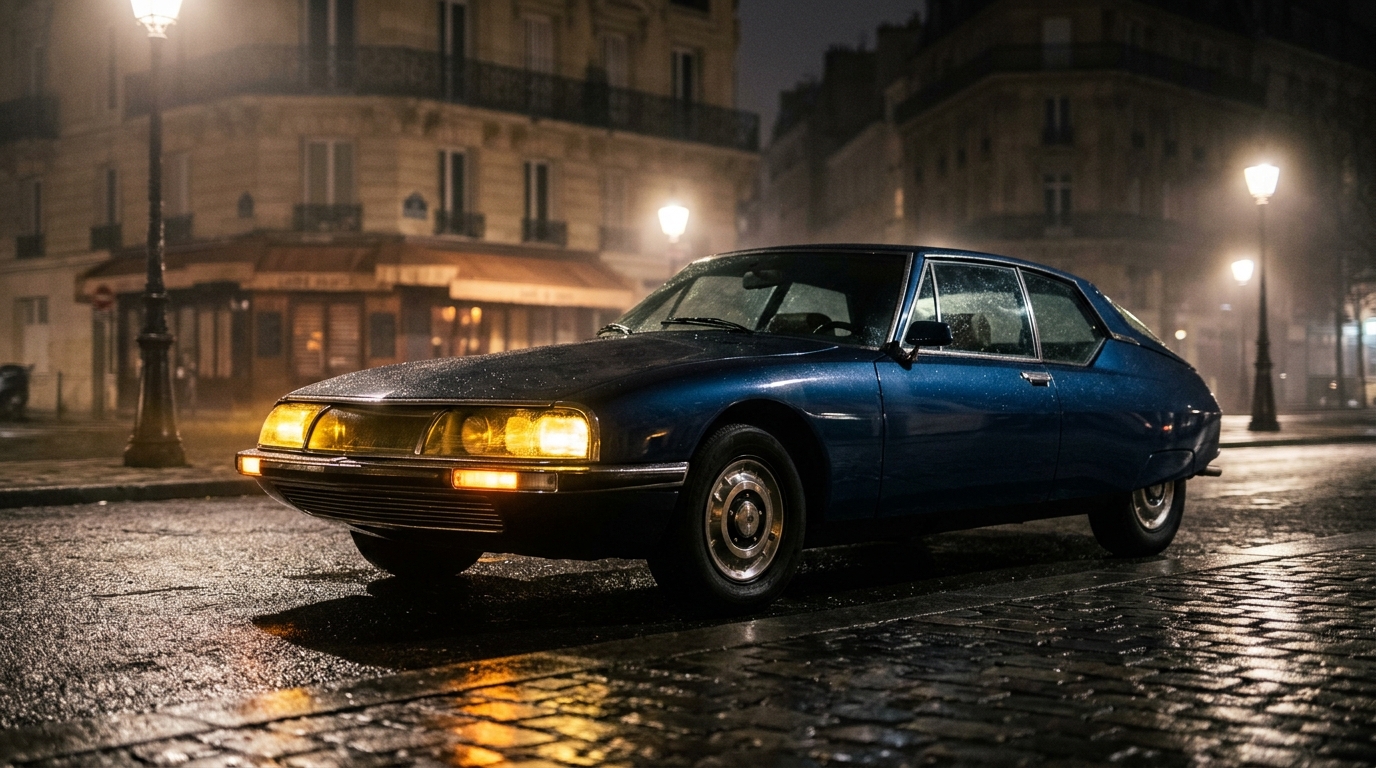
Past midnight on a deserted French route nationale, a pair of headlights behind you begin to swivel with the steering wheel, painting the next bend in light before the car has even turned into it. That is the 1971 Citroen SM at night, a machine that looks like it was beamed in from a decade that had not happened yet. It is the only grand tourer I know that makes the dark feel like its natural habitat.
A Maserati Heart in a Citroen Spaceship
The SM was born from Citroen’s 1968 purchase of Maserati, and the idea was audacious: take the hydropneumatic wizardry of the DS, wrap it in a long, low, aerodynamic coupe, and power the front wheels with an Italian V6. Maserati’s engineers, led by Giulio Alfieri, produced a compact 2.7 litre 90 degree V6 with four overhead camshafts, designed from scratch so it could sit behind the front axle line and keep the nose short. The car debuted at the Geneva Motor Show in March 1970, and by 1971 it was in full production, with the engine at 2,670 cc, fed by three Weber 42 DCNF carburetors and producing 170 PS.
That sounds modest by modern standards, but the SM was slippery. A drag coefficient around 0.33 and a tapering fastback body let it reach roughly 140 mph, which made it the fastest front-wheel-drive production car in the world at the time. Motor Trend named it Car of the Year for 1972, a rare honor for a French car.
The Headlight Trick That Defines the Night
Every Citroen SM story eventually turns to the lights, and after dark that story is the whole show. Behind a single sweeping glass cover sit six lamps: two outer fixed units for low beam, two inner high beam lamps that steer, and two small driving lamps. The inner pair is mechanically linked to the steering rack through cables, so they turn up to roughly 80 degrees as you turn the wheel. Late-1970s cars from other makers copied the idea decades later, but the SM did it in 1970 with cable and mechanical cunning.
The effect on a winding night road is hard to overstate. Where a conventional car throws light straight into the hedgerow on a corner, the SM lights the apex. In the US market the glass was replaced by sealed beam units behind regulations, which sadly stripped the car of some of its visual drama and light quality, but a European-spec 1971 car is a joy after dark.
Behind the Wheel After Dark
Climbing in, you meet a dashboard that looks like sculpture: a single-spoke steering wheel, a deep-set instrument binnacle, and a tiny fixed hub that tells you this car is not interested in convention. Start the engine and the hydraulic system pressurizes with a faint hiss, the car rising from its low resting stance like something waking up. It runs on LHM mineral fluid at around 170 bar, and that single circuit powers the suspension, the brakes, the steering and even the clutch.
The steering is the real party piece. DIRAVI, Citroen’s variable-assist power steering, uses hydraulic pressure that rises with road speed and, crucially, centers the wheel by itself. At night, with traffic thinning and the engine singing at 5,000 rpm, this makes the SM feel as though it is steering on rails, though you need to relearn your hands because the wheel returns to center with no input from you. Parking is effortless, high-speed stability is uncanny, and the whole experience feels like a software-defined car years before software existed.
The ride is magic. Hydropneumatic suspension irons out cobbles, potholes and rain-slicked autoroute joints, leaving the occupants floating on a cushion of nitrogen and fluid. On a long dark run it is one of the most relaxing cars ever built, yet it also corners with poise because of the self-leveling and fast, light steering.
The Sound
The Maserati V6 is not a loud engine, but it is a gorgeous one. Triple Webers inhale with a rasp that builds through the midrange into a metallic howl near the redline, and in a tunnel at night it fills the cabin like a hunting horn. It is more refined than raw, a smooth, urgent sound rather than a thunderous one, and it suits the car’s gentleman-racer character perfectly.
The Catch
No honest SM story skips reliability. The Maserati engine is complex, the timing chain system needs care, the hydraulic lines age, and the sheer number of unique components makes restoration pricey. Cars that have been properly maintained are wonderful. Cars that have been neglected are expensive lessons. Buy on condition and history, not on price alone.
Legacy
Citroen built roughly 12,920 SMs between 1970 and 1975 before the Peugeot takeover and the 1973 oil crisis killed it. It was too expensive, too complicated and too early for its own market, but time has been kind. Today the SM is recognized as one of the boldest cars of the twentieth century, and one that proves a grand tourer can be both rational and surreal.
The 1971 Citroen SM is not the easiest classic to own, but it may be the most extraordinary to drive after dark, with steering headlights, a Maserati howl and a ride like a magic carpet. If you can stomach the maintenance and the quirks, nothing else delivers a midnight run this strange and this seductive.