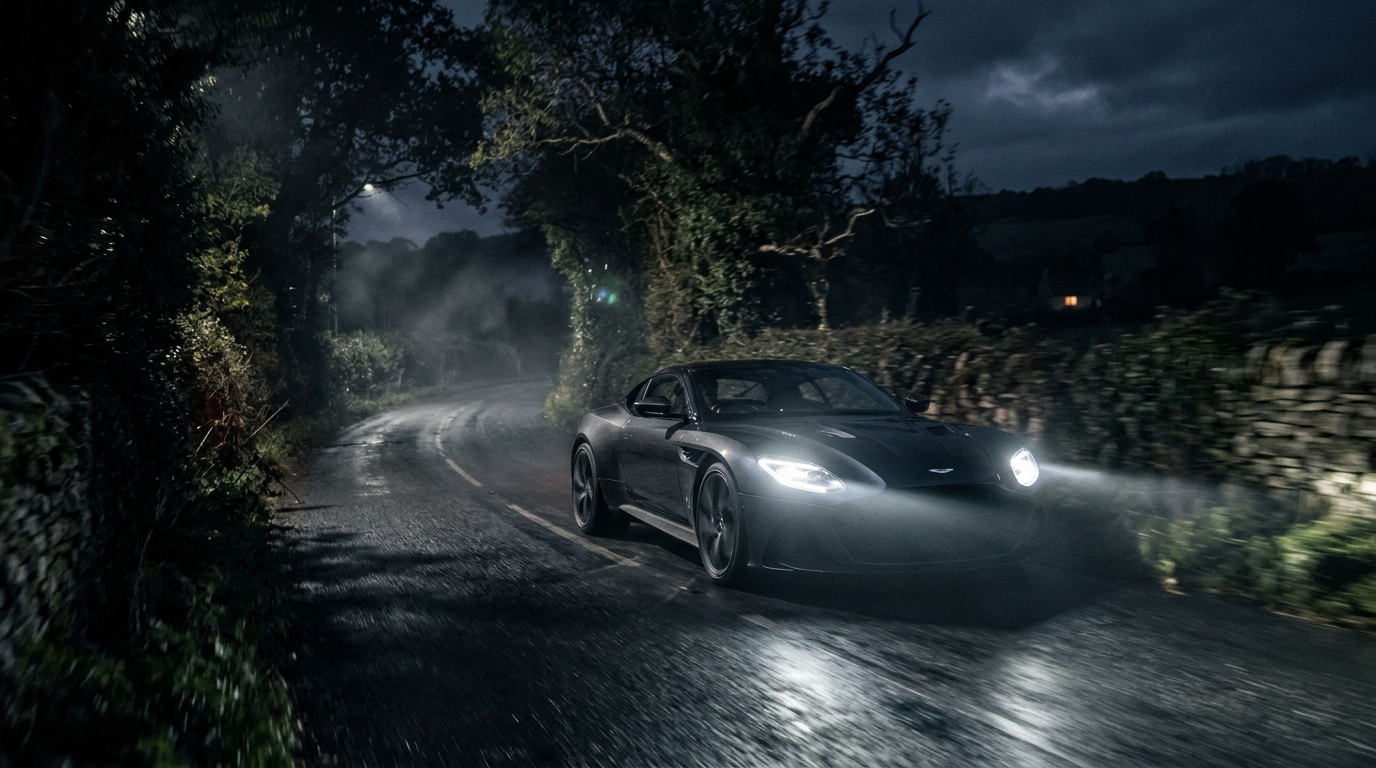
It is a little after midnight, and a single-track lane somewhere in the Cotswolds has gone completely black beyond the reach of the headlights. The temperature gauge reads four degrees, the hedgerows are glittering with frost, and behind the dashboard a twin-turbocharged V12 is ticking quietly as it cools between pulls. This is the environment the 2020 Aston Martin DBS Superleggera was born for: fast, dark, empty roads and a long way to go.
The Night Shift Begins
Nothing prepares you for how the DBS Superleggera feels the moment you pull away after dark. The cabin is wrapped in leather and Alcantara, the instrument cluster glows a calm amber-white, and the whole car feels like a very expensive study at midnight. The 5.2-litre twin-turbo V12 starts with a crackle-and-bark that echoes off sleeping stone cottages, then settles into a low, rolling idle that you can feel through the seat. Press the exhaust button and the car turns from gentleman to hooligan in about a second.
The numbers are serious. The engine makes 715 horsepower at 6,500 rpm and 664 lb-ft of torque from 1,800 to 5,000 rpm, driving the rear wheels through a ZF 8-speed automatic and a limited-slip differential. Aston claims 0-60 mph in 3.2 seconds and a top speed of 211 mph. At night on a deserted B-road, the fun part is not the headline figures but how the torque arrives. There is no lag worth mentioning, only a huge, elastic shove that makes 4th-gear overtakes on dark straights feel almost unfair.
Headlights, Visibility and the Dark
A grand tourer lives or dies after sunset, and the DBS handles the dark well. The LED headlights throw a wide, white, evenly lit pool of light that stays crisp at the edges, and the automatic high-beam assist behaves sensibly on country lanes where oncoming traffic is rare but unpredictable. Over a crest, the beam sweeps across the road with enough reach to show you the next bend before you commit to it. The long bonnet disappears into the black ahead of you, and the car’s wide hips are visible in the mirrors, glowing under the rear light bar.
Rear visibility is a mixed bag. The tiny rear window and fastback roofline mean you rely on mirrors and parking cameras more than you would in a hatchback. On a pitch-black lane, the dim reflection of the rear light bar and the flicker of your own exhaust note become the main sense of what is happening behind you.
Ride, Handling and Mood
The DBS Superleggera rides on adaptive Bilstein dampers with three modes: GT, Sport and Sport Plus. In GT mode, the ride is surprisingly supple for a car with this much power, absorbing the broken tarmac and cattle-grid rattles of country lanes without crashing into them. Switch to Sport Plus and the steering sharpens, the throttle sharpens, the gearbox sharpens, and the car tightens around you like a hand around a glove. The 21-inch wheels wear Pirelli P Zero tyres (265/35 at the front, 305/30 at the rear) and grip is formidable, though in cold, damp night conditions you quickly learn to respect the rear axle.
The carbon-ceramic brakes, 410 mm at the front and 360 mm at the rear, are firm, powerful and fade-free. Feathering them into a damp corner at 2 a.m. gives you a deep appreciation for the sort of engineering that never draws attention to itself.
The Name and the History
The DBS badge has a storied past. The original Aston Martin DBS arrived in 1967, designed by William Towns, and became a cultural icon when George Lazenby drove one in On Her Majesty’s Secret Service. The modern DBS Superleggera, launched in 2018 as the flagship of the DB11 range, revived the name with a modern take on the same idea: a big, fast, elegant GT with a hint of menace. The Superleggera name, Italian for super light, is a nod to the lightweight tubular construction methods licensed from Carrozzeria Touring Superleggera, which Aston used on the DB4, DB5 and DB6. The modern car uses carbon fibre bodywork for a lightweight structure and an aluminium bonded chassis underneath, with a claimed dry weight of around 3,693 lb.
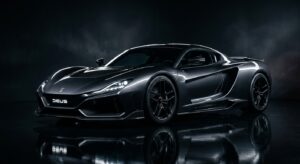
Visually, the DBS is all about presence. The wide grille, the carbon-fibre aero details, the subtle Gurney flap on the boot lid and the sculpted rear haunches combine into something that looks deliberately muscular without ever tipping into vulgar.
Living With It
As a daily-driven supercar, the DBS asks for patience. The infotainment system, Aston’s older Mercedes-sourced setup, was dated even in 2020, and the 2+2 rear seats are really for bags or very small humans. Fuel economy is exactly what you would expect from a 5.2-litre twin-turbo V12, though cruising at motorway speeds on a long night run, the car settles into a relaxed, almost hushed gait that makes 400 miles in one sitting feel easy. That is the real magic of the car: it is brutal when you want it to be, and almost meditative when you do not.
The DBS Superleggera is the sort of car that makes midnight feel like the best hour of the day: a 715-hp V12 wrapped in British tailoring, equally at home thundering down an empty B-road or ghosting through a sleeping village. It is not the most practical or the most high-tech grand tourer money can buy, but it is among the most intoxicating, and after dark it is very hard to beat.