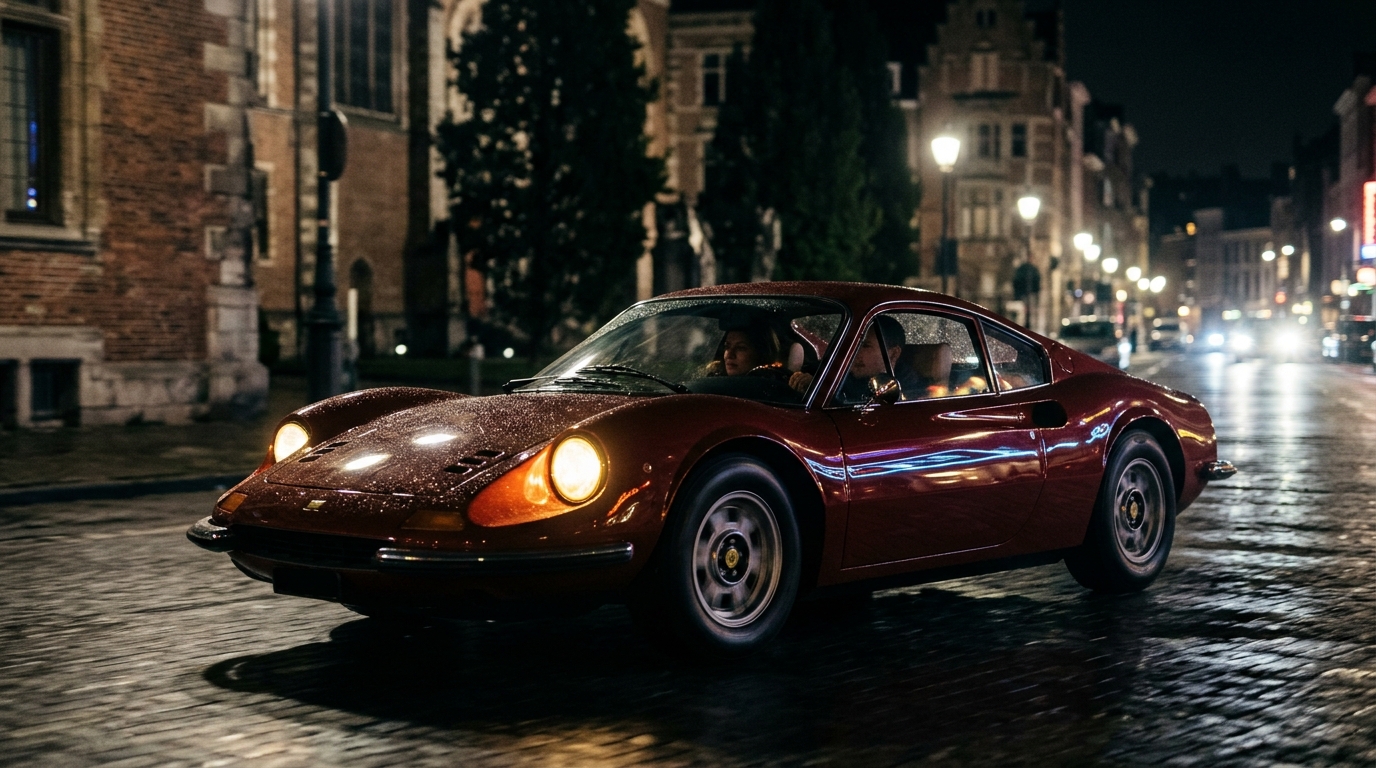
It is a quarter past midnight, the streets are empty and wet, and the Dino 246 GT is ticking as it cools under a sodium streetlight. Nothing in the car’s shape is aggressive, yet the curves of its fenders catch the amber glow like liquid. This is the Ferrari that was never officially called a Ferrari, and after dark it feels like the most personal one of all.
The Car That Wore No Prancing Horse
The Dino story begins with grief and engineering. Enzo Ferrari’s son Alfredo, nicknamed Alfredino or Dino, was an engineer who championed the idea of a small, high-revving V6 and who died in 1956 at just 24. Ferrari honored him by naming the V6 engines and the cars that used them Dino. Those cars carried the Dino script rather than the prancing horse, which was reserved for the V12 models of the day.
The first production car was the 206 GT, introduced in 1967 with an aluminum body and a 2.0-liter V6. It evolved into the 246 GT, launched in late 1969, with a larger 2.4-liter engine, an iron block, and a stretched wheelbase for better stability. Pininfarina’s Leonardo Fioravanti penned the body, and it is widely regarded as one of the most beautiful shapes of the twentieth century. The 246 GT was built from 1969 to 1974 in three series, called L, M, and E, with Series M cars arriving around 1971 and Series E cars from 1972. A 1972 car sits among the middle and later production, and the 246 GTS targa version arrived in 1972 as well.
Driving It at Night
Slipping into the low, snug cabin, the first thing you notice is how small and honest everything feels. The thin-rimmed Nardi wheel is large by modern standards, the leather seats hug your hips, and the gated metal shifter sits close to your right hand. The gauges glow a soft orange-green in the dark, and there is not a single screen to break the spell.
Turn the key and the 2.4-liter V6 catches with a bark that settles into a busy, metallic hum. At night that sound is everything. Sound travels differently in cool, still air, and the Dino’s induction roar and quad-cam rasp bounce off buildings and tunnel walls with a clarity that daytime traffic hides. Past 5,000 rpm the engine pulls with a hard-edged howl that feels closer to a motorcycle than a typical V8 of the era.
The mid-engine layout pays off the moment you turn in. The steering is unassisted, light at speed, and full of detail, so you feel the road surface through your palms. Because there is so little weight over the nose, the car rotates eagerly, and the thin pillars give excellent visibility in every direction. Period road testers praised the balance, and that remains true today. You do not need speed to enjoy it. A back road at 40 mph in the dark is plenty.
Headlights are the one place the car shows its age. The factory pop-up lamps of the early cars gave way to fixed units in the US-market trim of some years, and the output of any 1970s lighting is modest by modern standards. The glow is yellowish and the throw is short, which encourages a calmer pace. Many owners fit modern halogen or sealed-beam upgrades with period-correct styling, which is a sensible way to boost confidence after sunset without ruining the look.
Living With a Dino After Dark
The cabin is tight for tall drivers, the pedals are offset, and there is no meaningful luggage space beyond a shallow rear shelf and a small trunk. Heat can build in the cockpit in traffic, but in cool night air the car is a joy. The five-speed gearbox demands a deliberate hand: a firm pause in the gate when cold, then a quick, mechanical snick once warmed up.
Maintenance is a serious consideration. Cam belts, carburetors, and rust protection are all areas of attention, and these are valuable cars. Rust in the sills and around the screen is the great enemy. A well-sorted car, however, rewards you with an unfiltered, analog experience that few classics can match.
What stays with you after the engine goes quiet is the intimacy. Many Ferraris of this era ask you to be brave. The Dino asks you to be attentive, and in return it feels like a conversation between the car, the road, and the dark.
Editor’s verdict: The Dino 246 GT is not the fastest or the easiest classic Ferrari, but after dark it may be the most captivating. It trades brute force for balance, sound, and an intimacy that modern supercars cannot fake. If you want a classic that makes a quiet midnight road feel like an event, this is the one.