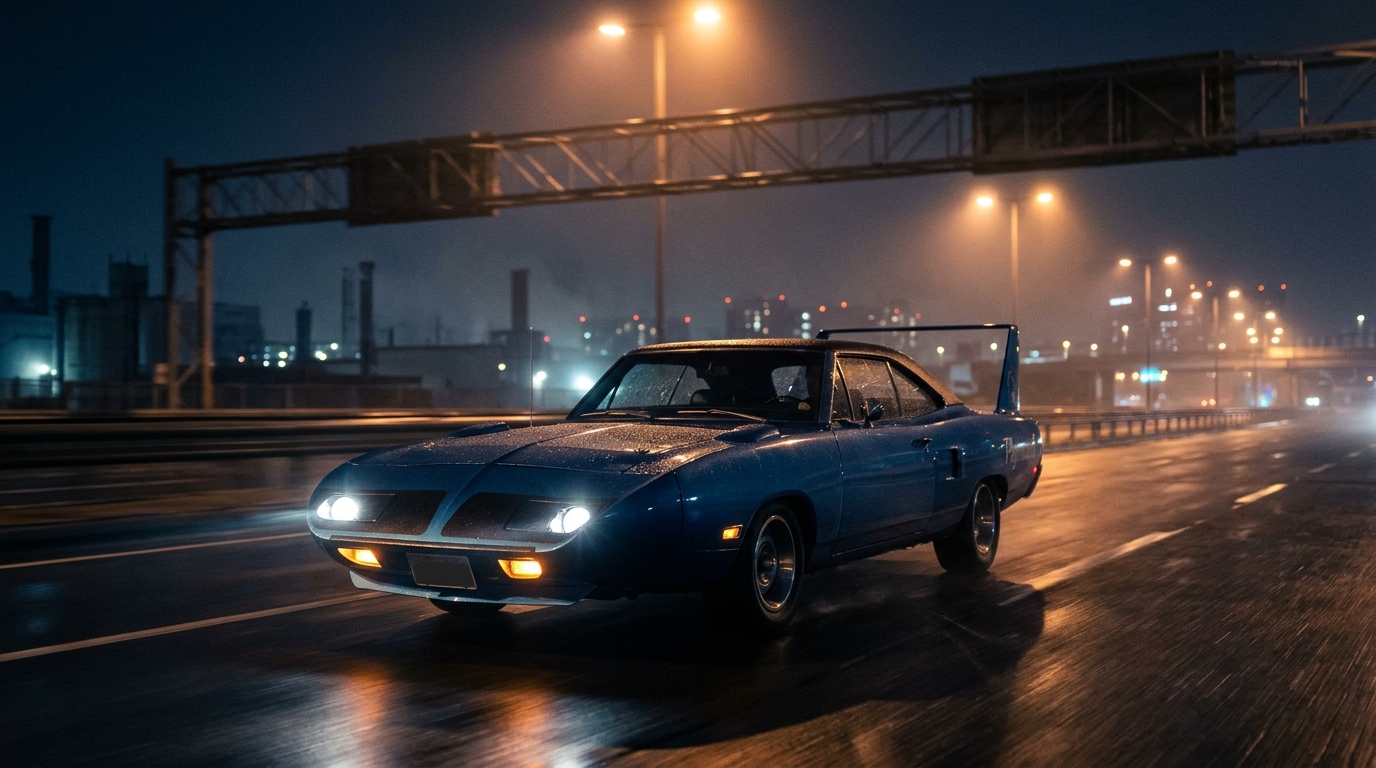
It is a little past midnight, the drive-in screen is dark, and a sodium streetlight is painting the gravel the color of weak tea. Then you hear it: a deep, lumpy rumble rolling across the lot, and a pointed nose cone slides out of the gloom with a wing the size of a barn door bolted to its tail. This is the Plymouth Superbird, and at night it looks less like a car and more like something that escaped from a hangar.
Built for the Banking, Sold to Skeptics
The Superbird exists because of NASCAR. Dodge had introduced the Charger Daytona for 1969 to conquer the high-banked superspeedways, and Plymouth wanted its own aero warrior for 1970. Richard Petty had left Plymouth for Ford in 1969, and the company’s pitch to win him back was simple: give him a winged car. He returned, and the Superbird was born. NASCAR’s homologation rules required manufacturers to sell one car per dealer in the country to qualify a body style, which meant Plymouth had to build roughly 1,920 of them for the street. By most accounts, 1,935 were produced.
The Superbird started life as a Road Runner. The bodywork is where things got strange: a fiberglass nose cone with retractable headlights replaced the stock front end, and a rear wing mounted on tall vertical stabilizers sat well above the trunk lid. The wing’s height was not for show. It placed the airfoil up in clean air, and it also allowed the trunk lid to open. Period sources, including the Plymouth press materials, describe the nose and wing combination as reducing drag significantly and adding real stability at speed. In race trim the car was credited with exceeding 200 mph at Talladega.
Showroom reality was less glamorous. Dealers struggled to move them, and unsold cars sat on lots, some reportedly discounted heavily. Today those same cars are some of the most coveted muscle machines in existence.
Driving Impressions After Dark
Climb in and the cabin is pure Road Runner: a bench or bucket seat setup, a big speedometer, and a long, wide dash. The cockpit feels enormous, and that matters at night, because the view over the hood is a long stretch of dark metal ending in that pointed nose. With the headlights retracted, the cone looks almost sharklike under streetlamps. Flip the switch and the lamps flip up from their housings, a small bit of theater that never gets old.
Night driving in a 1970 car is a lesson in humility. The sealed-beam headlamps of the era throw a modest, yellowish pool of light by modern standards, so you learn to drive within what you can see. That suits the Superbird’s character. This is not a car that begs to be thrown at corners in the dark. It wants to cruise, to growl, and to be admired.
The sound is the main event. In the most common engine choice, the 440 Super Commando, the exhaust note is a deep, syncopated burble at idle that turns to a hard, ripping roar under throttle. The optional 440 Six Pack, with three two-barrel carburetors, adds an urgent induction howl as the center carb opens and the secondaries come in. The rarest option, the 426 Hemi, delivers a ragged, thunderous bark that carries across an empty town and sets off car alarms three blocks away. Late at night, with traffic gone and the air cool and dense, an engine like this sounds enormous.
On the road the steering is slow and light, the brakes are drums or optional front discs depending on spec and demand a planned approach, and the ride is soft and floaty in true Mopar fashion. This is a straight-line weapon wearing a tuxedo. The torque of the big-block, especially the 440, makes it effortless: lean into the throttle and the nose lifts slightly as the car surges forward.
The Wing Question
People always ask whether the wing does anything on the street. Honestly, at legal speeds, not much. The aerodynamic benefits show up well above highway velocities. What it does at night is remarkable, though: the tall stabilizers catch passing streetlights and brake lamps, and the whole silhouette reads from half a block away. No other car of the era has such an unmistakable shape in the dark.
Standard Superbirds also carried a vinyl roof, a distinctive tape stripe treatment, and the famous Road Runner horn that goes beep beep. It is a gloriously silly detail on a car this serious.
Ownership Reality
A genuine Superbird is a blue-chip collectible now. The 440 Super Commando cars are the most common, with the 440 Six Pack and 426 Hemi versions commanding the highest premiums. Hemi cars are exceptionally rare, with only a few dozen built, and values for those can climb into the high six figures or beyond. Authenticity matters enormously, so documentation, fender tags, and build sheets are everything. Reproductions and clones exist, and buyers should verify any car against factory records before parting with serious money.
Maintenance is classic Mopar: sturdy, simple, and well supported by the aftermarket. The fiberglass nose and the unusual wing hardware are the parts to inspect carefully.
Editor’s verdict: The Superbird is not subtle, not particularly nimble, and not practical, and none of that matters at 1 a.m. with a Hemi or a Six Pack echoing off dark storefronts. It is a one-year wonder that turned a racing rulebook into rolling theater, and it remains one of the most magnetic cars ever to wear a license plate.