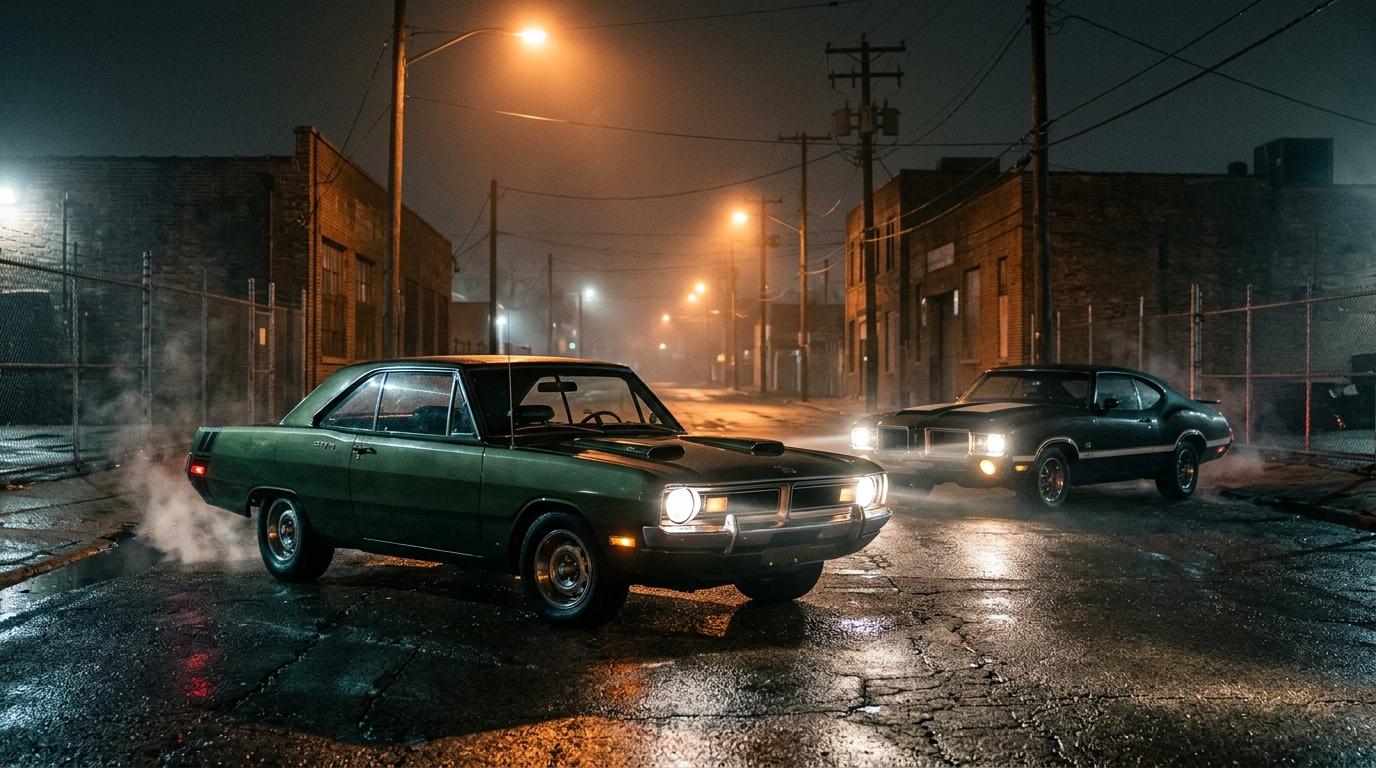
It is 12:40 a.m., the stoplight at the end of the industrial strip is stuck on red, and the only sound in the world is a big-bore Mopar V8 idling with that lumpy, impatient shuffle. A Buick-powered 442 once ruled nights like this one, but in 1970 the real threat in the next lane wore a Dodge badge and a hood scoop. Meet the Dart GTS, the compact that punched far above its weight class.
The Compact That Crashed the Big Boys’ Party
By 1970 the muscle car wars were at a fever pitch, and the Dodge Dart GTS was Chrysler’s answer to anyone who thought you needed a midsize body to make serious horsepower. The GTS was the performance model of the Dart lineup, built on the compact A-body platform that dated back to 1960 in concept. Dodge offered it as a two-door hardtop with a standard 340 cubic inch small block, or with the optional 383 Magnum big block, which is the one that earned the GTS its reputation.
Dodge advertised the 383 at 330 horsepower and 480 lb-ft of torque in this application. Those numbers are conservative by the standards of the day, and anyone who has driven one will tell you the car feels quicker than the paper suggests. The 340 version, rated at 275 horsepower, was a rev-happy alternative that many period testers actually preferred for its balance.
Driving the GTS After Dark
Night driving a 1970 muscle car is an exercise in character, and the GTS delivers it in spades. The first thing you notice is the cabin glow. The instrument cluster lights the gauges in a soft, warm wash, and the simple toggle layout makes everything feel mechanical and deliberate. There is no screen, no glare, nothing to distract you from the road and the sound.
The headlights are the car’s honest limitation. Sealed-beam units of the era throw a yellowish, narrow pool of light that fades quickly past about 150 feet. On a dark back road you learn to respect your speed and read the road ahead, because the lamps simply will not bail you out at triple-digit pace. Modern halogen or LED sealed-beam replacements transform the experience if you are willing to deviate from stock.
Then there is the sound. The 383 Magnum’s low rumble echoes beautifully off brick walls and overpasses, and at night with the windows down it is theatrical. Roll through a tunnel and the exhaust note ricochets back at you like a drumline. The Carter four-barrel inhales with a distinctive growl, and when you stand on it the car squats and goes, with the rear tires scrabbling for grip on cool pavement.
Handling and Brakes
This is a 1970 muscle car, so set your expectations accordingly. The front suspension uses Chrysler’s torsion bars, which give the Dart surprisingly decent turn-in compared with leaf-sprung rivals, and the 383 car’s added front weight makes it a touch nose-heavy. The steering is slow and light by modern standards, and body roll is part of the charm. The brakes are front discs on optional setups and drums otherwise, so leave generous following distance, especially on damp night streets.
Street Racing Lore and the Mopar Mystique
The Dart GTS fits neatly into the folklore of late-night stoplight showdowns. Its compact, lightweight body paired with a big-block was the classic sleeper formula, a car that looked tame enough to draw challengers and then humbled them. Chrysler built a reputation on exactly this kind of giant-killer thinking, and the GTS was a purist’s expression of it. The Dart also sat in the same showrooms as the Dodge Charger and Challenger, giving buyers a cheaper entry point into Mopar performance.
Production for the GTS was modest. Dodge built roughly 9,000 Dart Swingers and GTS-type models of the 340 and 383 variety in 1970 combined, and 383 GTS cars are scarce today, which is part of what makes a clean example so desirable. Parts availability for the A-body is excellent thanks to a devoted aftermarket, so ownership is far less intimidating than the rarity suggests.
Living With It
As a classic daily it is more usable than you would expect, with a simple mechanical layout and a roomy enough cabin for two adults. Fuel economy is dismal, so budget accordingly, and you will want to be comfortable with an old-school carbureted V8 that needs a little warm-up before it settles into a clean idle. But for weekend nights, cruise-ins, and drive-in movie nostalgia, it is a spectacular companion.
Editor’s verdict: The 1970 Dart GTS is the muscle car equivalent of a whispered dare, small, mean and loud once the streetlights go orange. It will not out-handle a modern hatchback, but nothing at a cruise-in makes noise this good for the money. If you want big-block Mopar drama in a package you can actually park, this is the one.