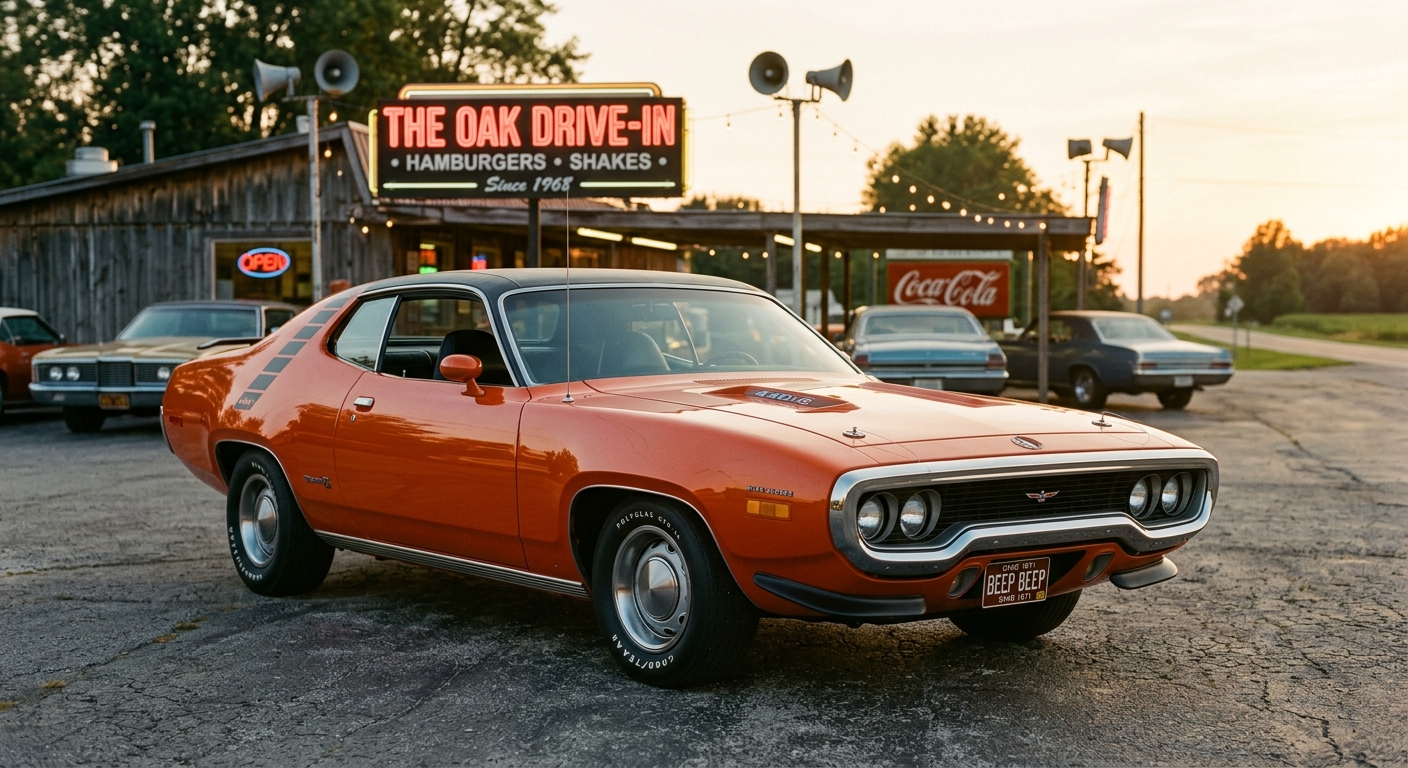
In 1968, Plymouth created something special: a muscle car that didn’t take itself too seriously. Named after the Warner Bros. cartoon character and complete with cartoon decals and a horn that went “beep beep,” the Road Runner was designed to be the everyman’s muscle car. By 1971, however, the party was winding down, making this year’s Road Runner both a high-water mark and a swan song for the golden age of American muscle.
The Philosophy Behind the Beep
The Road Runner concept was brilliantly simple: take Plymouth’s intermediate B-body platform, strip away the luxury appointments, and stuff in the biggest, nastiest engine you could get away with. While other manufacturers loaded their muscle cars with expensive options and premium interiors, Plymouth kept the Road Runner honest. Rubber floor mats, basic bench seats, and minimal sound deadening were the order of the day. The money went where it mattered: under the hood.
The base engine was the legendary 383 cubic inch V8, but the real star of the 1971 lineup was the 440 Six Pack. This monster displaced 440 cubic inches and featured three two-barrel carburetors sitting atop a high-rise intake manifold. The setup was as dramatic as it was effective, producing 385 horsepower and 490 lb-ft of torque in an era when those numbers were often underrated for insurance purposes.
Driving the Cartoon Character
Behind the wheel of a 1971 Road Runner with the 440 Six Pack, you’re immediately aware that this is not a refined machine. The engine idles with a lopey cam that shakes the entire car, and the exhaust note through the standard dual exhausts is nothing short of menacing. The three carburetors create a distinctive whistling sound under acceleration that’s become the stuff of legend among Mopar enthusiasts.
Launch the Road Runner hard, and those rear tires will disappear in a cloud of smoke despite their considerable width for the era. The power delivery is brutal and linear, with maximum torque arriving at just 3,200 rpm. This isn’t a car that needs to be revved to the moon to make power; it makes its statement with sheer displacement and mechanical aggression.
The handling, by modern standards, is exactly what you’d expect from a 3,600-pound muscle car riding on bias-ply tires and a suspension tuned for straight-line performance. The steering is heavy and slow, requiring genuine muscle to navigate parking lots. But on the open road, the Road Runner settles into a confident cruise that hints at its highway patrol origins.
The End of an Era
1971 was significant for more than just the Road Runner’s performance credentials. It marked the beginning of the end for the muscle car era, as insurance companies began cracking down on high-performance vehicles and emissions regulations started tightening. Compression ratios were dropping, and net horsepower ratings (which would become standard the following year) painted a less impressive picture on paper.
The Road Runner’s production numbers tell the story: from over 80,000 units in 1969, production had dropped to just over 14,000 by 1971. The 440 Six Pack engine, in particular, was becoming increasingly rare, making today’s survivors highly sought after by collectors who understand what they represent.
Living with the Legend
Daily driving a 1971 Road Runner today requires commitment and understanding. The fuel economy hovers around single digits in city driving, and the engine demands high-octane fuel to run properly. The interior, while charmingly spartan, offers little in the way of comfort or convenience. Air conditioning was available but robbed precious horsepower, leading most buyers to forgo it entirely.
But these compromises pale in comparison to the experience of unleashing 440 cubic inches of Detroit iron on a deserted stretch of highway. The sound, the fury, and the sheer mechanical honesty of the Road Runner represent everything that made the original muscle car era special. This was American performance distilled to its essence: maximum engine, minimum everything else.
The 1971 Plymouth Road Runner 440 Six Pack represents the last hurrah of unrestricted American muscle, delivering raw, uncompromising performance with cartoon character charm. Sure, it’s about as refined as a sledgehammer, but that’s precisely the point. This is muscle car purity distilled into 3,600 pounds of steel, rubber, and attitude.