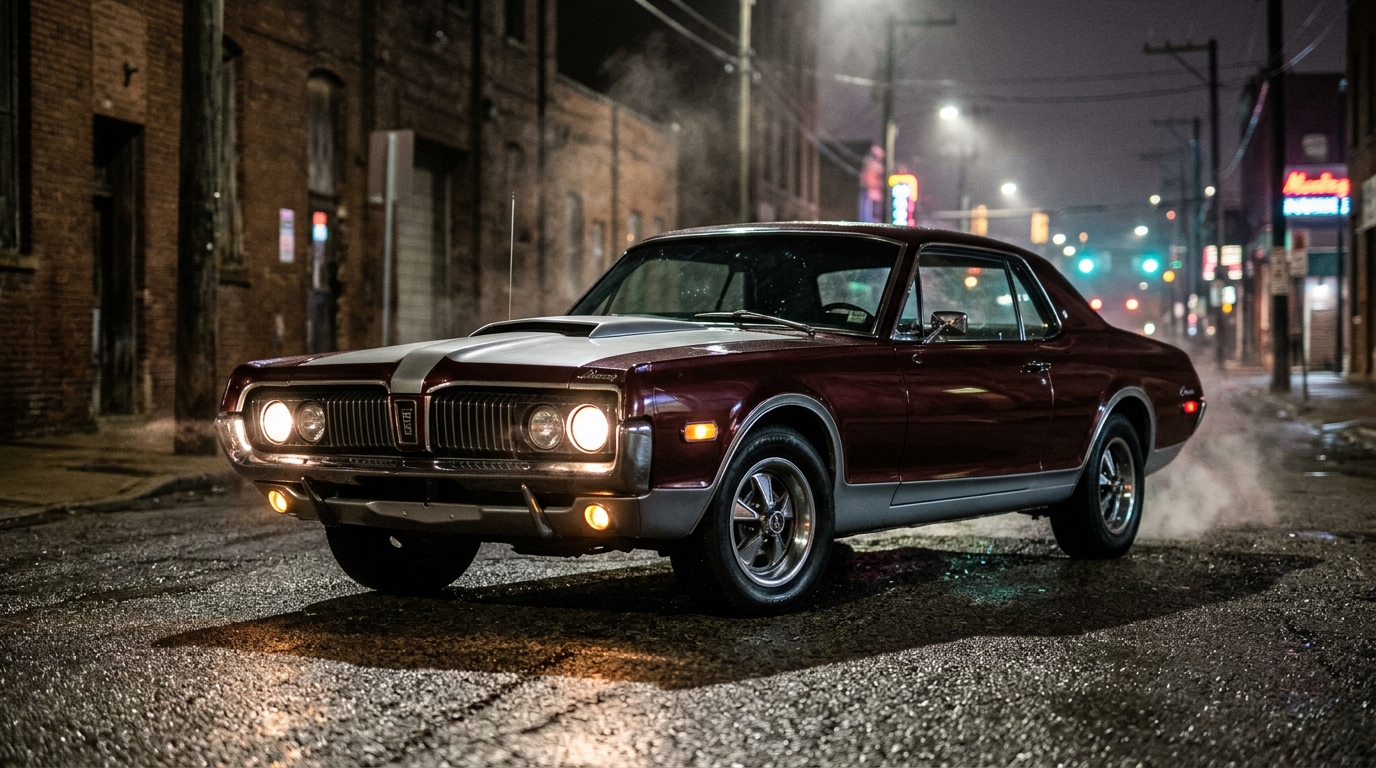
It is a little past midnight on an empty two-lane, and a pair of vacuum-operated doors has just swung open to reveal four glowing headlights. Then the big V8 pulls a slow breath through its induction system and the whole car seems to lean forward into the dark. The 1968 Mercury Cougar GT-E does its best work after the sun goes down, and the night is where this big cat earns its reputation.
A Pony Car in a Tuxedo
Mercury introduced the Cougar for 1967 as a more upscale, better-appointed sibling to the Mustang. It rode on a Mustang platform with a wheelbase stretched about three inches, to 111 inches, and wore its own sheet metal, topped by a handsome prowling-cat grille with hidden headlights tucked behind electrically-operated, vacuum-actuated doors. The brand pitched it as Detroit’s answer to the European grand tourer, and the Cougar won Motor Trend’s Car of the Year honors for 1967.
For 1968, the car got federally mandated safety updates, including side marker lights and shoulder belt provisions, and a few mid-year performance additions. The most important of those was the GT-E, a limited-run package introduced in 1968 that bolted Mercury’s strongest engines into a Cougar already known for style. Early GT-E cars came with a 427 cubic inch V8. Later in the model year, the 427 was replaced by the 390 cubic inch engine, then the 428 Cobra Jet arrived mid-year in a separate package. Documented 427 GT-E production is quite small, which is part of why original examples draw collector attention today.
The Look After Dark
Part of the Cougar’s drama is how it presents itself at night. The hidden headlight grille is a full-width, chrome-trimmed blade of metal that looks almost menacing parked under a streetlight. Flick the switch and the doors rotate open and four lamps stare out at the road. Those sealed-beam units are period-correct and, by modern standards, modest. Expect a warm yellowish cast and a throw that suits 1968 speeds rather than 2020s ones. On a dark rural road you learn to drive the car on instinct and listen closely, because the lights alone will not tell you everything.
The GT-E’s sequential rear turn signals are the other nighttime party trick. Mercury used a trio of sequential lamps per side that sweep outward when you signal, a visual flourish that was a signature of the Cougar and was adopted widely in the Mercury lineup. Behind a pair of taillamps stretched across the full width of the rump, they turn the rear of the car into a stage act. Follow a Cougar through a dark intersection and it is easy to understand why people remember them.
The Growl
This is the whole point of the Nightly Edition, and the GT-E delivers. Roll the 427 or 390 off idle in a quiet neighborhood and the sound ricochets back from every garage door: a deep, loping, slightly lumpy burble that settles into a bark when you squeeze the throttle. The GT-E carried dual exhaust with a distinct rumble, and without the competing noise of daytime traffic, the engine seems to fill the street.
At night, with the windows down and the dash lights glowing, the sensation is more cinematic than fast. Do not mistake the GT-E for a lightweight. It is a heavy, comfortable cruiser that accelerates hard in a straight line, rolls through corners with a lot of body movement, and prefers long, sweeping roads to tight ones. Steering is slow and light, the brakes are drums at the rear and, depending on the car, front discs were an available and, on performance variants, often fitted item, and you plan your stops. All of that is part of the experience. A well-sorted Cougar is not a track car. It is a night car, designed to wear out the miles between one city and the next while the radio hums in the background.
Inside the Cabin
The interior was the Cougar’s other selling point. Wood-grain trim, a toggle-switch center console, a deep bucket seat design, and a deep-set instrument panel with big round gauges gave it the feel of a small luxury car. At night those gauges glow a soft green-white and the toggle switches and rimmed steering wheel add to the sense of occasion. Visibility to the rear is limited and the pillars are thick, so mirrors and patience matter more than they do in a modern car.
Why It Still Matters
The Cougar GT-E is rare, loud, stylish, and a little theatrical. It is the sort of car that makes a drive-in parking lot look better and a midnight diner stop feel like a scene from a movie. Prices for genuine, documented examples have climbed steadily, and condition, originality, and matching-numbers drivetrains matter enormously. If you find a solid one, treat it like the cultural artifact it is, but do not leave it in the garage. A car built for the night is wasted if it never sees one.
The 1968 Mercury Cougar GT-E is a rare, theatrical, V8-powered cruiser that comes alive after dark, from its hidden headlights to the lump of big-block thunder in its exhaust. It will not out-corner a modern hot hatch, but it will out-charm nearly everything else on the road at midnight.