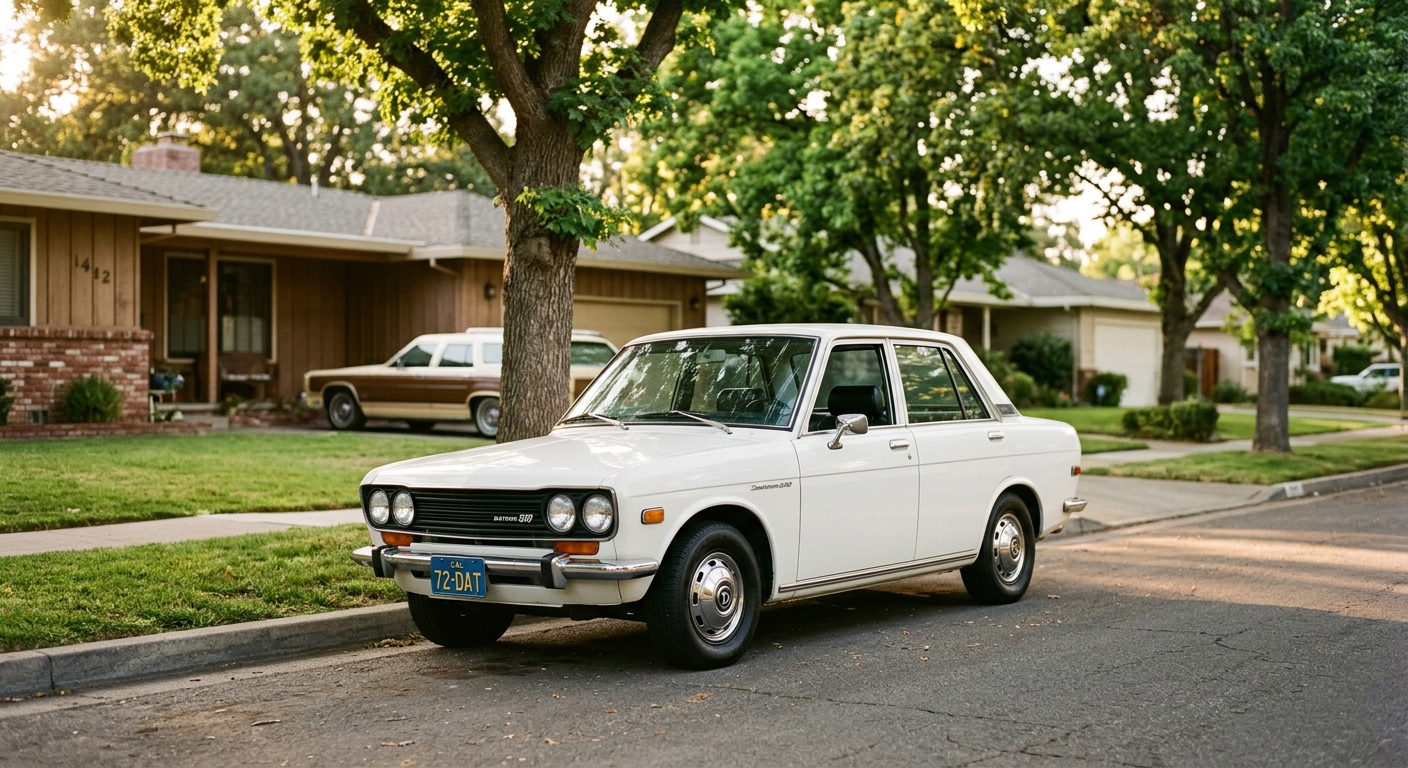
Long before the GT-R became a household name and the Z-car earned its stripes, there was a modest four-door sedan that quietly revolutionized how Americans viewed Japanese automobiles. The Datsun 510 arrived in 1968 as an unassuming economy car, but by 1972, it had evolved into something special: a perfectly balanced blend of European sophistication and Japanese reliability that punched well above its weight class.
While Detroit was building increasingly bloated muscle cars and European manufacturers charged premium prices for basic transportation, Datsun offered something different. The 510 combined the nimble handling of a BMW 2002 with the dependability of a Corolla, all wrapped in clean, understated styling that aged gracefully. This wasn’t just transportation; it was automotive education for a generation of drivers discovering that fun didn’t require V8 power.
Engineering Excellence on a Budget
The 510’s genius lay in its fundamentals. Independent front suspension with MacPherson struts, a live rear axle with coil springs, and rack-and-pinion steering provided handling that embarrassed cars costing twice as much. The four-wheel disc brakes were a revelation in an era when many economy cars still relied on drums all around.
Under the hood, the L16 single-overhead-cam four-cylinder produced a modest 96 horsepower, but it was the delivery that mattered. Smooth, willing to rev, and remarkably reliable, this engine would run forever with basic maintenance. The four-speed manual transmission offered crisp, precise shifts that made every drive engaging, even to the grocery store.
The Sweet Spot of Simplicity
By 1972, the 510 had reached its evolutionary peak. The interior featured supportive bucket seats, a straightforward dashboard layout, and build quality that put many domestic competitors to shame. Everything felt solid and purposeful, from the satisfying click of the switches to the precise action of the handbrake.
On the road, the 510 revealed its true character. The steering was quick and communicative, the suspension soaked up imperfections while maintaining composure through corners, and the whole package felt like it was built by people who actually enjoyed driving. This was the car that taught America that “economy” didn’t have to mean “penalty box.”
Racing Pedigree
The 510’s sporting credentials weren’t just marketing speak. In SCCA competition, modified 510s dominated the sedan classes throughout the early 1970s, often outrunning much more powerful competition through superior handling and reliability. This grassroots racing success helped establish Datsun’s performance reputation and paved the way for future sports cars.
Even in stock form, the 510 could show its heels to supposed performance cars on twisty roads. Its balanced chassis and responsive nature made it a favorite among driving enthusiasts who valued finesse over brute force.
The Datsun 510 proved that greatness doesn’t always announce itself with thunder. In a world obsessed with horsepower and luxury, this humble sedan quietly redefined what a driver’s car could be, earning its place as one of the most significant automobiles of the 1970s. For those seeking affordable classic car ownership with genuine driving pleasure, few cars deliver more smiles per dollar.