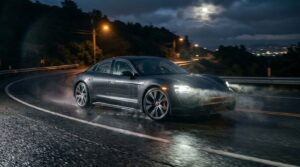
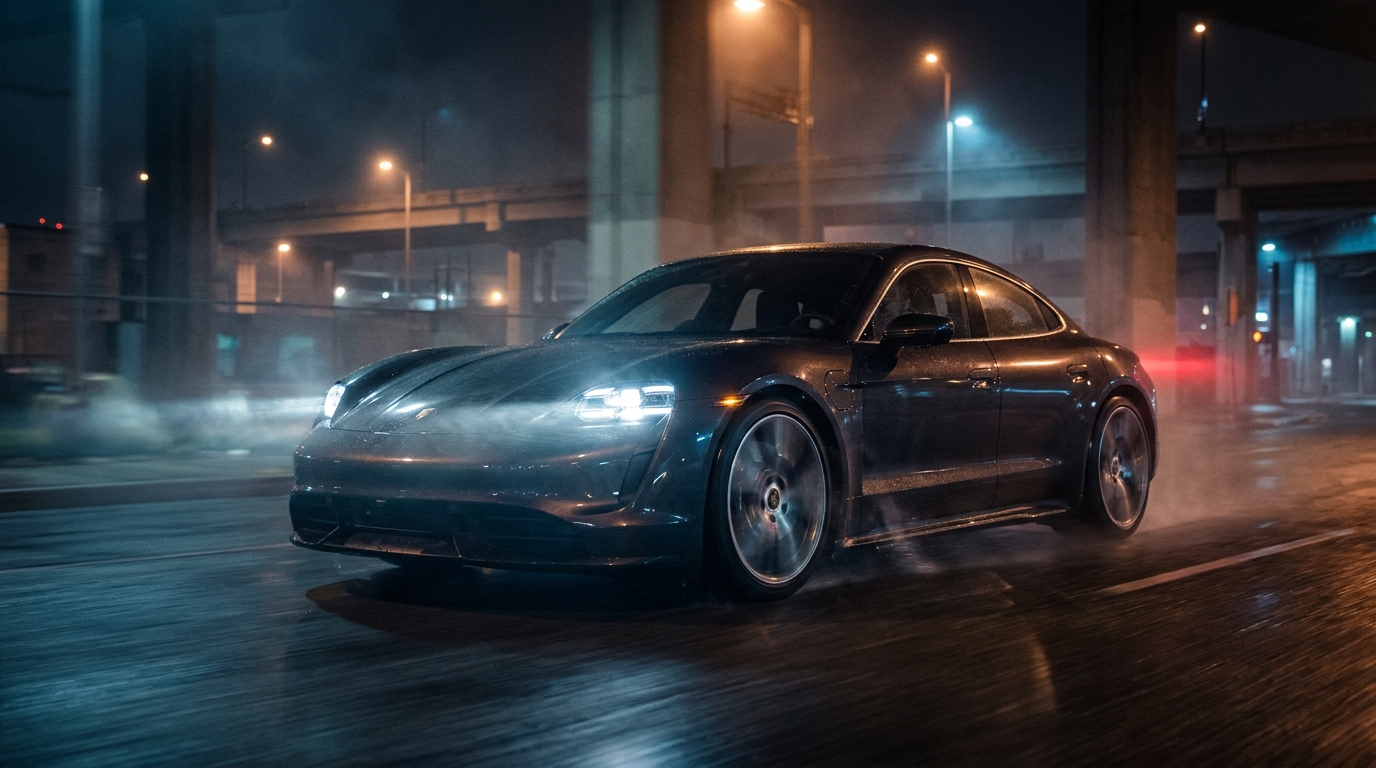
It is 1 a.m. on an empty stretch of road, and the only sound is the faint hiss of tires on cool pavement. Then you stomp the throttle, and the 2020 Porsche Taycan Turbo does something no combustion car can: it launches in two distinct, near-silent stages, shoving you into the seat while the dark blurs into streaks of sodium orange. This is the electric Porsche that finally made the Tesla crowd nervous.
A Clean-Sheet Porsche for the Electric Age
The Taycan arrived for the 2020 model year as Porsche’s first series-production fully electric car, and it was a genuine clean-sheet design on the new J1 platform. The big engineering headline is the 800-volt electrical architecture, double the roughly 400 volts used by most rivals at the time. That higher voltage allows faster DC charging, lighter cabling and better thermal behavior under repeated hard use. The Taycan Turbo sat one rung below the even faster Turbo S in the launch lineup, but with 670 horsepower on overboost it hardly felt like the junior model.
Two permanently excited synchronous motors, one on each axle, supply all-wheel drive. The real party piece is the rear axle’s two-speed transmission. First gear is short for brutal acceleration, while a taller second gear keeps the motor efficient and relaxed at highway speeds, and it is what lets the Taycan keep pulling hard well past triple digits instead of running out of breath like a single-speed EV.
The Two-Stage Launch
Engage Launch Control and the Taycan Turbo builds to a held-brake crouch, and when you release the brake the car fires off the line in first gear, then slips into second with a barely perceptible shift that tugs the pull forward again. At night, with the cabin lit by the curved digital instrument cluster and the road ahead empty, the sensation is almost cinematic. There is no engine note to tell your brain what is happening, only a rising electronic whine, tire noise and the sheer force pressing you backward. Porsche quotes 0-60 mph in 3.2 seconds for the Turbo with launch control, and independent testing has often matched or beaten that. Overboost power of 670 hp is available for short bursts in launch mode, with 616 lb-ft of torque on tap.
Reading the Road After Dark
Night driving is where the Taycan quietly shines. The signature four-point LED headlamps are bright and well-shaped, and the optional Porsche Dynamic Light System Plus adds adaptive cornering and a matrix-style high beam that masks oncoming traffic automatically, so you can leave the high beams on through a winding road without dazzling anyone. The dashboard’s low-glare digital displays are easy on the eyes at 2 a.m., and the dark mode keeps reflections off the windshield. Meanwhile the continuous rear light bar gives following traffic an unmistakable signature.
The chassis backs up the looks. Adaptive air suspension and Porsche Active Suspension Management work with rear-axle steering on cars so equipped, and the 1,100-plus pound battery pack sits low in the floor, giving the Taycan a center of gravity that makes a sports sedan this heavy feel genuinely agile. At about 5,000 pounds it is no featherweight, yet turn-in is crisp and steering feel is excellent for an EV. Body control on a dark, twisting road is the kind of thing that builds confidence at exactly the moment visibility drops.
Charging and Range Reality
The 93.4 kWh Performance Battery Plus is the larger of two packs, and it is what the Turbo carries. The EPA rated it at 201 miles of range for the 2020 model year, which was a point of controversy since many owners found real-world range closer to the WLTP figure of around 280 miles. That number is modest next to the best long-range rivals, but the Taycan makes up for it with charging speed. Peak DC fast-charging of up to 270 kW lets you go from 5 to 80 percent in roughly 22 to 23 minutes on a capable charger, which is among the best of its generation. It is a car you can road-trip, so long as you plan stops around fast-charging hubs.
The Competition and the Cost
At launch the Taycan Turbo started around $150,900 before options, with the Turbo S well above it. The obvious rival was the Tesla Model S Performance, which offered more range and a larger charging network for less money. Where the Porsche answers back is in sustained performance, interior quality, steering feel and repeatable launches without the power fade that plagued some competitors. It feels like a real Porsche, which is the whole point.
Editor’s verdict: the 2020 Taycan Turbo proved an electric car could carry a Porsche badge and still earn it, with real steering feel, repeatable launches and charging that shrugs at long nights on the road. It is expensive and its EPA range is modest, but after dark, with the two-stage launch shoving you toward the horizon in near silence, nothing else in its class feels quite this special.