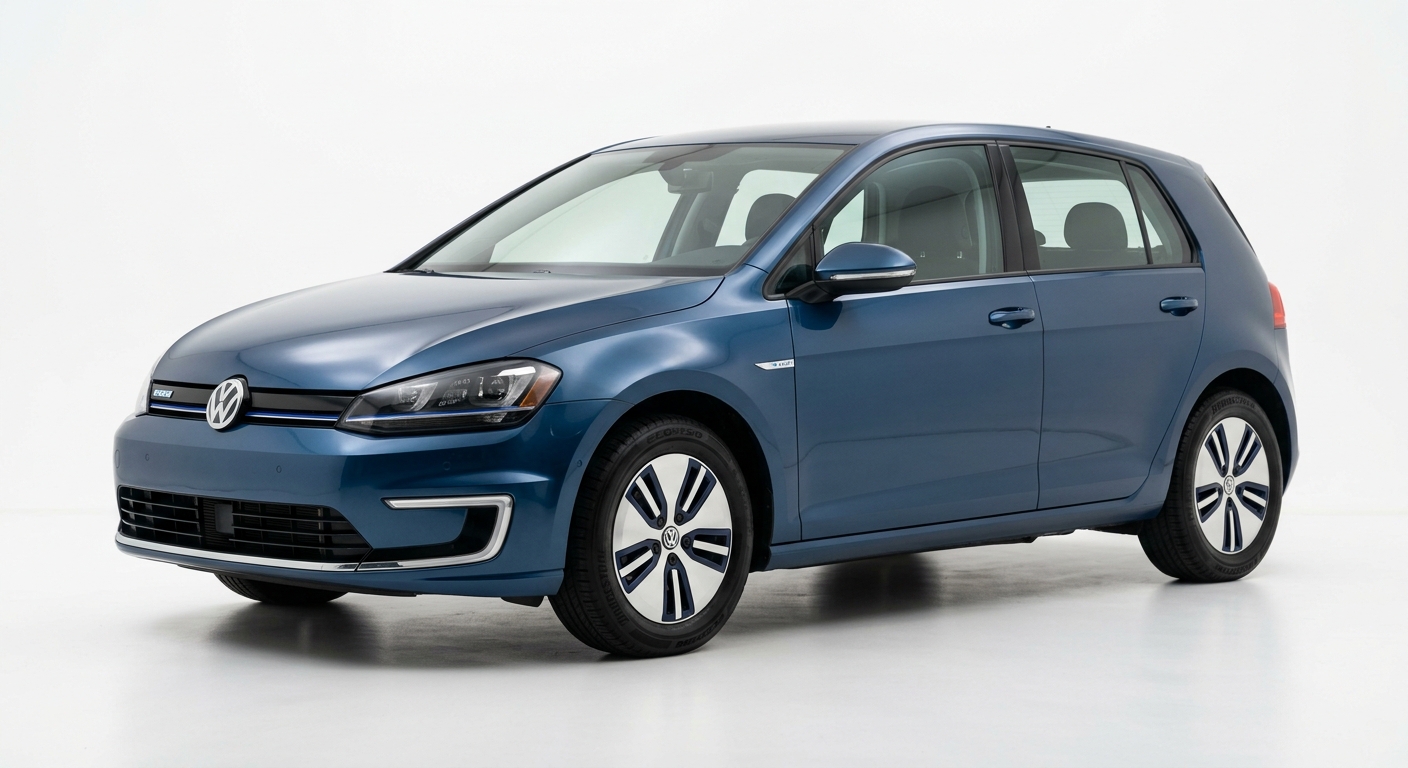
In an era when electric vehicles were either golf carts with delusions of grandeur or six-figure science experiments, Volkswagen did something radical with the e-Golf: they made it boring. Not boring in a bad way, but boring in the most wonderful, reassuring way possible. Here was an electric car that looked like a car, drove like a car, and cost like a car people might actually buy.
The e-Golf arrived in 2015 as VW’s first serious attempt at a mass-market electric vehicle, and it succeeded precisely because it didn’t try too hard to be revolutionary. Built on the familiar Golf platform, it offered the same practical interior space, Germanic build quality, and intuitive controls that made the Golf one of the world’s best-selling hatchbacks.
Everyday Electric Excellence
Behind the wheel, the e-Golf delivers exactly what you’d expect from a Golf that happens to be electric. The driving position is spot-on, with supportive seats and excellent visibility. The 115-horsepower electric motor provides smooth, linear acceleration that’s perfect for city driving, though it won’t pin you to your seat. The 83-mile EPA range was modest even by 2015 standards, but adequate for most daily commutes.
What impressed most about the e-Golf was its refinement. The regenerative braking system was beautifully calibrated, offering multiple levels of regeneration that could be adjusted via steering wheel paddles. In its most aggressive setting, you could drive almost entirely with the accelerator pedal, lifting off to slow down for corners or traffic. The suspension tuning struck an excellent balance between comfort and control, maintaining the Golf’s reputation for composed handling.
The Art of Subtle Electrification
Volkswagen’s designers showed admirable restraint with the e-Golf’s styling. Aside from subtle blue accents, unique LED headlights, and aerodynamically optimized wheels, it was virtually indistinguishable from its gasoline sibling. This understated approach was revolutionary in its own way, proving that electric cars didn’t need to look like they were beamed down from another planet.
The interior maintained the Golf’s reputation for excellent materials and thoughtful design. The infotainment system included specific EV functions like range estimation, charging station location, and energy flow displays, but these features were integrated seamlessly without overwhelming the user experience. The instrument cluster featured a unique blue-tinted power gauge that replaced the traditional tachometer, a subtle reminder of the car’s electric nature.
Charging into the Mainstream
The e-Golf’s 24.2 kWh battery pack was positioned low in the chassis, maintaining the Golf’s low center of gravity while providing space for five passengers and a generous cargo area. DC fast charging capability allowed for 80% charge in about 30 minutes, while the standard onboard charger could fully replenish the battery overnight on a 240V connection.
More importantly, the e-Golf proved that electric vehicles could integrate seamlessly into existing lifestyles. Its conventional appearance and operation meant that anyone comfortable with a regular Golf could adapt to the e-Golf immediately. This accessibility was crucial in building broader acceptance of electric vehicles beyond early adopters and environmental enthusiasts.
The 2015 e-Golf may not have been the fastest or longest-range electric vehicle of its era, but it accomplished something far more important: it proved that electric cars could be perfectly normal. Sometimes the most revolutionary act is simply being excellent at the fundamentals, and in that regard, the e-Golf was a quiet masterpiece that paved the way for mainstream EV adoption.