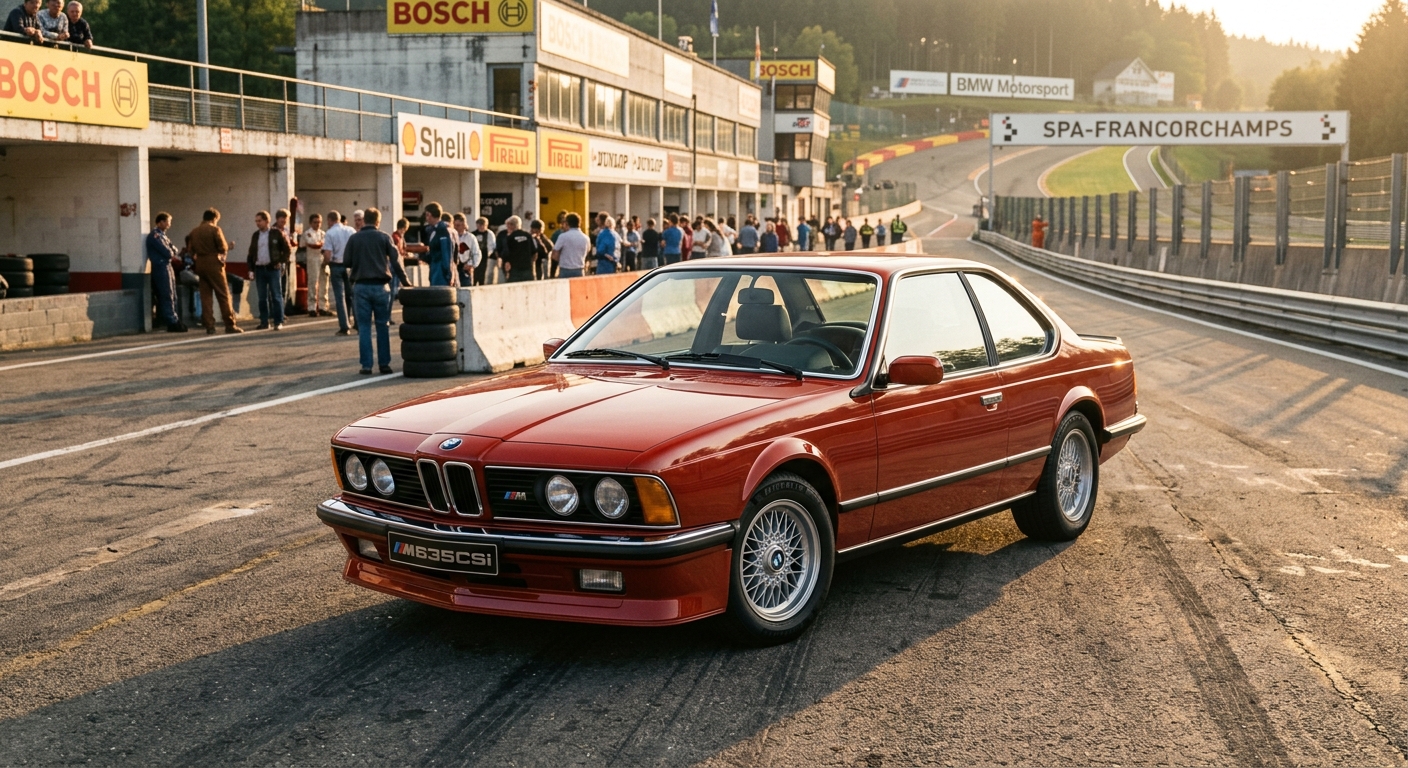
In 1985, BMW Motorsport unleashed something special upon the world: a grand touring coupe that could devour alpine passes with the same appetite it showed for Silverstone’s sweeping curves. The M635CSi wasn’t just another fast BMW; it was the company’s first serious attempt at creating a road-going motorsport machine that could actually serve as a daily driver.
Built on the bones of the elegant E24 6 Series, the M635CSi represented everything BMW Motorsport had learned from racing the Group A M635CSi in touring car championships across Europe. This wasn’t merely a cosmetic exercise or a marketing ploy. Every component had been scrutinized, refined, and purposefully engineered to create what many consider the ultimate 1980s grand tourer.
The Heart of Competition
At the core of the M635CSi beats the legendary S38 inline-six engine, a 3.5-liter masterpiece that borrowed heavily from BMW’s Formula One program. This wasn’t the docile straight-six from lesser 6 Series models; the S38 featured individual throttle bodies, a high-compression ratio, and aggressive camshaft profiles that helped it produce 286 horsepower and 251 lb-ft of torque.
The engine’s character is intoxicating. Below 3,000 rpm, it feels almost civilized, purring with the refined manners expected from a luxury grand tourer. But as the needle climbs past 4,000 rpm, the S38 transforms into something altogether more savage. The intake noise becomes a metallic howl, and the car surges forward with an urgency that catches first-time passengers off guard.
Chassis Dynamics That Still Impress
What separated the M635CSi from contemporary muscle cars was its sophisticated approach to handling. BMW Motorsport didn’t just add more power; they completely rethought the suspension geometry, adding stiffer springs, Bilstein dampers, and a more aggressive front spoiler that actually provided meaningful downforce at speed.
The result is a car that feels remarkably modern even by today’s standards. The steering is direct and communicative, providing excellent feedback about what the front wheels are encountering. Body roll is well-controlled without being harsh, and the car maintains composure even when pushed hard through demanding corners.
Perhaps most impressively, the M635CSi manages to be genuinely comfortable during long-distance cruising. This was always intended to be a car capable of crossing continents at sustained high speeds, and the suspension tuning reflects that mission perfectly.
Design Language of the 1980s
Visually, the M635CSi is pure 1980s automotive sculpture. The shark-nose front end, penned by Paul Bracq, remains one of the most distinctive designs of the decade. Aggressive flares house wider wheels, while the subtle rear spoiler and deeper front air dam hint at the car’s performance capabilities without resorting to boy-racer aesthetics.
The interior continues this theme of restrained aggression. Sport seats provide excellent support during spirited driving, while the dashboard layout prioritizes the driver with all controls falling easily to hand. The build quality throughout is exemplary, demonstrating BMW’s commitment to creating a proper luxury performance machine.
Racing Pedigree Made Road-Legal
The M635CSi’s development was inextricably linked to BMW’s touring car racing efforts. Homologation requirements meant that BMW had to produce a minimum number of road cars to qualify the racing version for competition. Fortunately for enthusiasts, this resulted in one of the most successful race-to-road translations ever attempted.
The racing M635CSi dominated European Touring Car Championships throughout the mid-1980s, and much of that competition-bred DNA made it into the road car. The aerodynamic package, suspension geometry, and even the engine management system all benefited from lessons learned on the racetrack.
The M635CSi represents BMW at its absolute peak, combining motorsport engineering with grand touring sophistication in a package that still feels special four decades later. This is the car that established the template for every M car that followed, proving that ultimate performance and daily usability aren’t mutually exclusive. Find a good one and prepare to understand why the shark-nose generation remains the benchmark for executive performance coupes.