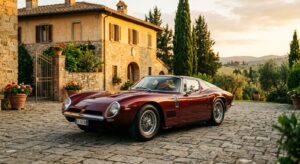
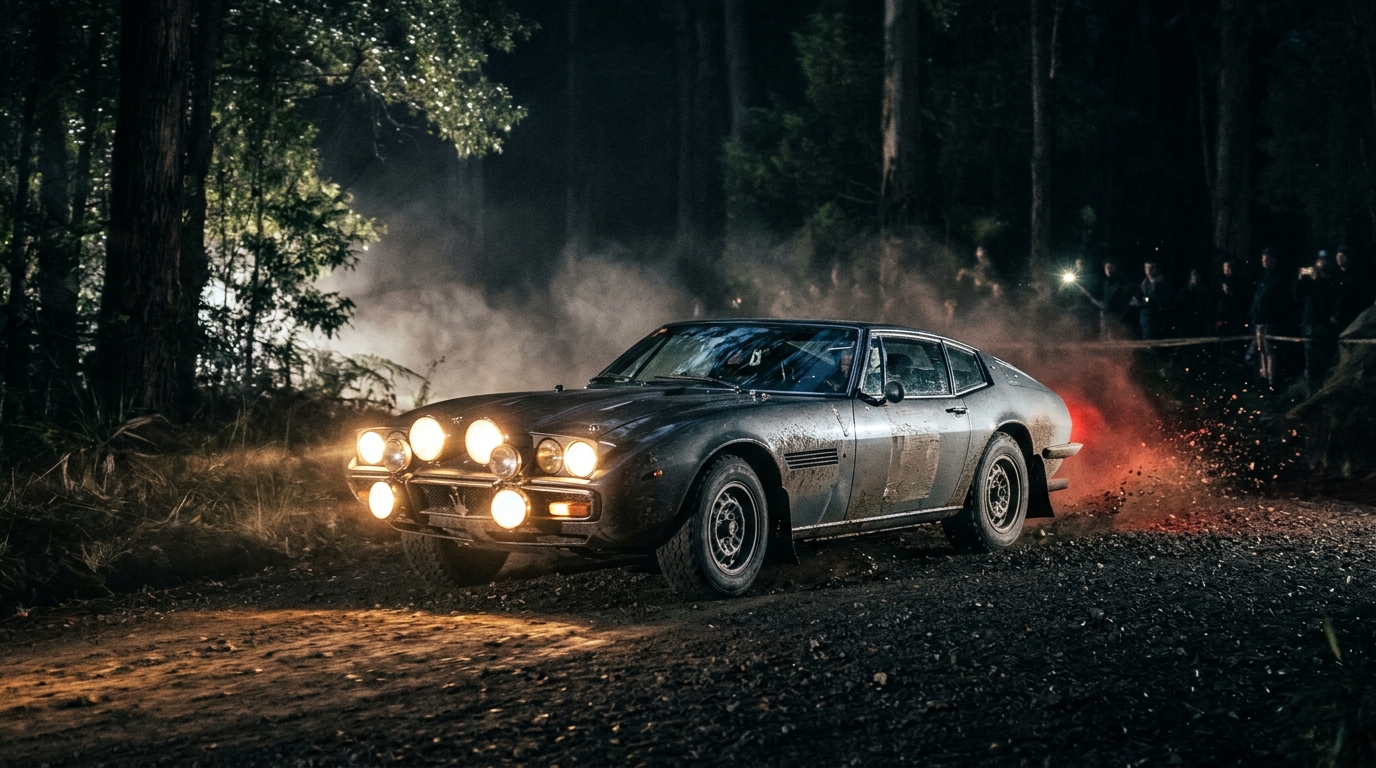
Picture a mountain stage at two in the morning, fog hanging in the hairpins, and a long, flat-nosed shape sliding out of the dark with a thunderous V8 bark bouncing off the rock walls. That is the mood the Ghibli SS lives in. We took one out after sunset to find out whether the legend holds up when the sun goes down and the instrument lights come up.
The Shark That Came From Turin
The Ghibli debuted at the 1966 Turin Motor Show, penned by a young Giorgetto Giugiaro while he was at Ghia. It was a low, wide, razor-edged coupe with a hood so long and a roofline so low that it looks like it is doing 100 mph standing still. Maserati built it as a rival to the Ferrari Daytona and the Lamborghini Miura era of grand tourers, and it carried the company’s all-aluminum quad-cam V8 up front. The SS badge arrived in 1969 with a bigger 4.9-litre engine, and the car remained in production until 1973, with a few late cars delivered into the 1974 model year as Maserati wound the line down. That is exactly why a 1974 Ghibli SS is such a rare and sought-after find.
Walking Up to It in the Dark
Night is when the Ghibli’s design makes the most sense. The nose is almost knife-flat, and the headlights hide behind pop-up covers. Flip the switch and the lamps swing up out of the bodywork like a shark opening an eye. The effect under streetlights is theatrical. The long hood catches amber light and the flanks fall away into shadow, so you only see the shoulder line and the wheel arches. It looks even lower and meaner than it does in daylight.
Driving Impressions After Dark
Climb in and the cabin is a period-perfect leather and wood cockpit with a big wood-rimmed wheel and a row of round gauges. The instrument lighting is a soft glow rather than a harsh glare, which is lovely on a dark road. Visibility forward is good thanks to the low hood line, though the sealed-beam era headlights are modest by modern standards. Expect a warm, yellowish pool of light rather than a wall of illumination, so you drive with your head up and respect the dark. This is a car that rewards confidence but punishes recklessness.
Turn the key and the 4.9-litre quad-cam V8 catches with a deep, mechanical bark. At idle it burbles with a loping rhythm. Roll into the throttle and the sound builds into a rich, metallic howl that is far more refined than a muscle car V8 but just as loud when pushed. Maserati claimed around 330 horsepower and 355 lb-ft of torque from the SS motor, and the pull is long and strong rather than frantic. Through a quiet tunnel after midnight, with the windows down, the exhaust note ricochets off the walls and it is easy to understand why this car became a favourite of rally lore and film-set night scenes.
Handling and Ride
This is a front-engined, rear-drive GT with a live rear axle on leaf springs and a long wheelbase, so it is not a razor-sharp sports car. It is a grand tourer that flows. The steering is heavy at parking speeds and lightens up as you move. Through fast sweeping curves it feels planted and confident, with the long nose pointing the way. Tighten the radius and you feel the weight of that big V8 up front, so smooth inputs are the key. The ZF five-speed manual gearbox is a delight, with a heavy but precise shift gate that feels like operating fine machinery. Brakes are discs all round, adequate for the era, but you plan your stops well ahead.
The Night Stage Spirit
The Ghibli’s reputation as a rally and endurance legend comes from its blend of big-engine torque and long-distance stability. It was a car built for crossing Europe in one sitting, headlights burning into the dark, V8 humming at a lazy rev. On a deserted night road you feel that purpose immediately. It settles into a rhythm and eats miles, and the cabin becomes a calm, warm, leather-scented capsule while the world outside is black.
Living With It
Ownership is a commitment. These cars are mechanically complex, parts are specialist, and the Weber carburetors need an experienced hand. Rust can lurk beneath the beautiful steel skin. But the reward is an automobile with presence unmatched by almost anything of its era. Park it under a streetlight and strangers stop to stare.
The Ghibli SS is not the sharpest tool or the easiest classic to live with, but after dark it is pure theatre: a Giugiaro masterpiece with a quad-cam V8 howl that fills a tunnel and a presence no modern supercar can fake. If you want a Maserati that makes every midnight run feel like a rally stage, this is the one.