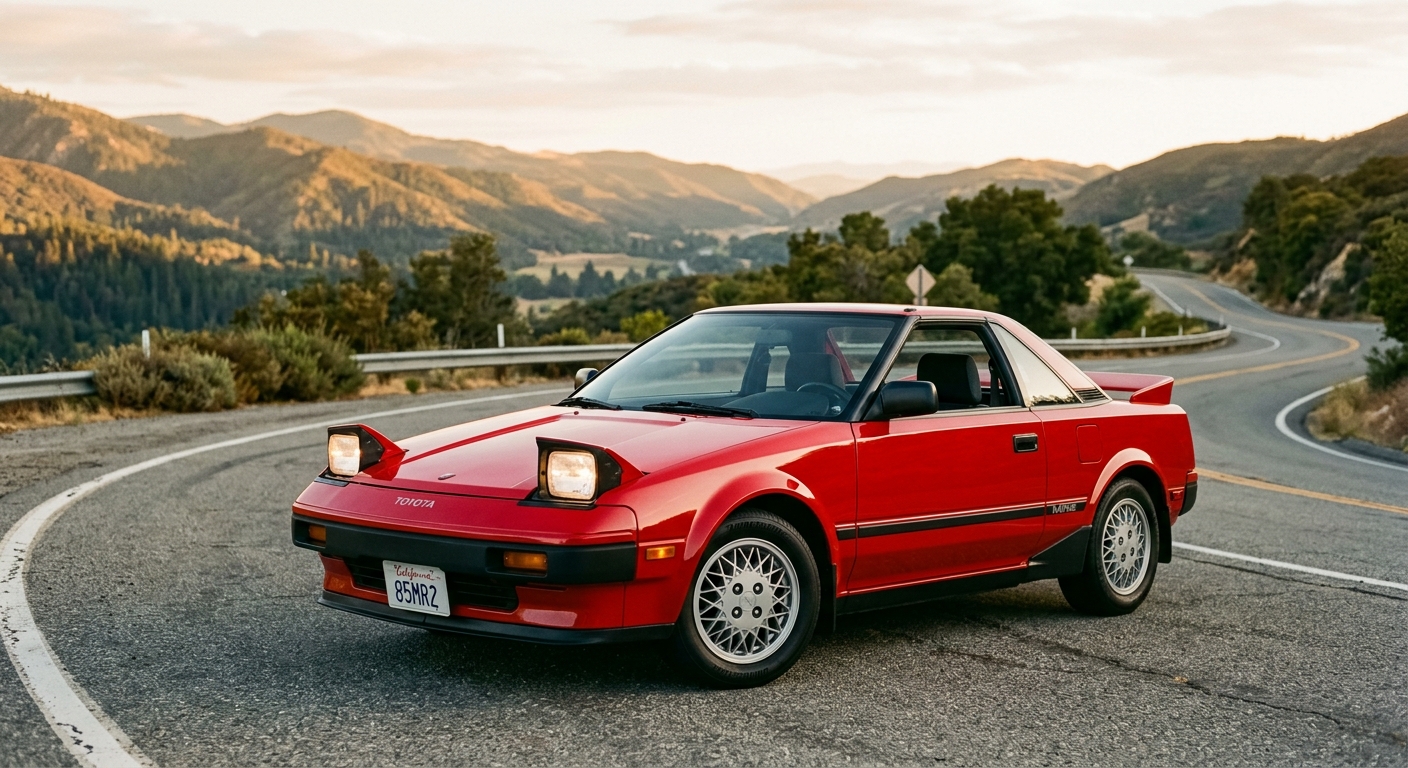
In 1984, Toyota stunned the automotive world by announcing they would build a mid-engine sports car to compete directly with Porsche and Lotus. The MR2, launched for the 1985 model year, wasn’t just Toyota’s first serious sports car: it was proof that Japanese engineering could create something truly special when freed from practical constraints.
What emerged was a masterpiece of packaging and precision that would redefine what an affordable sports car could be. The MR2 combined exotic mid-engine layout with Toyota’s legendary reliability, creating a driver’s car that could be enjoyed every day without the temperamental nature of its European competitors.
Engineering Excellence
Toyota’s approach to the MR2 was methodical and brilliant. Rather than chase outright power, they focused on achieving perfect balance through intelligent engineering. The mid-mounted 4A-GE twin-cam engine, borrowed from the Corolla GT-S, produced a modest 112 horsepower but was positioned precisely behind the driver for optimal weight distribution.
The result was a car that felt planted and predictable at any speed. Unlike the tail-happy Porsche 911 or the nervous Lotus Esprit, the MR2 rewarded smooth inputs with precise responses. The MacPherson strut suspension was tuned specifically for this application, creating a ride that was firm but never harsh.
The Driving Experience
Behind the wheel, the MR2 reveals its true character within the first few corners. The steering is beautifully weighted and communicative, transmitting every nuance of the road surface directly to your fingertips. Turn-in is immediate and precise, with none of the vagueness that plagued many sports cars of the era.
The 4A-GE engine loves to rev, producing its peak power at 6,600 rpm and continuing to pull cleanly to the 7,000 rpm redline. While 112 horsepower might seem modest today, in a car weighing just 2,350 pounds, it’s more than adequate for serious fun. The five-speed manual transmission is a gem, with short throws and perfect gate spacing that makes heel-and-toe downshifts a genuine pleasure.
Design That Defined a Decade
The MR2’s wedge-shaped profile was pure 1980s automotive design, yet it possessed a timeless quality that still looks fresh today. The pop-up headlights, angular air intakes, and distinctive side vents weren’t just styling exercises: they were functional elements that helped cool the mid-mounted engine and provided optimal aerodynamics.
Inside, the cockpit was all business. The driver-focused layout put every control within easy reach, while the instrument cluster provided clear, readable information. The seats offered excellent support during spirited driving, though taller drivers might find the interior a bit snug.
Market Impact and Legacy
The MR2’s impact on the sports car market was immediate and lasting. Here was proof that you didn’t need Italian exotica or German engineering to experience the thrill of a mid-engine layout. Toyota had democratized the supercar experience, making it accessible to a whole new generation of enthusiasts.
More importantly, the MR2 established Toyota as a serious player in the performance car arena. It paved the way for future legends like the Supra and demonstrated that Japanese manufacturers could build cars that satisfied the heart as well as the head.
The first-generation MR2 remains one of the most successful attempts at democratizing the supercar experience. Toyota created something genuinely special: a mid-engine sports car that delivered exotic thrills with everyday reliability. Nearly four decades later, it still represents one of the greatest automotive bargains ever created.