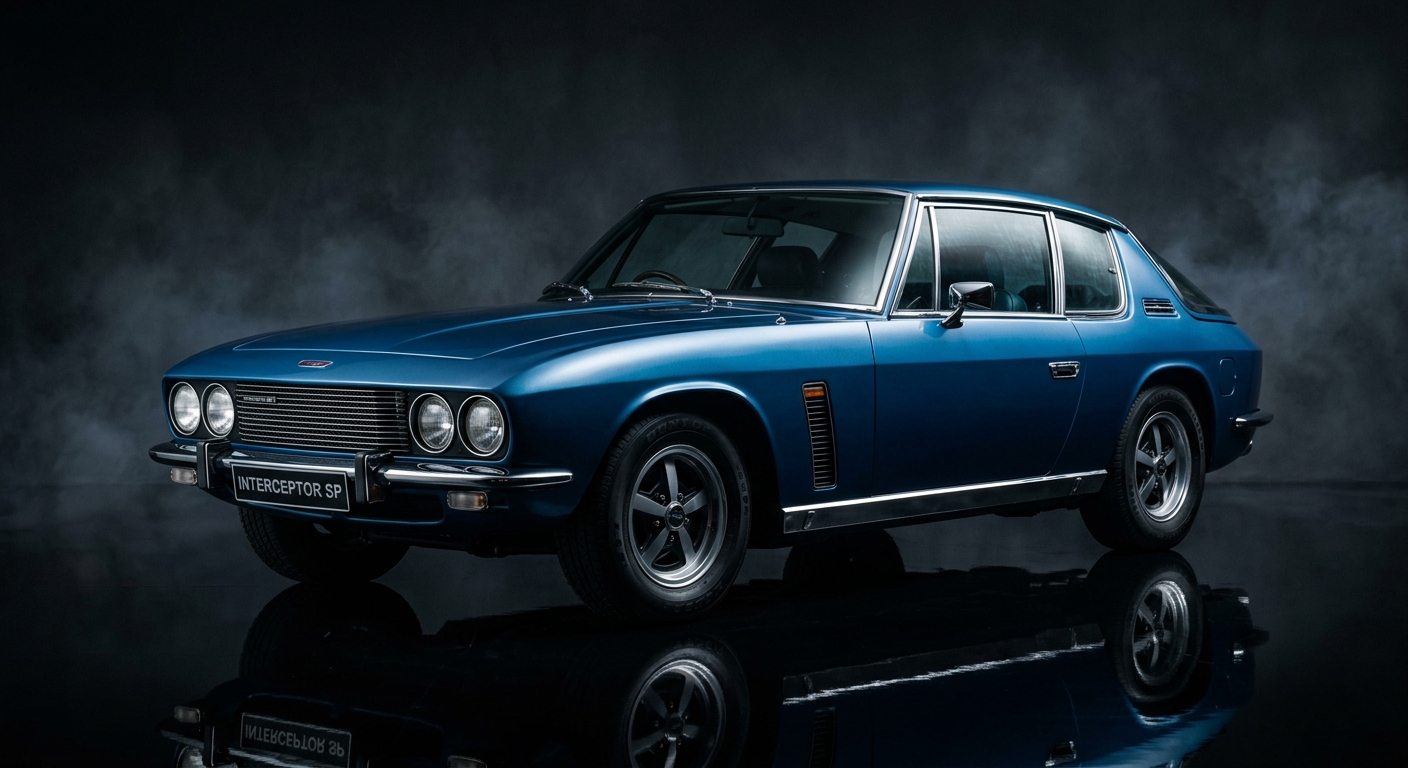
In the early 1970s, while American muscle cars were choking on emissions regulations and European sports cars were focusing on finesse, Jensen Motors was quietly building something extraordinary in West Bromwich. The Interceptor SP represented a uniquely British approach to the muscle car formula: take gorgeous Italian styling by Touring, stuff in the biggest American V8 you can find, and create something that could embarrass both continents on their home turf.
The SP package, introduced in 1971 and refined through 1973, transformed the already potent Interceptor into a genuine supercar killer. With its 440 cubic inch Chrysler V8 producing 385 horsepower, the SP could rocket from standstill to 60 mph in just 5.9 seconds and achieve a top speed of 142 mph, figures that put it squarely in Ferrari territory at a fraction of the price.
The Sound and the Fury
What made the Interceptor SP truly special wasn’t just its straight-line performance, but the way it delivered that power. The 440 Six Pack engine, borrowed from Dodge’s most aggressive muscle cars, produced a thunderous exhaust note that could wake the dead three counties over. Unlike the refined burble of a Jaguar V12 or the mechanical symphony of a Ferrari V12, the SP’s soundtrack was pure American aggression filtered through British sensibilities.
The driving experience was equally dramatic. The SP’s combination of massive torque and relatively sophisticated suspension created a car that could play gentleman’s express on the motorway and then transform into a tire-shredding monster at the touch of the accelerator. The steering was heavy but precise, the brakes powerful enough to haul down all that mass, and the ride quality surprisingly civilized for such a brutal machine.
Italian Elegance Meets American Muscle
The Interceptor’s bodywork, penned by Touring of Milan, remains one of the most beautiful grand touring designs of the era. The long, low profile with its distinctive wrap-around rear window and muscular haunches created a silhouette that was both elegant and aggressive. The SP package added subtle but important visual cues: a functional hood scoop, wider tires, and discreet badging that hinted at the violence lurking beneath.
Inside, the SP maintained Jensen’s reputation for luxury appointments. Rich leather, real wood trim, and comprehensive instrumentation created an environment that was both sporty and sophisticated. Air conditioning was standard, as were power steering and brakes, amenities that many Italian exotics still treated as expensive options.
The Brief Candle
Jensen’s golden period was tragically short-lived. Financial troubles, quality control issues, and the oil crisis of 1973 combined to kill not just the SP package but the entire Interceptor line by 1976. Only about 300 SP models were produced, making them among the rarest and most desirable of all Jensen products today.
The SP represented the high-water mark of Jensen’s ambitious vision: a car that could match the performance of Italian exotics while offering American reliability and British refinement. In many ways, it was too good to last, a victim of timing and economics rather than any fundamental flaw in the concept.
The Jensen Interceptor SP remains one of motoring’s great what-ifs, a brilliant concept executed just well enough to prove its worth before circumstances conspired against it. In today’s market of sanitized supercars and clinical hypercars, the SP’s blend of raw American power, Italian beauty, and British eccentricity feels more appealing than ever. For those lucky enough to find one, it represents the ultimate grand touring experience from an era when such combinations were still possible.