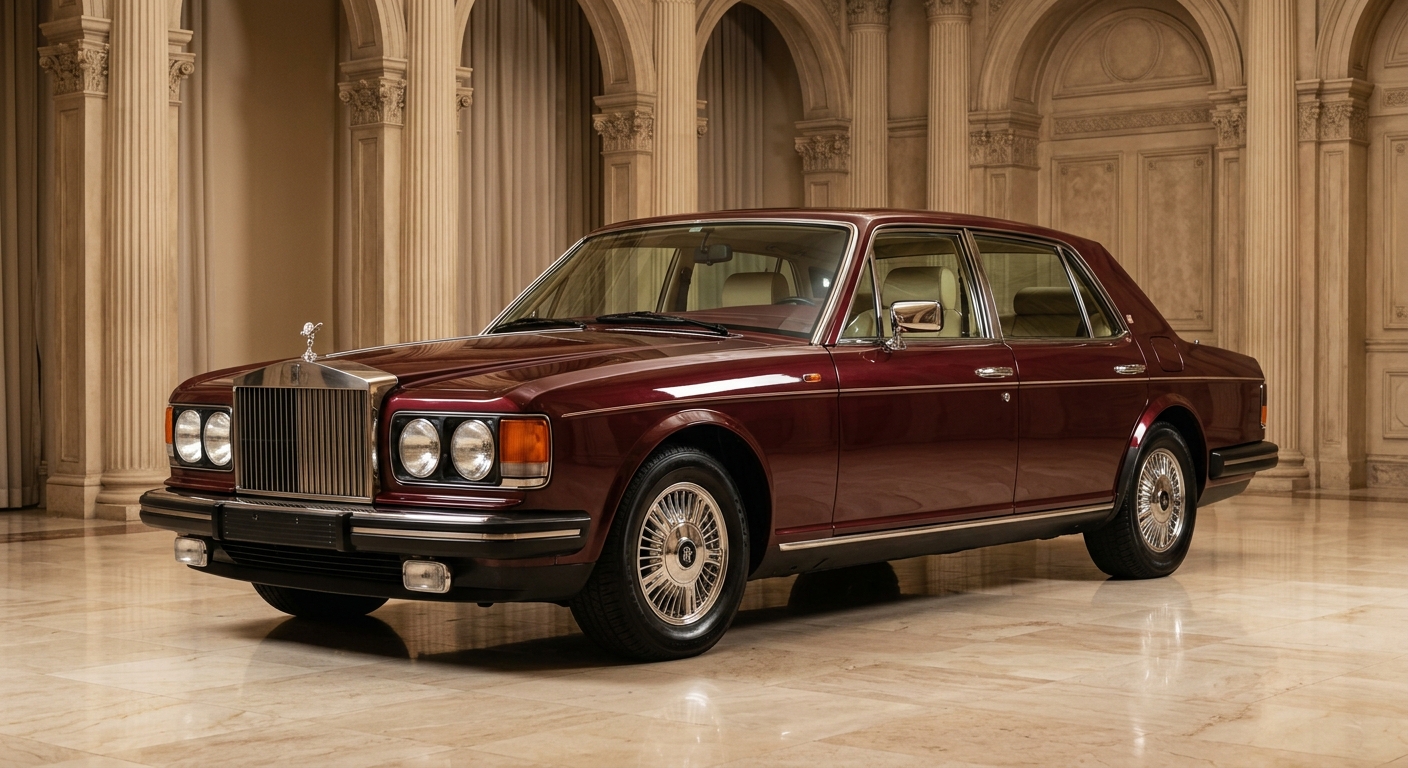
In 1997, Rolls-Royce produced what would unknowingly become the final chapter of an era. The Silver Spur IV represented the last hurrah of traditional British luxury before BMW’s acquisition would forever change the marque’s DNA. This wasn’t just another model year update; it was the culmination of decades of refinement in the art of moving human beings in the most sublime manner possible.
The End of Pure British Luxury
The Silver Spur IV arrived at a crossroads in automotive history. While the world was rushing toward electronic everything and Germanic efficiency, this Rolls-Royce remained defiantly analog. Every control required physical interaction, every system operated with mechanical precision, and every journey felt like a ritualistic celebration of craftsmanship over technology.
Built at the legendary Crewe factory, each Silver Spur IV required over 400 hours of hand assembly. The famous 6.75-liter V8 had been refined to near perfection, producing adequate power through a torque curve as flat as a Kansas highway. This wasn’t about speed; it was about serenity in motion.
The Art of Effortless Progress
Behind the wheel, the Silver Spur IV delivers an experience that modern luxury cars simply cannot replicate. The steering wheel, crafted from English walnut and leather, connects you to a hydraulic system that filters out every imperfection in the road while maintaining a sense of connection to the mechanical symphony beneath the long hood.
The famous Rolls-Royce ride quality reaches its zenith here. The self-leveling suspension system uses a combination of steel springs and sophisticated damping to create what can only be described as automotive levitation. Road irregularities simply cease to exist, absorbed by a chassis engineered with the singular purpose of isolating its occupants from the harsh realities of the physical world.
Interior Sanctuary
Step inside, and you’re transported to a world where time moves differently. The cabin represents the pinnacle of British coachbuilding, with hand-selected Connolly leather covering surfaces shaped by craftsmen who learned their trade from masters of the art. Real wood veneers, often requiring trees over 100 years old, create patterns that will never be repeated.
The rear compartment transforms every journey into a first-class experience. Individual reading lights with cut crystal lenses, fold-out writing tables, and climate control that operates with the precision of a Swiss timepiece create an environment where business can be conducted or relaxation can be achieved with equal facility.
Legacy of the Last
What makes the Silver Spur IV particularly significant is its position as the final expression of Rolls-Royce’s traditional philosophy. Every component was engineered to last generations, not lease cycles. The attention to detail extended to elements you’d never see: wiring harnesses hand-wrapped in cloth, fasteners made from materials chosen for century-long durability, and assembly techniques passed down through generations of Crewe craftsmen.
The car’s proportions speak to a different era’s priorities. Nearly 18 feet long and weighing over 5,000 pounds, the Silver Spur IV makes no apologies for its presence. This was luxury as statement, transportation as theater, and engineering as art form.
The Silver Spur IV stands as a monument to a philosophy that valued permanence over progress, craftsmanship over efficiency. In today’s world of lease cycles and planned obsolescence, there’s something profoundly moving about a car built to outlast its owners. This wasn’t the fastest or most technologically advanced luxury sedan of 1997, but it was undoubtedly the most luxurious in the truest sense of the word.