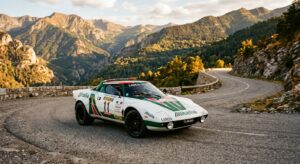
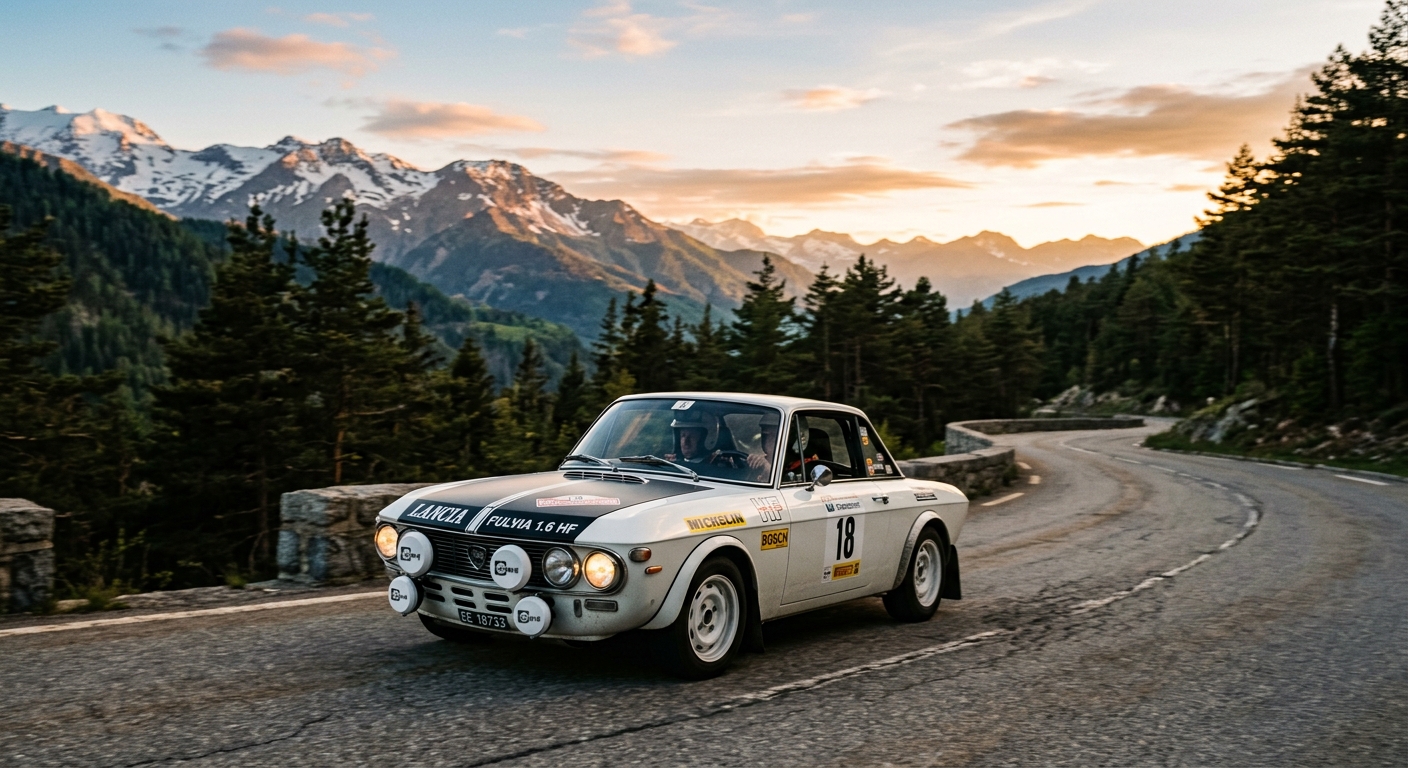
In the pantheon of rally legends, few cars capture the essence of Italian passion and engineering artistry quite like the Lancia Fulvia HF. Born from Lancia’s relentless pursuit of rallying perfection, this narrow-bodied warrior dominated the Monte Carlo Rally and became the stuff of motorsport folklore. The 1973 model represents the final evolution of a design that rewrote the rulebook on what a compact rally car could achieve.
The Heart of a Champion
At the core of the Fulvia HF lies one of the most characterful engines ever conceived: a narrow-angle V4 that sounds like nothing else on earth. This 1.6-liter masterpiece, with its distinctive 13-degree cylinder angle, produces a mechanical symphony that’s equal parts growl and scream. The engine’s compact dimensions allowed Lancia’s engineers to mount it entirely ahead of the front axle line, creating near-perfect weight distribution that would make modern chassis engineers weep with envy.
The power delivery is intoxicating, building progressively from 3,000 rpm before erupting into a crescendo at 6,500 rpm. It’s an engine that rewards commitment, demanding to be worked hard to extract its 115 horsepower. This isn’t brute force; it’s surgical precision wrapped in Italian passion.
Rally-Bred Chassis Dynamics
The Fulvia HF’s chassis represents the culmination of Lancia’s rally experience, with every component optimized for competition. The front-wheel-drive layout, still revolutionary in 1973, combines with sophisticated independent suspension to deliver handling that’s both predictable and thrilling. The car’s narrow track and compact wheelbase create an immediacy of response that modern cars struggle to match.
On twisting mountain roads, the Fulvia HF reveals its true character. The steering, unassisted but perfectly weighted, communicates every nuance of the road surface. Turn-in is knife-sharp, with minimal body roll despite the relatively soft springs needed for rally duty. The front wheels pull you through corners with a determination that’s addictive, while the rear follows with absolute faithfulness.
Competition Heritage
This isn’t just another classic Italian sports car; it’s a genuine homologation special built to satisfy FIA Group 4 regulations. The HF suffix stands for “High Fidelity,” Lancia’s audio equipment division, but on the Fulvia, it represents high-performance engineering. Every modification serves a purpose: the flared wheel arches house wider wheels, the aggressive front spoiler generates downforce, and the stripped interior saves precious kilograms.
The competition pedigree runs deep. Fulvia HFs dominated the International Championship for Manufacturers from 1972 to 1974, with legends like Sandro Munari and Björn Waldegård piloting these machines to victory on some of the world’s most challenging stages. The 1972 Monte Carlo Rally victory remains one of the greatest underdog stories in motorsport history.
Living With a Legend
Daily driving a Fulvia HF requires commitment and understanding. The clutch is heavy, the gearchange demands precision, and the carburetor setup needs constant attention. But these quirks fade into insignificance when you experience the car’s unique character. Every journey becomes an event, every corner an opportunity to connect with decades of Italian engineering excellence.
The interior, sparse by luxury standards, focuses on the essentials. The thin-rimmed steering wheel, period-correct instrumentation, and lightweight seats create an environment that’s purely about driving. Visibility is excellent, with the narrow pillars and upright seating position providing commanding views of the road ahead.
The Lancia Fulvia HF stands as a testament to an era when manufacturers built cars with souls, not spreadsheets. Its narrow-angle V4 symphony, razor-sharp handling, and rally-bred heritage create an ownership experience that’s utterly unique in the classic car landscape. For those seeking automotive passion distilled into its purest form, few cars deliver quite like this Italian masterpiece.