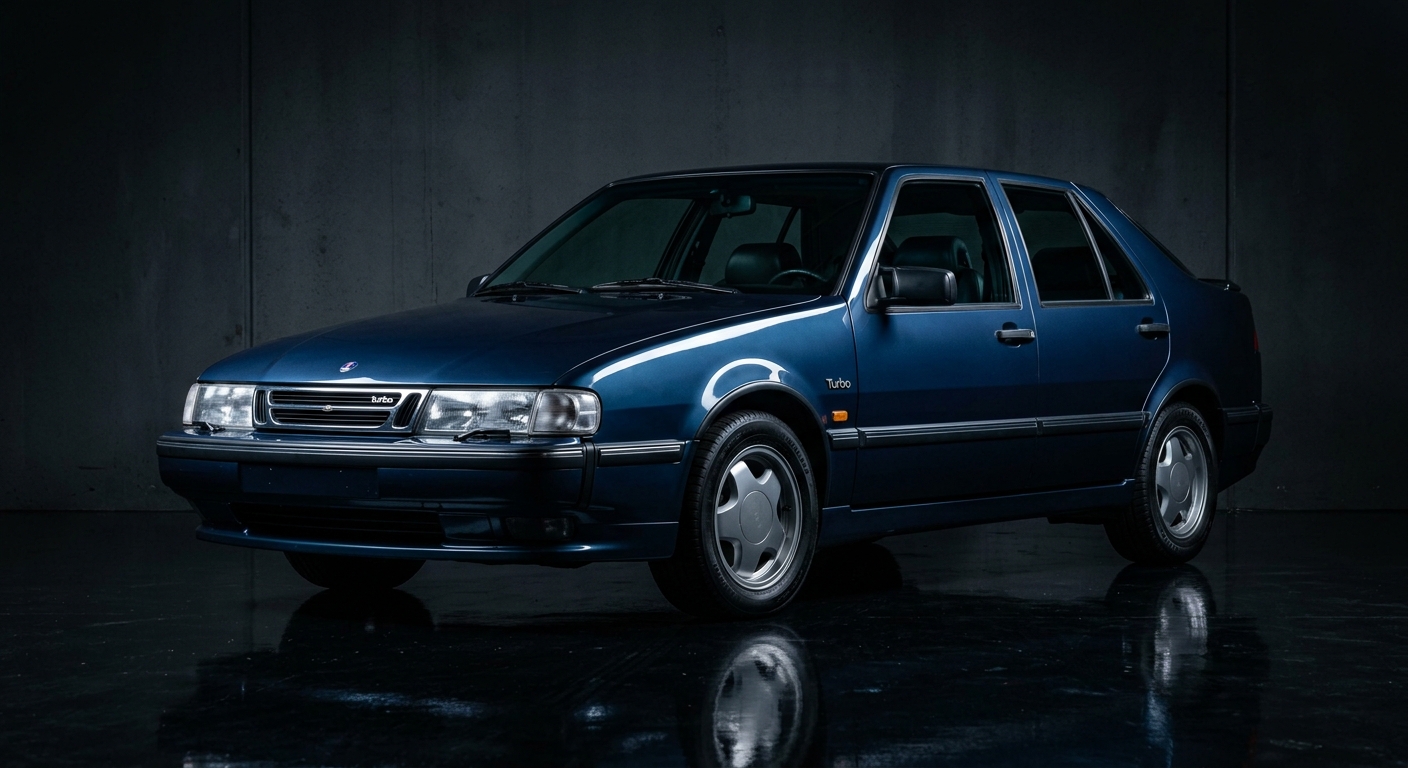
While American muscle cars were busy flexing their V8s in the late 1980s, Saab quietly revolutionized the performance sedan game with something entirely different. The 9000 Turbo didn’t roar, it whooshed. It didn’t swagger, it surged. And in doing so, it proved that muscle didn’t always need eight cylinders and a carburetor to deliver genuine thrills.
The Swedish Alternative
The 1989 Saab 9000 Turbo represented everything unconventional about Scandinavian performance philosophy. Where American muscle cars relied on displacement and tradition, Saab’s engineers turned to turbocharging and aerodynamics. The result was a sedan that could embarrass many sports cars while carrying four adults in genuine comfort.
Built on a platform shared with the Fiat Croma, Lancia Thema, and Alfa Romeo 164, the 9000 was Saab’s entry into the executive sedan segment. But this wasn’t just badge engineering. Saab’s interpretation featured their signature turbocharged four-cylinder engine, distinctive styling cues, and that unmistakably quirky Swedish character that made every journey feel like an adventure.
Turbo Power, Swedish Style
The heart of the 9000 Turbo was Saab’s 2.0-liter turbocharged four-cylinder engine, producing 165 horsepower and 195 lb-ft of torque. These numbers might seem modest by today’s standards, but in 1989, they were genuinely impressive for a four-cylinder engine. More importantly, the turbo’s delivery was intoxicating. There was a brief pause as you pressed the accelerator, then a surge of power that built relentlessly to the redline.
The driving experience was unlike anything from Detroit or even Bavaria. The 9000 Turbo felt eager and responsive, with a light, flickable quality that belied its size. The steering was precise, the handling balanced, and the whole car felt engineered for real-world performance rather than straight-line bragging rights.
Beyond the Numbers
What made the 9000 Turbo special wasn’t just its performance, but how it delivered that performance. This was a thinking person’s muscle car, one that prioritized usability and refinement alongside speed. The cabin was airy and comfortable, with Saab’s trademark dashboard design that put everything at the driver’s fingertips. The seats were supportive enough for spirited driving yet comfortable enough for long journeys.
The build quality was typically Swedish: solid, dependable, and engineered to survive harsh winters and demanding owners. While American muscle cars of the era often felt like barely civilized race cars, the 9000 Turbo was sophisticated transportation that happened to be very fast.
A Different Kind of Performance
The 9000 Turbo’s performance was more about sustained speed than dramatic acceleration. It was the kind of car that could cruise effortlessly at illegal speeds while its occupants barely noticed the pace. This was autobahn performance in a world increasingly focused on quarter-mile times.
On twisty roads, the 9000 Turbo revealed another dimension of its character. The chassis was well-balanced and communicative, with enough grip to exploit the turbo engine’s power band fully. It wasn’t quite a sports sedan in the BMW sense, but it was something arguably better: a genuinely fast car that anyone could drive quickly.
The 1989 Saab 9000 Turbo proved that muscle cars didn’t need to follow American formulas to deliver genuine thrills. With its turbocharged sophistication and Swedish sensibility, it carved out a unique niche that modern performance sedans still aspire to fill. This was thinking person’s performance car that happened to be faster than most of its contemporaries.